Department of Nuclear Medicine, Shanghai Tenth People's Hospital, Tongji University School of Medicine, Shanghai, China.
Thyroid. 2021 May;31(5):810-820. doi: 10.1089/thy.2020.0193. Epub 2021 Jan 7.
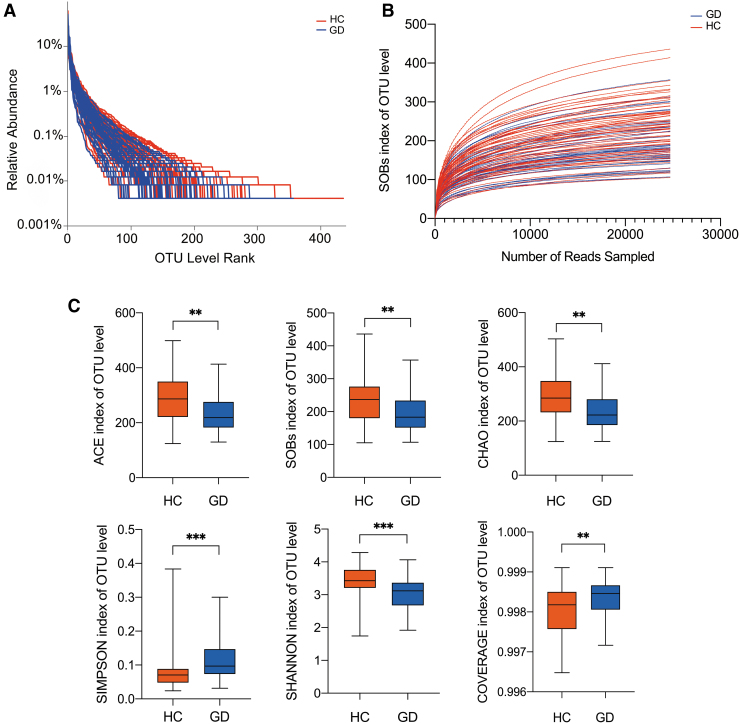
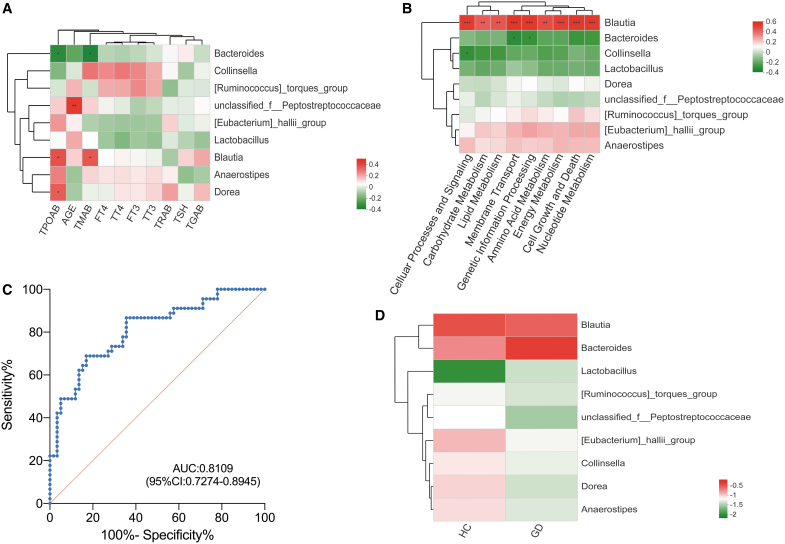
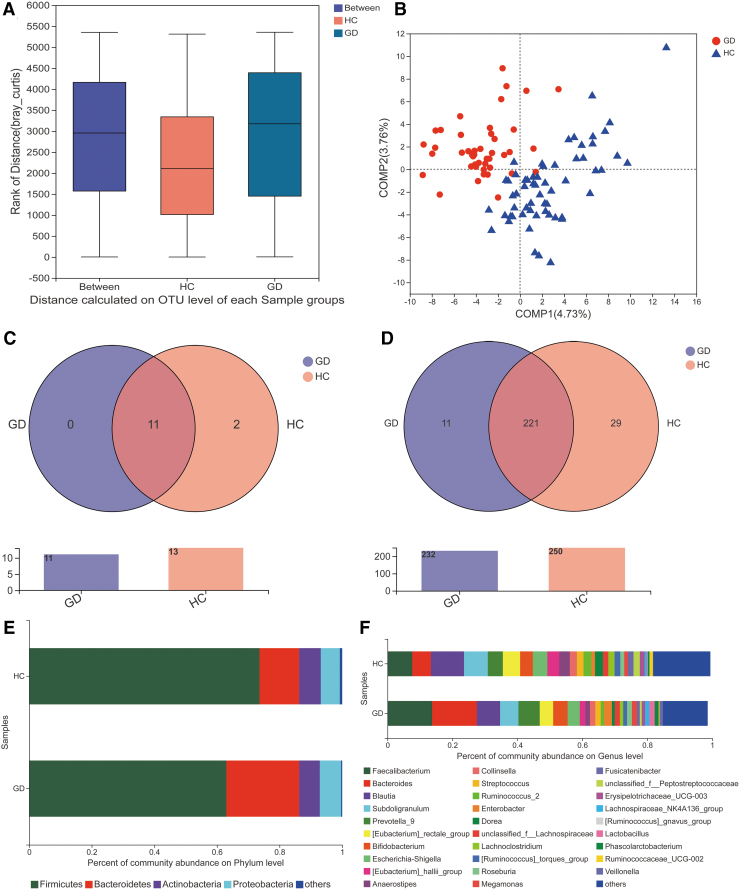
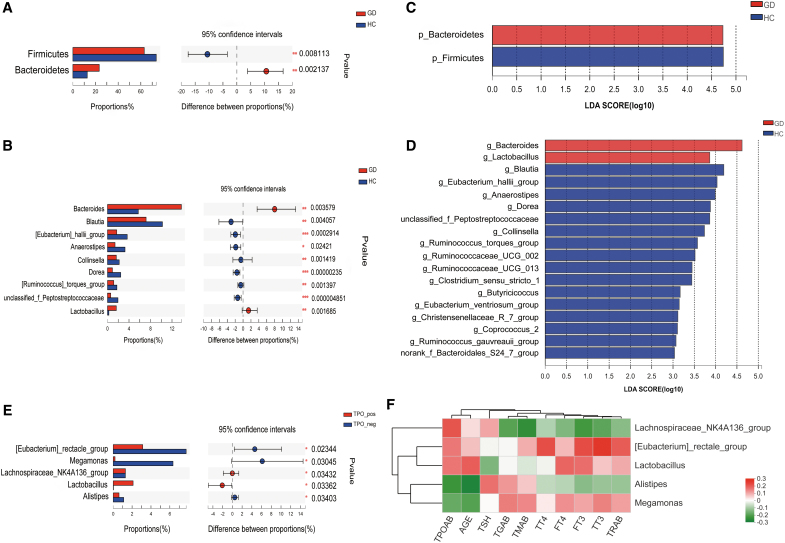
Gut microbiota are considered to be intrinsic regulators of thyroid autoimmunity. We designed a cross-sectional study to examine the makeup and metabolic function of microbiota in Graves' disease (GD) patients, with the ultimate aim of offering new perspectives on the diagnosis and treatment of GD. The 16S ribosomal RNA (rRNA) V3-V4 DNA regions of microbiota were obtained from fecal samples collected from 45 GD patients and 59 controls. Microbial differences between the two groups were subsequently analyzed based on high-throughput sequencing. Compared with controls, GD patients had reduced alpha diversity ( < 0.05). At the phylum level, GD patients had a significantly lower proportion of ( = 0.008) and a significantly higher proportion of ( = 0.002) compared with the controls. At the genus level, GD patients had greater numbers of and , although fewer , , , , , , and than controls (all < 0.05). Subgroup analysis of GD patients revealed that may play a key role in the pathogenesis of autoimmune thyroid diseases. Nine distinct genera showed significant correlations with certain thyroid function tests. Functional prediction revealed that may be an important microbe in certain metabolic pathways that occur in the hyperthyroid state. In addition, linear discriminant analysis (LDA) and effect size (LEfSe) analysis showed that there were significant differences in the levels of 18 genera between GD patients and controls (LDA >3.0, all < 0.05). A diagnostic model using the top nine genera had an area under the curve of 0.8109 [confidence interval: 0.7274-0.8945]. Intestinal microbiota are different in GD patients. The microbiota we identified offer an alternative noninvasive diagnostic methodology for GD. Microbiota may also play a role in thyroid autoimmunity, and future research is needed to further elucidate the role.
肠道微生物群被认为是甲状腺自身免疫的内在调节剂。我们设计了一项横断面研究,以检查格雷夫斯病(GD)患者的微生物群组成和代谢功能,最终目的是为 GD 的诊断和治疗提供新的视角。从 45 名 GD 患者和 59 名对照者的粪便样本中获得了微生物群的 16S 核糖体 RNA(rRNA)V3-V4 DNA 区域。随后根据高通量测序分析两组之间的微生物差异。与对照组相比,GD 患者的α多样性降低( < 0.05)。在门水平上,GD 患者的 比例显著降低( = 0.008), 比例显著升高( = 0.002)。在属水平上,GD 患者的 和 数量较多,而 、 、 、 、 、 和 数量较少(均 < 0.05)。GD 患者的亚组分析表明, 可能在自身免疫性甲状腺疾病的发病机制中起关键作用。9 个不同的属与某些甲状腺功能测试呈显著相关。功能预测显示, 可能是某些代谢途径中的重要微生物,这些代谢途径发生在甲状腺功能亢进状态。此外,线性判别分析(LDA)和效应大小(LEfSe)分析显示,GD 患者和对照组之间有 18 个属的水平存在显著差异(LDA >3.0,均 < 0.05)。使用前 9 个属的诊断模型的曲线下面积为 0.8109 [置信区间:0.7274-0.8945]。GD 患者的肠道微生物群不同。我们鉴定的微生物群为 GD 提供了一种替代的非侵入性诊断方法。微生物群也可能在甲状腺自身免疫中发挥作用,需要进一步研究来阐明其作用。