
病例报告:2型沃夫勒姆综合征患者的长期眼科评估:缓慢进展性视神经病变作为一种可能的临床发现
Case Report: Ophthalmologic Evaluation Over a Long Follow-Up Time in a Patient With Wolfram Syndrome Type 2: Slowly Progressive Optic Neuropathy as a Possible Clinical Finding.
作者信息
Di Iorio Valentina, Mozzillo Enza, Rosanio Francesco Maria, Di Candia Francesca, Genesio Rita, Testa Francesco, Iovino Claudio, Franzese Adriana, Simonelli Francesca
机构信息
Eye Clinic, Multidisciplinary Department of Medical, Surgical and Dental Sciences, Università degli Studi della Campania 'Luigi Vanvitelli', Naples, Italy.
Section of Pediatrics, Department of Translational Medical Science, Regional Center of Pediatric Diabetes, Federico II University of Naples, Naples, Italy.
出版信息
Front Pediatr. 2021 Apr 29;9:661434. doi: 10.3389/fped.2021.661434. eCollection 2021.
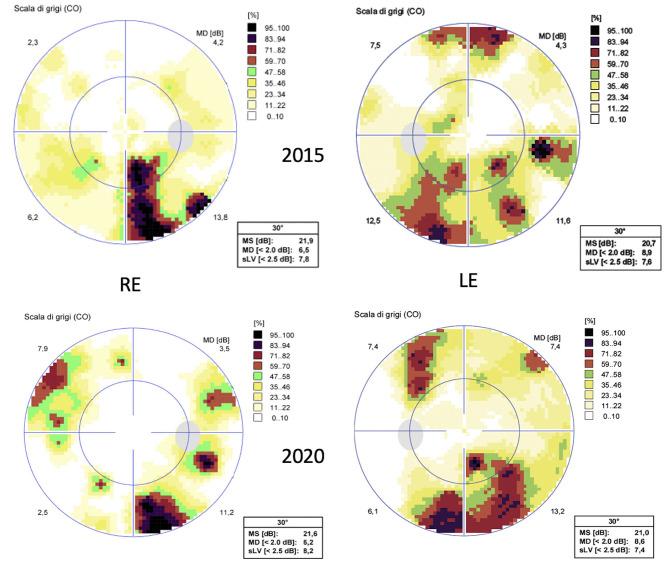
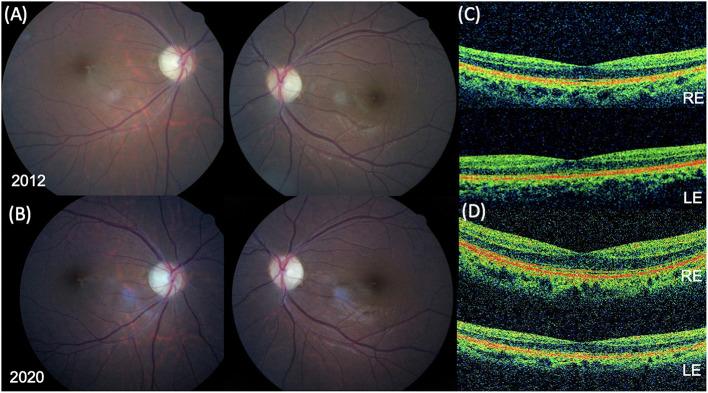
Wolfram syndrome (WFS) is a rare autosomal recessive neurodegenerative disease whose diagnosis requires diabetes mellitus and optic atrophy (OA). WFS includes a wide spectrum of other possible complications such as diabetes insipidus, sensorineural deafness, urinary tract problems, neurological and psychiatric disorders. Most WFS patients show type 1 syndrome (WFS1) caused by mutations in the WFS1 gene, encoding Wolframin protein, while few patients are affected by WFS type 2 (WFS2) due to a pathogenetic variants in the CISD2 gene encoding an endoplasmic reticulum intermembrane small protein. WFS2 is considered a phenotypic and genotypic variant of WFS, from which differs only for the increased risk of bleeding and presence of peptic ulcers. OA and diabetes are considered cardinal features of WFS. We hereby report the ophthalmologic evaluation in a patient, previously described, with WFS2 after 8 years of follow-up. A 20-year-old white woman was referred to our retinal center for the first time in 2012 following a diagnosis of a novel intragenic exon 2 CISD2 homozygous deletion, for the suspicion of an associated bilateral OA. Fundus examination, spectral-domain optical coherence tomography, visual field, visual evoked potentials were performed and confirmed the presence of an optic neuropathy that remained stable over 8 years follow up. A slowly progressive optic neuropathy, rather than OA can characterize patients with WFS2 and CISD2 intragenic deletion.
沃尔弗勒姆综合征(WFS)是一种罕见的常染色体隐性神经退行性疾病,其诊断需要糖尿病和视神经萎缩(OA)。WFS还包括一系列其他可能的并发症,如尿崩症、感音神经性耳聋、泌尿系统问题、神经和精神障碍。大多数WFS患者表现为1型综合征(WFS1),由编码沃尔弗勒姆蛋白的WFS1基因突变引起,而少数患者因编码内质网跨膜小蛋白的CISD2基因的致病变异而患2型WFS(WFS2)。WFS2被认为是WFS的一种表型和基因型变异,与之不同的只是出血风险增加和存在消化性溃疡。OA和糖尿病被认为是WFS的主要特征。我们在此报告对一名先前描述过的WFS2患者进行8年随访后的眼科评估情况。一名20岁白人女性于2012年首次因诊断出一种新的基因内第2外显子CISD2纯合缺失并怀疑伴有双侧OA而被转诊至我们的视网膜中心。进行了眼底检查、光谱域光学相干断层扫描、视野检查、视觉诱发电位检查,结果证实存在视神经病变,且在8年随访期间保持稳定。缓慢进展的视神经病变而非OA可能是WFS2和CISD2基因内缺失患者的特征。

 Zotero 插件