Planning Division, Pasteur Institute in Ho Chi Minh City, Ho Chi Minh City, Vietnam.
Training Center, Pasteur Institute in Ho Chi Minh City, Ho Chi Minh City, Vietnam.
Front Public Health. 2021 Apr 29;9:610905. doi: 10.3389/fpubh.2021.610905. eCollection 2021.
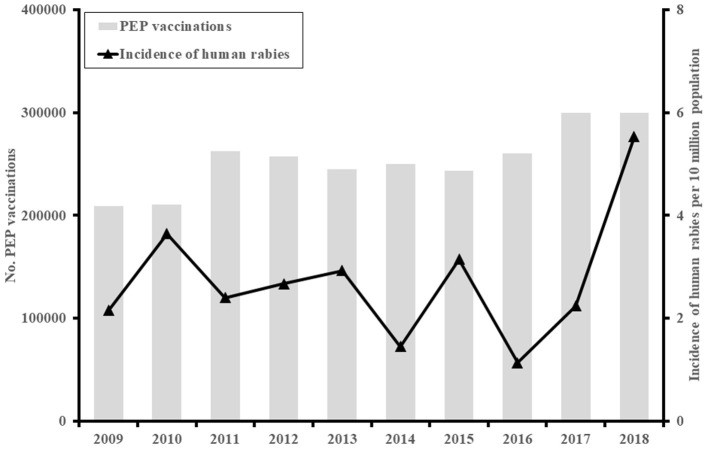
Rabies is endemic in Vietnam and has been a statutory notifiable infectious disease since 1998. We, herein, assessed the performance of rabies surveillance in Southern Vietnam and identified areas for improvement. We analyzed data on human rabies cases reported during 1991-2018. We adapted guidelines from the U.S. Centers for Disease Control and Prevention to evaluate attributes of surveillance. Between June and November 2018, we interviewed a total of 145 staff from hospitals, preventive medicine centers, and animal health offices at provincial and district levels in five southern provinces. Between 2009 and 2018, an average of nine cases of human rabies (range: 4-20 cases) was reported annually in Southern Vietnam, representing an incidence of 2.7 cases per 10 million population. The highest incidence was observed in 2018 (5.5 cases per 10 million population). Survey data suggested that only 24% (13/53) of participants agreed that the monthly report template was easy to complete and that 42% (23/55) indicated that the change from the paper-based to the electronic case notification systems was easy. Only 7% (2/29) of human rabies cases were reported timely, and 65% (13/20) successfully collected specimens. Approximately 39% (56/144) of staff were aware of turning surveillance data into prevention activities, and 21% (31/145) witnessed data used for strategic program decision making. Although rabies surveillance was quite simple, flexible, and accepted in southern Vietnam, simplifying the report forms, training staff, and improving the timeliness of reporting and data usage are highly recommended for a better implementation of rabies surveillance.
狂犬病在越南流行,自 1998 年以来一直是法定传染病报告病种。在此,我们评估了越南南部的狂犬病监测表现,并确定了需要改进的领域。我们分析了 1991-2018 年报告的人类狂犬病病例数据。我们采用了美国疾病控制与预防中心的指导方针来评估监测属性。2018 年 6 月至 11 月,我们共采访了来自南部五个省份省和地区级医院、预防医学中心和动物卫生办公室的 145 名工作人员。2009 年至 2018 年,越南南部每年平均报告 9 例人类狂犬病病例(范围:4-20 例),发病率为每 100 万人 2.7 例。发病率最高的是 2018 年(每 100 万人 5.5 例)。调查数据表明,只有 24%(53 个中的 13 个)的参与者认为每月报告模板易于填写,42%(55 个中的 23 个)表示从纸质到电子病例报告系统的转变很容易。只有 7%(29 个中的 2 个)的人类狂犬病病例及时报告,65%(20 个中的 13 个)成功采集了标本。约 39%(144 个中的 56 个)的工作人员了解将监测数据转化为预防活动,21%(145 个中的 31 个)目睹了数据用于战略规划决策。尽管狂犬病监测在越南南部相当简单、灵活且被接受,但简化报告表格、培训工作人员并提高报告和数据使用的及时性,对于更好地实施狂犬病监测非常重要。