Xiao Lei, Li Chenze, Sun Yang, Chen Yanghui, Wei Haoran, Hu Dong, Yu Ting, Li Xianqing, Jin Li, Shi Leming, Marian Ali J, Wang Dao Wen
Division of Cardiology, Department of Internal Medicine, Tongji Hospital, Tongji Medical College, Huazhong University of Science and Technology, Wuhan, China.
Hubei Key Laboratory of Genetics and Molecular Mechanism of Cardiologic Disorders, Huazhong University of Science and Technology, Wuhan, China.
Front Cardiovasc Med. 2021 Apr 30;8:657689. doi: 10.3389/fcvm.2021.657689. eCollection 2021.
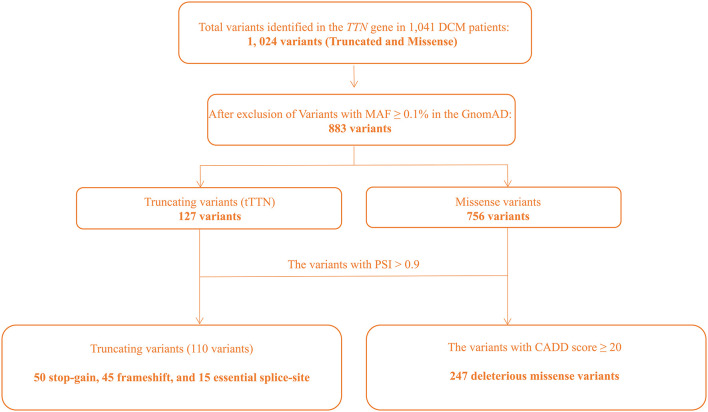
Mutations in the gene are the most common causes of dilated cardiomyopathy (DCM). The clinical significance of gene variants remains inadequately understood. Whole-exome sequencing and phenotypic characterisation were performed, and patients were followed up for a median of 44 months. We analyzed the association of the variants with the clinical outcomes in a prospective study of 1,041 patients with sporadic DCM. truncating variants (tTTN) were detected in 120 (11.5%) patients as compared with 2.4/10,000 East Asian populations in the Genome Aggregation Database (GnomAD; < 0.0001). Pathogenic missense variants were also enriched in DCM as compared with the GnomAD populations (27.6 vs. 5.9%, < 0.0001). DCM patients with tTTN had a lower left ventricular ejection fraction (28.89 ± 8.72 vs. 31.81 ± 9.97, = 0.002) and a lower frequency of the left bundle branch block (3.3 vs. 11.3%, = 0.011) than those without or with mutations in other known causal genes (OCG). However, tTTN were not associated with the composite primary endpoint of cardiac death and heart transplantation during the follow-up period [adjusted hazard ratio (HR): 0.912; 95% confidence interval: 0.464-1.793; = 0.790]. There was also no sex-dependent effect. Concomitant tTTN and pathogenic variants in OCG were present in only eight DCM patients and did not affect the outcome. The phenotype of DCM caused by tTTN, major causes of sporadic DCM, is not distinctly different from those caused by other causal genes for DCM.
该基因的突变是扩张型心肌病(DCM)最常见的病因。基因变异的临床意义仍未得到充分理解。我们进行了全外显子组测序和表型特征分析,并对患者进行了中位时间为44个月的随访。在一项对1041例散发性DCM患者的前瞻性研究中,我们分析了该基因变异与临床结局的关联。与基因组聚合数据库(GnomAD)中每10000名东亚人群中2.4例的发生率相比,120例(11.5%)患者检测到截短变异(tTTN)(P<0.0001)。与GnomAD人群相比,致病性错义变异在DCM中也有富集(27.6%对5.9%,P<0.0001)。与无其他已知致病基因(OCG)突变或有其他已知致病基因突变的患者相比,有tTTN的DCM患者左心室射血分数更低(28.89±8.72对31.81±9.97,P=0.002),左束支传导阻滞的发生率更低(3.3%对11.3%,P=0.011)。然而,在随访期间,tTTN与心脏死亡和心脏移植的复合主要终点无关[调整后风险比(HR):0.912;95%置信区间:0.464-1.793;P=0.790]。也没有性别依赖性效应。仅8例DCM患者同时存在tTTN和OCG中的致病性变异,且不影响结局。由tTTN导致的DCM(散发性DCM的主要病因)的表型与由DCM其他致病基因导致的表型没有明显差异。