Heath Anthony F, Schneider Silke L
Centre for Social Investigation, Nuffield College, University of Oxford, Oxford, United Kingdom.
Department Survey Design and Methodology, GESIS - Leibniz Institute for the Social Sciences, Mannheim, Germany.
Front Sociol. 2021 Apr 29;6:510987. doi: 10.3389/fsoc.2021.510987. eCollection 2021.
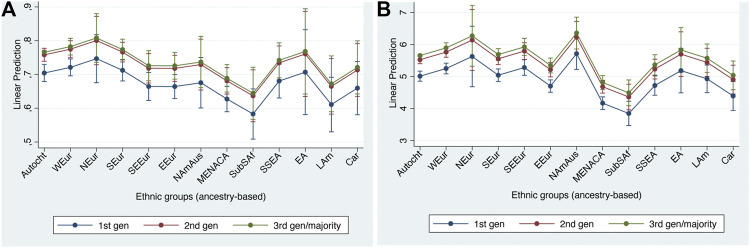
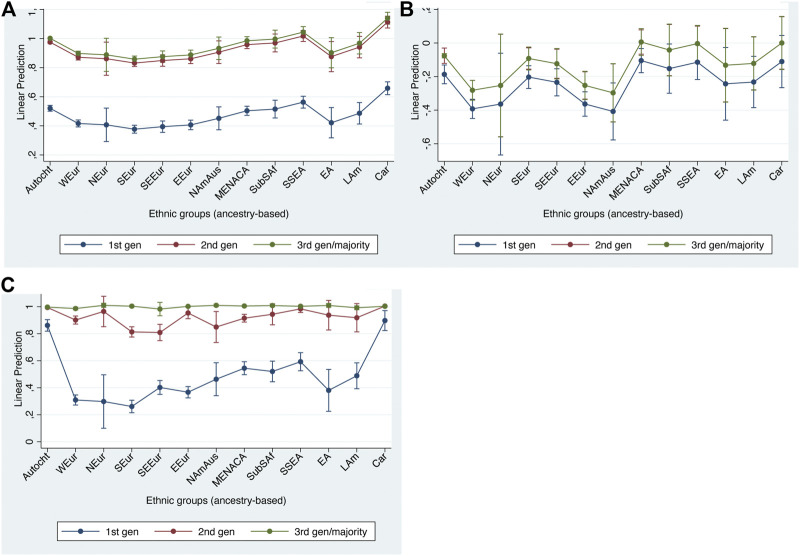
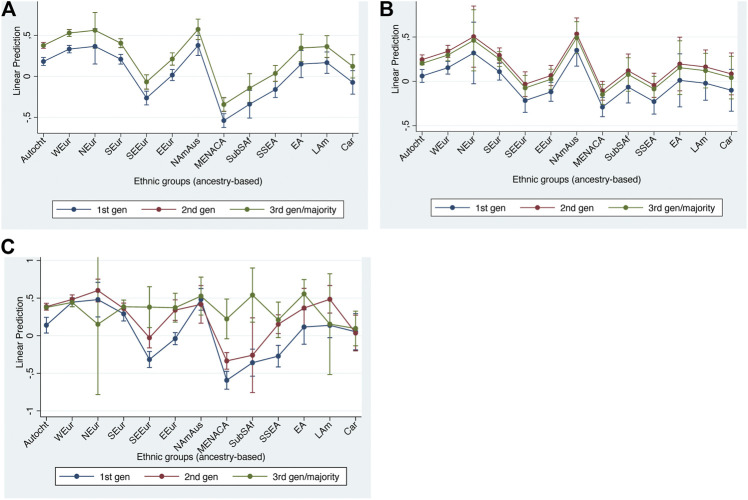
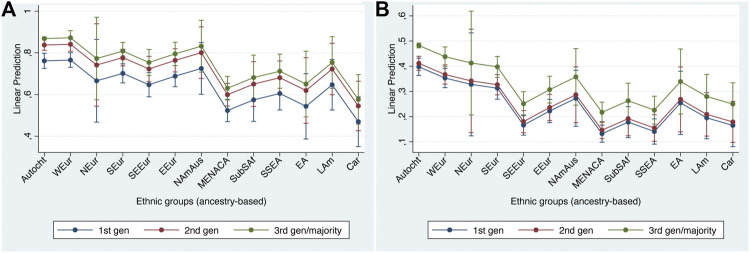
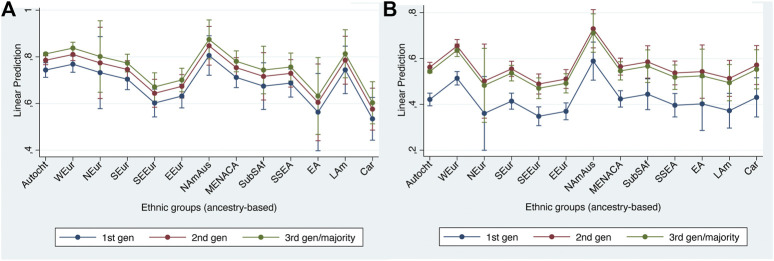
The integration of immigrant minorities is a major concern for diverse societies-with major implications for the well-being of those affected, social cohesion and group relations, and economic and social progress. In this paper, we give a comprehensive description of long-term migrant integration in Western Europe to investigate theories of migrant assimilation and integration. We take a multidimensional approach, looking at 10 indicators measuring social, structural, political, civic and cultural integration. We take an innovative approach to measuring minority background by using two complementary measures: generational status, distinguishing first and second-generation migrants from the third and higher up 'natives,' and self-reported ancestry, separating those with autochthonous-only ancestry from those with various kinds of allochthonous ancestry. Using interaction effects between these measures, we can test whether generational change is faster or slower for some ethnic groups than for others, i.e. whether different groups integrate at differing speeds. Using the pooled samples of all Western European countries included in the European Social Survey rounds 7 and 8, we run multivariate regression analyses to estimate the effects of migrant background on the 10 indicators of integration. Compared to migrants with autochthonous ancestry, respondents of Middle Eastern, North African & Central Asian as well as Sub-Saharan African ancestry are less integrated on all dimensions of integration except the political and civic ones. The South & South-East Asian group is also substantially less assimilated socially and culturally, but not so much structurally. They are closely followed by the South East and East European groups, following the same pattern except that the latter are less integrated politically as well. We only find substantial interaction effects between ethnic group and migrant generation for two integration indicators, namely citizenship and homophobia, for which speed of integration thus appears to differ across ethnic groups. For all other indicators, integration speed does not appear to differ across ethnic groups, supporting straight line assimilation theory, with social integration in terms of interethnic friendship potentially rather following a 'bumpy-line' pattern.
移民少数群体的融合是多元社会的一个主要关切问题,对受影响者的福祉、社会凝聚力和群体关系以及经济和社会进步都有重大影响。在本文中,我们全面描述了西欧长期移民融合情况,以研究移民同化和融合理论。我们采用多维方法,考察衡量社会、结构、政治、公民和文化融合的10项指标。我们采用创新方法衡量少数群体背景,使用两种互补措施:代际身份,区分第一代和第二代移民与第三代及以上的“本地人”,以及自我报告的血统,将只有本地血统的人与有各种外来血统的人区分开来。通过这些措施之间的交互作用,我们可以检验某些族裔群体的代际变化是比其他群体更快还是更慢,即不同群体的融合速度是否不同。利用欧洲社会调查第7轮和第8轮中所有西欧国家的合并样本,我们进行多元回归分析,以估计移民背景对10项融合指标的影响。与有本地血统的移民相比,中东、北非和中亚以及撒哈拉以南非洲血统的受访者在除政治和公民融合之外的所有融合维度上的融合程度较低。南亚和东南亚群体在社会和文化方面的同化程度也大大较低,但在结构方面则不然。紧随其后的是东南欧和东欧群体,遵循相同模式,只是后者在政治方面的融合程度也较低。我们仅在两个融合指标(即公民身份和恐同症)上发现族裔群体与移民代际之间存在显著的交互作用,因此不同族裔群体的融合速度似乎不同。对于所有其他指标,不同族裔群体的融合速度似乎没有差异,这支持了直线同化理论,而族际友谊方面的社会融合可能更遵循“折线”模式。