Yuan Qian, Li Xiao-Dong, Zhang Si-Miao, Wang Hong-Wei, Wang Yun-Liang
Department of Neurology, The Second Affiliated Hospital of Zhengzhou University, Zhengzhou, Henan Province, 450014, PR China.
Department of Neurology, Zhengzhou Central Hospital, Zhengzhou, Henan Province, 450014, PR China.
Genes Dis. 2019 Dec 14;8(2):124-132. doi: 10.1016/j.gendis.2019.12.001. eCollection 2021 Mar.
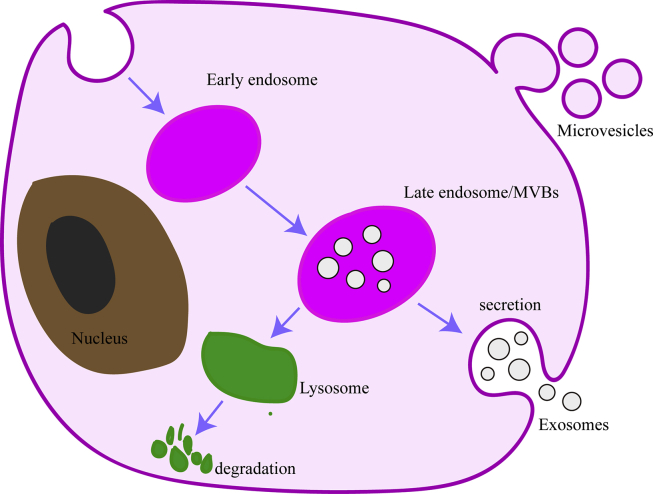
Extracellular vesicles (EVs) are vesicle-like substances released by eukaryotic cells. Based on their origin and size, EVs are mainly divided into exosomes, microvesicles and apoptotic bodies, and they are secreted by eukaryotic cells under physiological and pathological conditions. EVs are enriched with nucleic acids, proteins and other factors. EVs can regulate the function of adjacent and distant cells, and they are even involved in the pathogenesis of diseases. They contain proteins associated with the pathogenesis of neurodegenerative diseases (NDs), such as the α-synuclein (α-syn) and tau proteins, which suggest potential roles for EVs as biomarkers and carriers of drugs and other therapeutic molecules that can cross the blood-brain barrier to treat NDs. In this review, we summarized the function of EVs in the pathogenesis of different NDs and related advances in EVs as diagnostic biomarkers and treatments for diseases.
细胞外囊泡(EVs)是真核细胞释放的囊泡样物质。根据其来源和大小,EVs主要分为外泌体、微囊泡和凋亡小体,它们在生理和病理条件下由真核细胞分泌。EVs富含核酸、蛋白质和其他因子。EVs可调节邻近和远处细胞的功能,甚至参与疾病的发病机制。它们含有与神经退行性疾病(NDs)发病机制相关的蛋白质,如α-突触核蛋白(α-syn)和tau蛋白,这表明EVs作为生物标志物以及能够穿越血脑屏障治疗NDs的药物和其他治疗分子的载体具有潜在作用。在本综述中,我们总结了EVs在不同NDs发病机制中的作用以及EVs作为疾病诊断生物标志物和治疗方法的相关进展。