Kodym Oldřich, Li Jianning, Pepe Antonio, Gsaxner Christina, Chilamkurthy Sasank, Egger Jan, Španěl Michal
Brno University of Technology (BUT), Brno, Czech Republic.
Graz University of Technology (TU Graz), Graz, Styria, Austria.
Data Brief. 2021 Feb 24;35:106902. doi: 10.1016/j.dib.2021.106902. eCollection 2021 Apr.
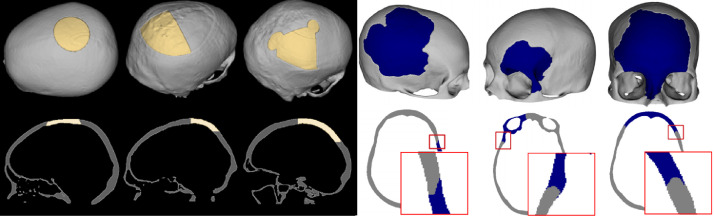
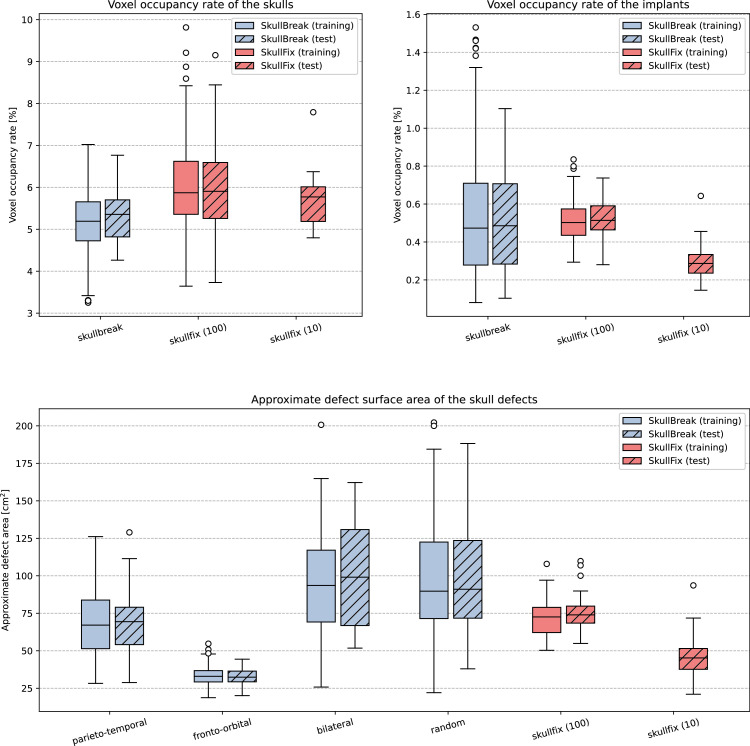
The article introduces two complementary datasets intended for the development of data-driven solutions for cranial implant design, which remains to be a time-consuming and laborious task in current clinical routine of cranioplasty. The two datasets, referred to as the SkullBreak and SkullFix in this article, are both adapted from a public head CT collection (http://headctstudy.qure.ai/dataset) with license. The SkullBreak contains 114 and 20 complete skulls, each accompanied by five defective skulls and the corresponding cranial implants, for training and evaluation respectively. The SkullFix contains 100 triplets (complete skull, defective skull and the implant) for training and 110 triplets for evaluation. The SkullFix dataset was first used in the MICCAI 2020 AutoImplant Challenge (https://autoimplant.grand-challenge.org/) and the ground truth, i.e., the complete skulls and the implants in the evaluation set are held private by the organizers. The two datasets are not overlapping and differ regarding data selection and synthetic defect creation and each serves as a complement to the other. Besides cranial implant design, the datasets can be used for the evaluation of volumetric shape learning algorithms, such as volumetric shape completion. This article gives a description of the two datasets in detail.
本文介绍了两个互补的数据集,旨在开发用于颅骨植入物设计的数据驱动解决方案,在当前颅骨成形术的临床常规操作中,这仍然是一项耗时费力的任务。这两个数据集在本文中称为SkullBreak和SkullFix,均改编自一个获得许可的公共头部CT数据集(http://headctstudy.qure.ai/dataset)。SkullBreak包含114个完整颅骨和20个完整颅骨,每个分别伴有5个有缺陷的颅骨和相应的颅骨植入物,用于训练和评估。SkullFix包含100个三元组(完整颅骨、有缺陷的颅骨和植入物)用于训练,110个三元组用于评估。SkullFix数据集首次用于2020年医学图像计算与计算机辅助干预国际会议(MICCAI)的自动植入物挑战赛(https://autoimplant.grand-challenge.org/),并且评估集中的真实数据,即完整颅骨和植入物由组织者保密。这两个数据集不重叠,在数据选择和合成缺陷创建方面有所不同,且彼此互补。除了颅骨植入物设计外,这些数据集还可用于评估体积形状学习算法,如体积形状完成。本文详细介绍了这两个数据集。