Chaouch Melek, Chaabane Amal, Ayari Chiraz, Ben Othman Souad, Sereno Denis, Chemkhi Jomaa, BenAbderrazak Souha
Laboratoire de Parasitologie Médiale, Biotechnologies et Biomolécules (LR11IPT06), Institut Pasteur de Tunis, 13, Place Pasteur-BP74, 1002 Tunis, Tunisia.
Laboratory of Bioinformatics, Biomathematics and Biostatistics (LR 16 IPT 09), Institut Pasteur de Tunis, 13, Place Pasteur-BP74, 1002 Tunis, Tunisia.
Parasite Epidemiol Control. 2021 Apr 17;14:e00212. doi: 10.1016/j.parepi.2021.e00212. eCollection 2021 Aug.
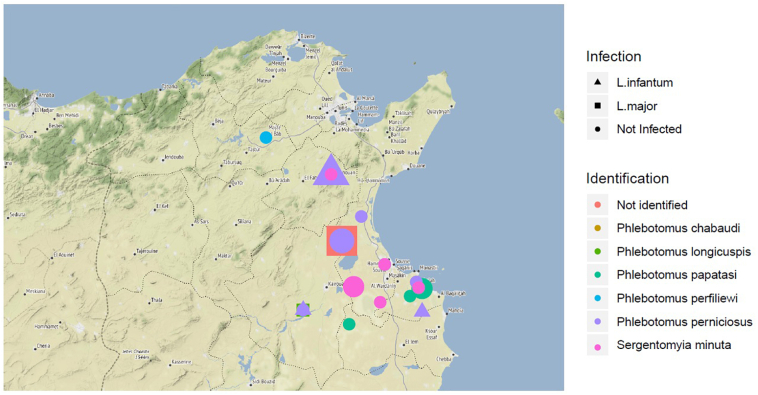
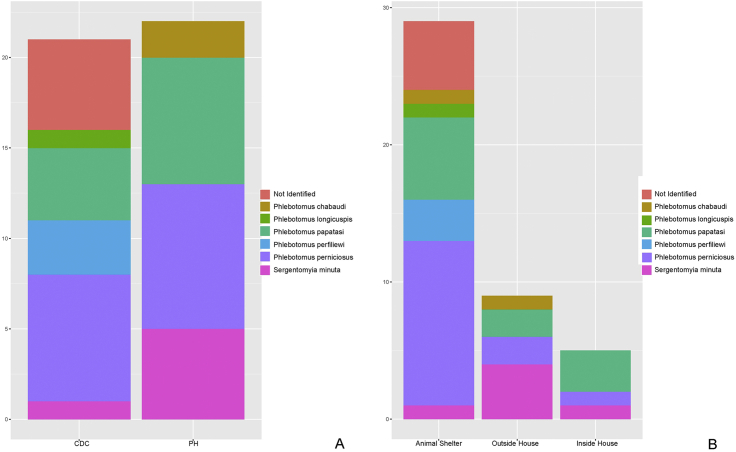
Leishmaniases are caused by protozoan parasites of the genus transmitted by females blood-feeding phlebotomine insects (Diptera: Psychodidae). In Tunisia, cutaneous and visceral leishmaniases are of public health concern. In Tunisia, 17 species of phlebotomine sand flies are described. Here we investigate natural infection in Tunisian mixed foci regions of leishmaniases. We trap female sandflies during the transmission season in the country's central-eastern and northern parts. We investigate Leishmania infection using PCR-RFLP targeting the ITS1 ribosomal DNA, followed by enzymatic digestion with III; then, we identify sand flies using molecular methodologies. We confirm the presence of and infected by and parasites in Tunisia.
利什曼病由利什曼原虫属的原生动物寄生虫引起,通过雌性吸血白蛉昆虫(双翅目:毛蠓科)传播。在突尼斯,皮肤利什曼病和内脏利什曼病是公共卫生关注的问题。在突尼斯,已描述了17种白蛉沙蝇。在此,我们调查突尼斯利什曼病混合疫源地地区的自然感染情况。我们在该国中东部和北部的传播季节捕获雌性沙蝇。我们使用针对ITS1核糖体DNA的PCR-RFLP进行调查,随后用III进行酶切;然后,我们使用分子方法鉴定沙蝇。我们证实在突尼斯存在被 和 寄生虫感染的 和 。