Khan Safi U, Khan Muhammad Zia, Khan Muhammad U, Khan Muhammad Shahzeb, Mamas Mamas A, Rashid Muhammad, Blankstein Ron, Virani Salim S, Johansen Michelle C, Shapiro Michael D, Blaha Michael J, Cainzos-Achirica Miguel, Vahidy Farhaan S, Nasir Khurram
Department of Medicine, West Virginia University, Morgantown, WV.
Department of Medicine, John H. Stroger, Jr. Hospital of Cook County, Chicago, IL.
Mayo Clin Proc Innov Qual Outcomes. 2021 Apr 8;5(2):431-441. doi: 10.1016/j.mayocpiqo.2021.01.015. eCollection 2021 Apr.
To assess trends of stroke hospitalization rates, inpatient mortality, and health care resource use in young (aged ≤44 years), midlife (aged 45-64 years), and older (aged ≥65 years) adults.
We studied the National Inpatient Sample database (January 1, 2002 to December 31, 2017) to analyze stroke-related hospitalizations. We identified data using the codes.
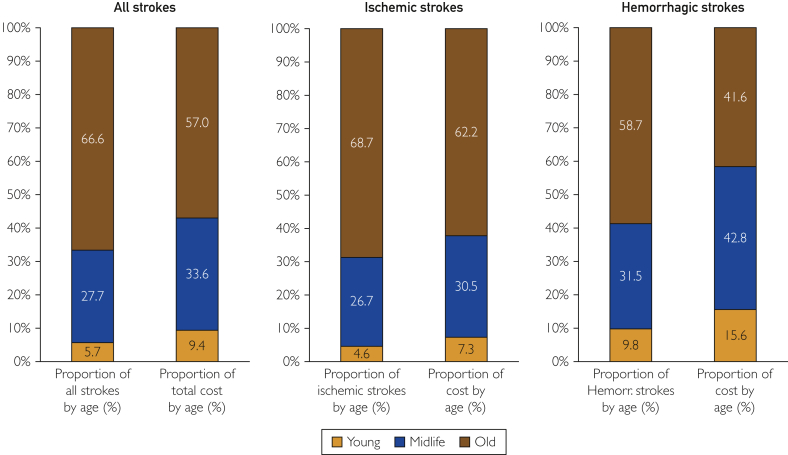
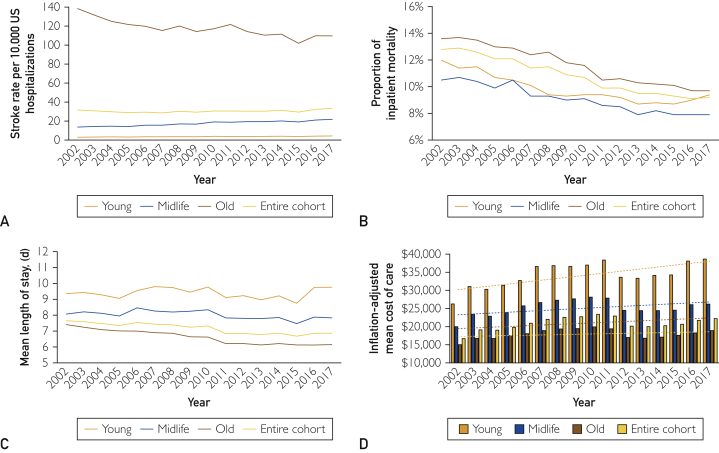
Of 11,381,390 strokes, 79% (n=9,009,007) were ischemic and 21% (n=2,372,383) were hemorrhagic. Chronic diseases were more frequent in older adults; smoking, alcoholism, and migraine were more prevalent in midlife adults; and coagulopathy and intravenous drug abuse were more common in young patients with stroke. The hospitalization rates of stroke per 10,000 increased overall (31.6 to 33.3) in young and midlife adults while decreasing in older adults. Although mortality decreased overall and in all age groups, the decline was slower in young and midlife adults than older adults. The mean length of stay significantly decreased in midlife and older adults and increased in young adults. The inflation-adjusted mean cost of stay increased consistently, with an average annual growth rate of 2.44% in young, 1.72% in midlife, and 1.45% in older adults owing to the higher use of health care resources. These trends were consistent in both ischemic and hemorrhagic stroke.
Stroke-related hospitalization and health care expenditure are increasing in the United States, particularly among young and midlife adults. A higher cost of stay counterbalances the benefits of reducing stroke and mortality in older patients.
评估年轻(年龄≤44岁)、中年(年龄45 - 64岁)和老年(年龄≥65岁)成年人中风住院率、住院死亡率及医疗资源使用情况的趋势。
我们研究了国家住院样本数据库(2002年1月1日至2017年12月31日)以分析与中风相关的住院情况。我们使用编码识别数据。
在11381390例中风病例中,79%(n = 9009007)为缺血性中风,21%(n = 2372383)为出血性中风。慢性疾病在老年人中更为常见;吸烟、酗酒和偏头痛在中年成年人中更为普遍;凝血病和静脉药物滥用在年轻中风患者中更为常见。每10000人中中风的住院率在年轻和中年成年人中总体上升(从31.6升至33.3),而在老年人中下降。尽管总体及所有年龄组的死亡率均下降,但年轻和中年成年人的下降速度比老年人慢。中年和老年人的平均住院时间显著缩短,而年轻人的平均住院时间增加。由于医疗资源使用增加,经通胀调整后的平均住院费用持续上升,年轻人平均年增长率为2.44%,中年人为1.72%,老年人为1.45%。这些趋势在缺血性和出血性中风中均一致。
在美国,与中风相关的住院率和医疗支出正在增加,尤其是在年轻和中年成年人中。较高的住院费用抵消了老年患者中风和死亡率降低带来的益处。