Iske Cayla J, Herrick Jason R, Morris Cheryl L
Department of Animal Science, Iowa State University, Ames, IA 50011, USA.
Omaha's Henry Doorly Zoo and Aquarium, Omaha, NE 68107, USA.
Transl Anim Sci. 2021 May 8;5(2):txab034. doi: 10.1093/tas/txab034. eCollection 2021 Apr.
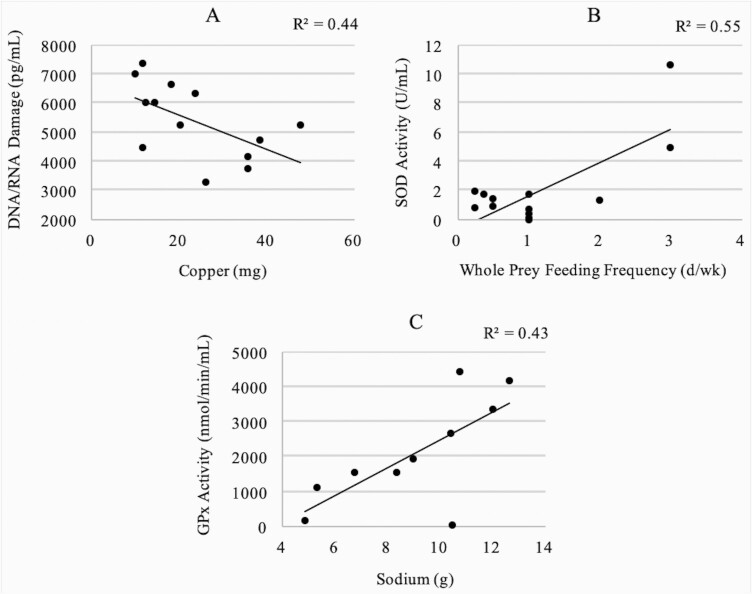
Oxidative stress (OS) results from the overproduction of reactive species. Nutrient intake can contribute positively or negatively to OS, and the lack of established nutrient requirements for most of the exotic species managed in zoos exacerbates the possibilities for nutrient imbalances that potentially could lead to reactive species production. The objective of this study was to evaluate the influence of nutrient intake and nutritional husbandry on markers of OS in male snow leopards ( = 14) maintained in U.S. facilities ( = 12). Diet samples and husbandry information were obtained and snow leopards were immobilized once for collection of blood. Samples were analyzed for chemical composition (diet and blood), antioxidant capacity (blood), and markers of OS (blood). Correlations between weekly nutrient intakes and markers of OS were analyzed by linear regression. Analyzed markers of OS included antioxidant enzymes (superoxide dismutase [SOD] and glutathione peroxidase [GPx]) and ferric reducing antioxidant potential that are protective against OS, and protein carbonyls, thiobarbituric acid reactive substances, and DNA/RNA damage that are indicative of oxidative damage. Weekly copper intake (10.1 to 80.2 mg) was negatively correlated with DNA/RNA damage ( = 0.44; 0.01). Weekly sodium intake (4.4 to 12.7 g) was positively correlated with GPx activity ( = 0.43; 0.04). More frequent feeding of whole prey (0.3 to 3 times/wk) was correlated with increased blood SOD activity ( = 0.55; < 0.01). In conclusion, greater dietary copper intake and more frequent feeding of whole prey may reduce OS in snow leopards. Dietary sodium intake and relationship with GPx activity should be further evaluated to determine benefit or detriment. No cause and effect can be inferred from our results, but our data suggest altering dietary form and nutrient concentrations may influence OS in snow leopards.
氧化应激(OS)源于活性物质的过度产生。营养摄入对氧化应激可能产生积极或消极影响,而动物园中管理的大多数外来物种缺乏既定的营养需求,这加剧了营养失衡的可能性,而营养失衡可能会导致活性物质的产生。本研究的目的是评估营养摄入和营养饲养对美国设施中饲养的雄性雪豹(n = 14)氧化应激标志物的影响(设施数量 = 12)。获取了饮食样本和饲养信息,并且雪豹被麻醉一次以采集血液。对样本进行化学成分(饮食和血液)、抗氧化能力(血液)以及氧化应激标志物(血液)分析。通过线性回归分析每周营养摄入量与氧化应激标志物之间的相关性。分析的氧化应激标志物包括对抗氧化应激有保护作用的抗氧化酶(超氧化物歧化酶[SOD]和谷胱甘肽过氧化物酶[GPx])以及铁还原抗氧化能力,还有指示氧化损伤的蛋白质羰基、硫代巴比妥酸反应性物质以及DNA/RNA损伤。每周铜摄入量(10.1至80.2毫克)与DNA/RNA损伤呈负相关(r = 0.44;P < 0.01)。每周钠摄入量(4.4至12.7克)与GPx活性呈正相关(r = 0.43;P < 0.04)。更频繁地投喂整只猎物(每周0.3至3次)与血液SOD活性增加相关(r = 0.55;P < 0.01)。总之,增加饮食中铜的摄入量以及更频繁地投喂整只猎物可能会降低雪豹的氧化应激。饮食中钠的摄入量及其与GPx活性的关系应进一步评估以确定其益处或危害。我们的结果无法推断因果关系,但我们的数据表明改变饮食形式和营养浓度可能会影响雪豹的氧化应激。