Stanford University, Stanford, California (S.A., J.P.).
Stanford University, Palo Alto, California (M.E.M., P.G., S.D.B., G.M.C.).
Ann Intern Med. 2021 Aug;174(8):1073-1080. doi: 10.7326/M21-0256. Epub 2021 May 18.
Assessing the evolution of SARS-CoV-2 immune response among patients receiving dialysis can define its durability in a highly clinically relevant context because patients receiving dialysis share the characteristics of persons most susceptible to SARS-CoV-2 infection.
To evaluate the persistence of SARS-CoV-2 receptor-binding domain (RBD) IgG in seroprevalent patients receiving dialysis.
Prospective.
Nationwide sample from dialysis facilities.
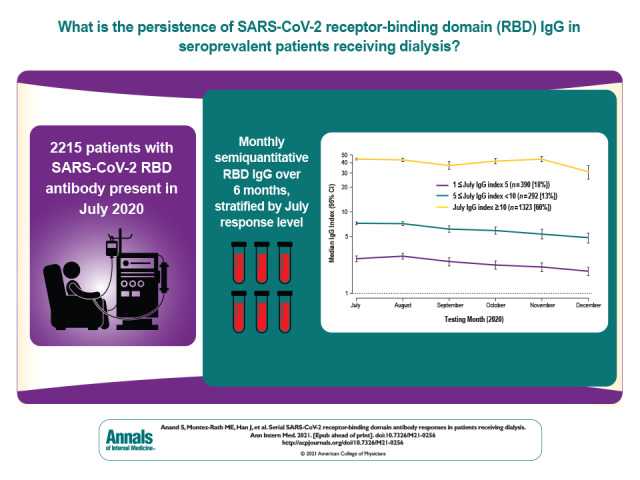
2215 patients receiving dialysis who had evidence of SARS-CoV-2 infection as of July 2020.
Remainder plasma from routine monthly laboratories was used to measure semiquantitative RBD IgG index value over 6 months.
A total of 2063 (93%) seroprevalent patients reached an assay detectable response (IgG index value ≥1). Most ( = 1323, 60%) had responses in July with index values classified as high (IgG ≥10); 1003 (76%) remained within this stratum. Adjusted median index values declined slowly but continuously (July vs. December values were 21 vs. 13; < 0.001). The trajectory of the response did not vary by age group, sex, race/ethnicity, or diabetes status. Patients without an assay detectable response ( = 137) were more likely to be White and in the younger (18 to 44 years) or older (≥80 years) age groups and less likely to have diabetes and hypoalbuminemia.
Lack of data on symptoms or reverse transcriptase polymerase chain reaction diagnosis, cohort of persons who survived infection, and use of a semiquantitative assay.
Despite impaired immunity, most seropositive patients receiving dialysis maintained RBD antibody levels over 6 months. A slow and continual decline in median antibody levels over time was seen, but no indication that subgroups with impaired immunity had a shorter-lived humoral response was found.
Ascend Clinical Laboratories.
评估接受透析治疗的患者中 SARS-CoV-2 免疫反应的演变可以在高度临床相关的情况下定义其持久性,因为接受透析治疗的患者具有易感染 SARS-CoV-2 的人群的特征。
评估在血清阳性接受透析治疗的患者中 SARS-CoV-2 受体结合域(RBD)IgG 的持续存在。
前瞻性。
来自透析机构的全国性样本。
截至 2020 年 7 月,有 SARS-CoV-2 感染证据的 2215 名接受透析治疗的患者。
使用常规每月实验室的剩余血浆在 6 个月内测量半定量 RBD IgG 指数值。
共有 2063 名(93%)血清阳性患者达到可检测到的反应(IgG 指数值≥1)。大多数(=1323,60%)在 7 月有反应,指数值分类为高(IgG≥10);1003 名(76%)仍处于这一水平。调整后的中位数指数值缓慢但持续下降(7 月与 12 月的数值分别为 21 和 13;<0.001)。反应的轨迹不因年龄组、性别、种族/民族或糖尿病状态而异。无可检测到的反应(=137)的患者更可能是白人,年龄在 18 至 44 岁或 80 岁以上,且不太可能患有糖尿病和低白蛋白血症。
缺乏症状或逆转录酶聚合酶链反应诊断、感染存活者队列以及使用半定量检测的相关数据。
尽管免疫受损,大多数接受透析治疗的血清阳性患者在 6 个月内维持 RBD 抗体水平。随着时间的推移,观察到中位数抗体水平缓慢而持续下降,但没有发现免疫受损亚组的体液反应寿命更短的迹象。
Ascend 临床实验室。