Internal Medicine B, Tel-Aviv Sourasky Medical Center and Sackler Faculty of Medicine, Tel Aviv University, Tel Aviv, Israel.
Infectious Diseases Unit, Tel-Aviv Sourasky Medical Center and Sackler Faculty of Medicine, Tel-Aviv University, Tel Aviv, Israel.
PLoS One. 2022 May 10;17(5):e0268050. doi: 10.1371/journal.pone.0268050. eCollection 2022.
The resurgence of COVID-19 cases since June 2021, referred to as the fourth COVID-19 wave, has led to the approval and administration of booster vaccines. Our study aims to identify any associations between vaccine status with the characteristics and outcomes of patients hospitalized with severe COVID-19 disease.
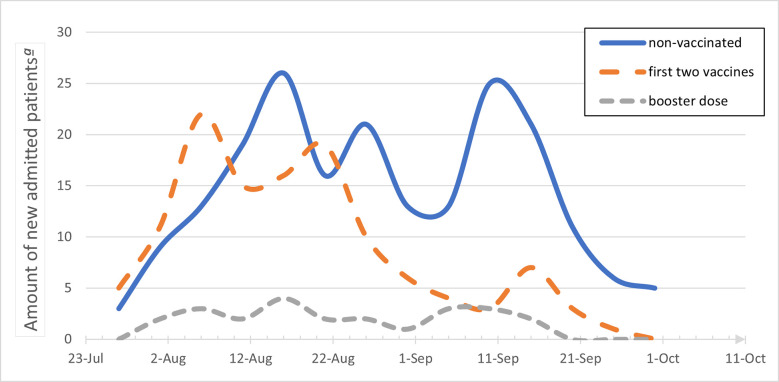
We retrospectively reviewed all COVID-19 patients admitted to a large tertiary center between July 25 and October 25, 2021 (fourth wave in Israel). Univariant and multivariant analyses of variables associated with vaccine status were performed.
Overall, 349 patients with severe or critical disease were included. Patients were either not vaccinated (58%), had the first two vaccine doses (35%) or had the booster vaccine (7%). Vaccinated patients were significantly older, male predominant, and with a higher number of comorbidities including diabetes, hyperlipidemia, ischemic heart disease, heart failure, immunodeficient state, kidney disease and cognitive decline. Time from the first symptom to hospital admission was longer among non-vaccinated patients (7.2 ± 4.4 days, p = 0.002). Critical disease (p<0.05), admissions to the intensive care unit (p = 0.01) and advanced oxygen support (p = 0.004) were inversely proportional to the number of vaccines given, lowest among the booster vaccine group. Death (20%, p = 0.83) and hospital stay duration (8.05± 8.47, p = 0.19) were similar between the groups.
Hospitalized vaccinated patients with severe COVID-19 had significantly higher rates of most known risk factors for COVID-19 adverse outcomes. Still, all disease outcomes were similar or better compared with the non-vaccinated patients.
自 2021 年 6 月以来,COVID-19 病例再次出现,被称为第四波 COVID-19,导致批准并管理了加强疫苗。我们的研究旨在确定疫苗状况与因严重 COVID-19 住院患者的特征和结局之间的任何关联。
我们回顾性地分析了 2021 年 7 月 25 日至 10 月 25 日期间(以色列的第四次波)在一家大型三级中心住院的所有 COVID-19 患者。对与疫苗状况相关的变量进行了单变量和多变量分析。
共有 349 名患有严重或危急疾病的患者纳入研究。患者要么未接种疫苗(58%),要么接种了前两剂疫苗(35%),要么接种了加强疫苗(7%)。接种疫苗的患者年龄较大,男性为主,合并症较多,包括糖尿病、高血脂、缺血性心脏病、心力衰竭、免疫缺陷状态、肾脏疾病和认知障碍。未接种疫苗患者从出现症状到住院的时间较长(7.2±4.4 天,p=0.002)。危重病(p<0.05)、入住重症监护病房(p=0.01)和高级氧支持(p=0.004)与接种疫苗的数量成反比,在接种加强疫苗组中最低。死亡率(20%,p=0.83)和住院时间(8.05±8.47,p=0.19)在各组之间相似。
因严重 COVID-19 住院的接种疫苗患者具有更高比例的已知 COVID-19 不良结局的风险因素。尽管如此,与未接种疫苗的患者相比,所有疾病结局相似或更好。