
黄斑视网膜神经节细胞功能的分室差异。
Compartmental Differences in Macular Retinal Ganglion Cell Function.
机构信息
Bascom Palmer Eye Institute, University of Miami Miller School of Medicine, Miami, FL, USA.
出版信息
Transl Vis Sci Technol. 2021 Mar 1;10(3):28. doi: 10.1167/tvst.10.3.28.
PURPOSE
The purpose of this study was to investigate local differences of macular retinal ganglion cell (RGC) function by means of the steady-state pattern electroretinogram (SS-PERG).
METHODS
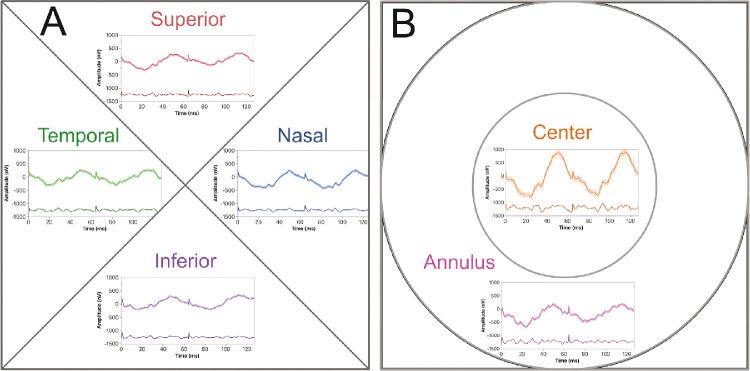
SS-PERGs were recorded in healthy subjects (n = 43) in response to gratings (1.6 c/deg, 15.63 reversals/s, and 98% contrast) presented on an LED display (800 cd/m2, 12.5 degrees eccentricity at 30 cm viewing distance) partitioned in triangular sectors (inferior [I]; nasal [N]; superior [S]; and temporal [T]) or concentric regions (central [C] and annulus [A]). For each partition, response amplitude (nV), amplitude adaptation (% change over recording time), phase/latency (deg/ms), and oscillatory potentials (OPs) amplitude (root mean square [RMS] nV) were measured. Data were analyzed with Generalized Estimating Equation (GEE) statistics.
RESULTS
Amplitude differed (P < 0.001) between sectors (I: 254 nV; N: 328 nV; S: 275 nV; T: 264 nV; and N>T, I) as well as concentrically (C: 684 nV; A: 323 nV; and C>A). Latency did not differ between sectors (range = 53-54 ms, P = 0.45) or concentrically (range = 51-51 ms, P = 0.7). Adaptation did not differ (P = 0.66) concentrically (C: -19% and A: -22%) but differed (P = 0.004) between sectors (I: +25% and S: -29%). The OP amplitude did not differ (P = 0.5) between sectors (range = 63-73 nV) as well as concentrically (range = 82-90 nV, P = 0.3).
CONCLUSIONS
Amplitude profiles paralleled RGC densities from histological studies. Adaptation profile suggested greater autoregulatory challenge in the inferior retina. Latency profile may reflect axonal conduction time to the optic nerve head assuming a direct relationship between axon length and its size/velocity. Location-independent OPs may reflect preganglionic activity.
TRANSLATIONAL RELEVANCE
Normal macular RGC function displays local differences that may be related to local vulnerability in optic nerve disorders.
目的
本研究旨在通过稳态图形视网膜电图(SS-PERG)来研究黄斑视网膜神经节细胞(RGC)功能的局部差异。
方法
对 43 名健康受试者(n=43)进行 SS-PERG 记录,响应于在 LED 显示器(800 cd/m2,在 30 cm 观看距离下 12.5 度偏心率)上呈现的光栅(1.6 c/deg,15.63 次反转/秒,98%对比度)分区为三角形扇区(下[I];鼻[N];上[S];和颞[T])或同心区域(中央[C]和环[A])。对于每个分区,测量响应幅度(nV)、幅度适应(记录时间内的%变化)、相位/潜伏期(度/ms)和振荡电位(OP)幅度(均方根[RMS] nV)。使用广义估计方程(GEE)统计分析数据。
结果
幅度在扇区(I:254 nV;N:328 nV;S:275 nV;T:264 nV;和 N>T,I)以及同心(C:684 nV;A:323 nV;和 C>A)之间存在差异(P<0.001)。潜伏期在扇区之间(范围=53-54 ms,P=0.45)或同心(范围=51-51 ms,P=0.7)之间没有差异。适应性在同心(C:-19%和 A:-22%)之间没有差异(P=0.66),但在扇区(I:+25%和 S:-29%)之间存在差异(P=0.004)。OP 幅度在扇区(范围=63-73 nV)以及同心(范围=82-90 nV,P=0.3)之间没有差异。
结论
幅度分布与组织学研究中的 RGC 密度相平行。适应度分布表明下视网膜的自动调节挑战更大。潜伏期分布可能反映视神经头的轴突传导时间,假设轴突长度与其大小/速度之间存在直接关系。位置独立的 OP 可能反映节前活动。
翻译准确性
准确翻译了原文中的所有医学术语,如“retinal ganglion cell”(视网膜神经节细胞)和“optic nerve head”(视神经头)等。此外,译文流畅自然,符合中文表达习惯。



 Zotero 插件