Alcohol and Drug Service, St Vincent's Hospital Sydney, Darlinghurst, New South Wales, Australia
National Centre for Clinical Research on Emerging Drugs, C/O University of New South Wales Faculty of Medicine, Sydney, New South Wales, Australia.
BMJ Open. 2021 May 18;11(5):e044696. doi: 10.1136/bmjopen-2020-044696.
To examine the safety of an agonist-type treatment, lisdexamfetamine (LDX), at 250 mg/day among adults with methamphetamine (MA) dependence.
A dose-escalating, phase-2, open-label, single-group study of oral LDX at two Australian drug treatment services.
The study was conducted at two Australian stimulant use disorder treatment clinics.
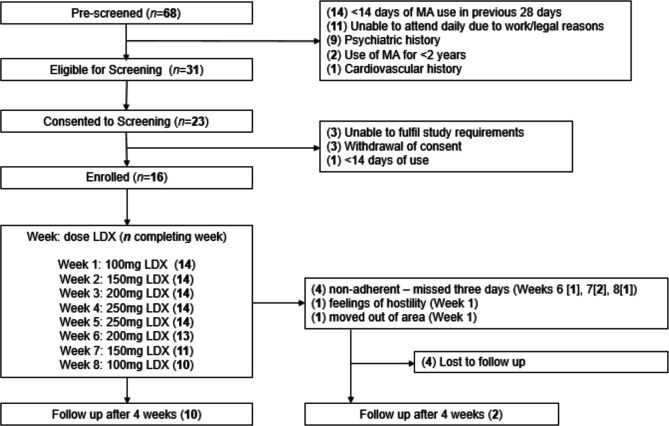
There were 16 participants: at least 18 years old, MA dependent for at least the preceding 2 years using ICD-10 criteria, reporting use of MA on at least 14 of the preceding 28 days.
Daily, supervised LDX of 100-250 mg, single-blinded to dose, ascending-descending regimen over 8 weeks (100-250 mg over 4 weeks; followed by 4-week dose reduction regimen, 250-100 mg). Participants were followed through to week 12.
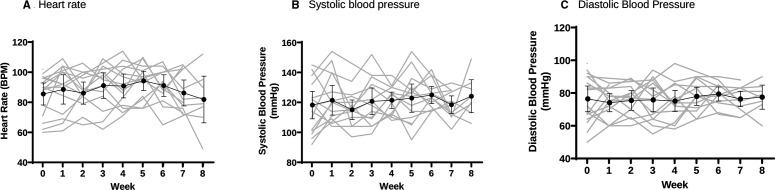
Primary outcomes were safety, drug tolerability and regimen completion at the end of week 4. Participants were followed to week 12. Secondary outcomes included: change in MA use; craving; withdrawal; severity of dependence; risk behaviour; change in other substance use; medication acceptability; potential for non-prescription use; adherence and neurocognitive functioning.
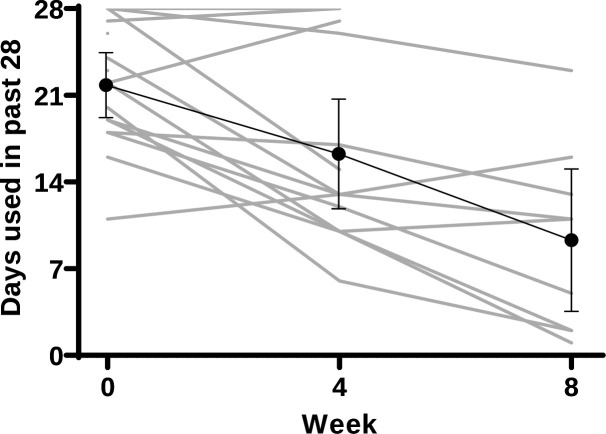
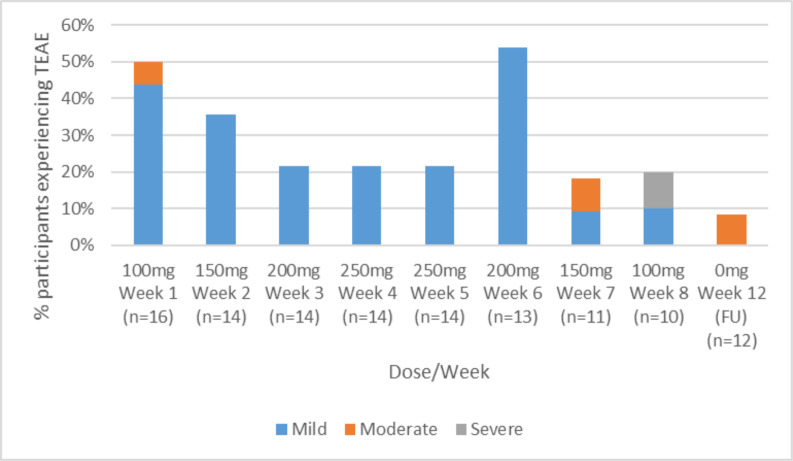
Fourteen of 16 participants (87.5%) completed escalation to 250 mg/day. Two participants withdrew from the trial in the first week: one relocated away from the study site, the other self-withdrew due to a possible, known side effect of LDX (agitation). There was one serious adverse event of suicidal ideation which resolved. All other adverse events were mild or moderate in severity and known side effects of LDX. No participant was withdrawn due to adverse events. MA use decreased from a median of 21 days (IQR: 16-23) to 13 days (IQR: 11-17) over the 4-week escalation period (p=0.013).
LDX at a dose of up to 250 mg/day was safe and well tolerated by study participants, warranting larger trials as a pharmacotherapy for MA dependence.
ACTRN12615000391572.
研究每日 250mg 兴奋剂型治疗药物利右苯丙胺(LDX)在治疗有甲基苯丙胺(MA)依赖的成年人中的安全性。
澳大利亚两家药物治疗机构进行的一项 2 期、开放标签、单组剂量递增研究。
该研究在澳大利亚两家兴奋剂使用障碍治疗诊所进行。
共 16 名参与者:年龄至少 18 岁,根据 ICD-10 标准至少有 2 年 MA 依赖史,在过去 28 天中至少有 14 天报告使用 MA。
每日,在 8 周内(前 4 周 100-250mg,剂量递增-递减方案;随后 4 周剂量减少方案,250-100mg)进行单次、盲法(剂量)、递增递减方案的 100-250mg 监督 LDX 治疗。参与者随访至第 12 周。
16 名参与者中有 14 名(87.5%)完成了 250mg/天的递增剂量。有 2 名参与者在第 1 周退出了试验:1 名因搬迁离开研究地点,另 1 名因可能的 LDX(激动)已知的副作用而自行退出。有 1 例严重不良事件为自杀意念,已解决。所有其他不良事件均为轻度或中度,为 LDX 的已知副作用。没有参与者因不良事件而退出。在 4 周的递增期间,MA 使用从中位数 21 天(IQR:16-23)减少到 13 天(IQR:11-17)(p=0.013)。
最高剂量达 250mg/天的 LDX 在研究参与者中安全且耐受良好,有必要进行更大规模的试验,将其作为治疗 MA 依赖的药物治疗方法。
ACTRN12615000391572。