Ezard Nadine, Clifford Brendan, Siefried Krista J, Ali Robert, Dunlop Adrian, McKetin Rebecca, Bruno Raimondo, Carr Andrew, Ward James, Farrell Michael, Graham Robert, Haber Paul, Lubman Dan, Donoghoe Mark W, Olsen Nick, Baker Amanda, Hall Michelle, Arunogiri Shalini, Lintzeris Nicholas
National Centre for Clinical Research on Emerging Drugs, University of New South Wales, Sydney, Australia.
Alcohol and Drug Service, St Vincent's Hospital Sydney, Sydney, Australia.
Addiction. 2025 Jul;120(7):1345-1359. doi: 10.1111/add.16730. Epub 2024 Dec 19.
This study tested the efficacy and safety of a 12-week course of lisdexamfetamine in reducing methamphetamine use, an outcome which is associated with improvements in health and wellbeing, in people dependent on methamphetamine.
DESIGN, SETTING AND PARTICIPANTS: This study was a randomised double-blind placebo-controlled trial conducted in six specialist outpatient clinics in Adelaide, Melbourne, Newcastle and Sydney, Australia (2018-2021). Participants were164 adults with methamphetamine dependence, reporting at least 14 use days out of the previous 28 days (62% male, 38% female, < 1% other; mean age 39 years).
Participants were randomly allocated 1:1 to a 15-week regimen of lisdexamfetamine (1-week induction to 250 mg, 12-week maintenance regimen, 2-week reduction; n = 80) or matched placebo (n = 84), followed-up to Week 19.
The primary efficacy measure was past 28-day methamphetamine use at Week 13. Safety was assessed by adverse event rates. Secondary measures included methamphetamine use during the 12-week treatment period and treatment satisfaction.
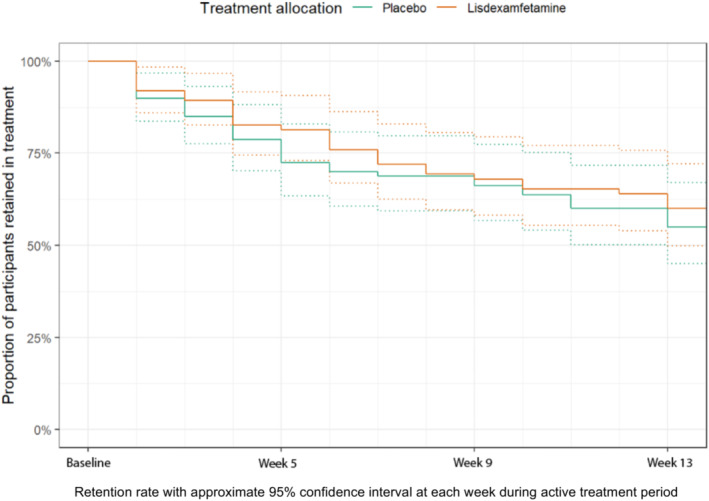
Nine randomized participants did not start treatment (five were allocated to lisdexamfetamine and four allocated to placebo) and were excluded from the analyses. Fifty-seven per cent of participants were retained on study medication to primary end-point. There was only weak evidence of a lisdexamfetamine benefit at 13 weeks [adjusted difference in days of methamphetamine use = 2.2, 95% confidence interval (CI) = -0.5 to 5.0; P = 0.49]. However, throughout the whole 12-week treatment maintenance phase, the lisdexamfetamine group had fewer days of methamphetamine use in total (difference = 8.8, 95% CI = 2.7-15.0; P = 0.005). The lisdexamfetamine group reported greater self-reported treatment effectiveness [odds ratio (OR) = 2.89, 95% CI = 1.67-5.02; P < 0.001] and treatment satisfaction (OR = 3.80, 95% CI = 1.93-7.47; P < 0.001). Adverse events with lisdexamfetamine included nausea. Serious adverse events occurred in four (5%) of participants who received lisdexamfetamine.
Lisdexamfetamine appears to reduce methamphetamine use over a 12-week treatment period, although there is only weak evidence that reduced use is maintained during the last 4 weeks.
本研究测试了12周疗程的赖氨酸安非他命在减少甲基苯丙胺使用方面的疗效和安全性,这一结果与依赖甲基苯丙胺者的健康和幸福感改善相关。
设计、地点和参与者:本研究是一项随机双盲安慰剂对照试验,在澳大利亚阿德莱德、墨尔本、纽卡斯尔和悉尼的六个专科门诊诊所进行(2018 - 2021年)。参与者为164名甲基苯丙胺依赖的成年人,在前28天中至少有14天使用甲基苯丙胺(62%为男性,38%为女性,<1%为其他;平均年龄39岁)。
参与者按1:1随机分配至赖氨酸安非他命15周治疗方案(1周导入期至250毫克,12周维持治疗方案,2周减量期;n = 80)或匹配的安慰剂(n = 84),随访至第19周。
主要疗效指标是第13周过去28天内甲基苯丙胺的使用情况。通过不良事件发生率评估安全性。次要指标包括12周治疗期内甲基苯丙胺的使用情况和治疗满意度。
9名随机分组的参与者未开始治疗(5名被分配至赖氨酸安非他命组,4名被分配至安慰剂组),并被排除在分析之外。57%的参与者坚持服用研究药物至主要终点。在第13周时,仅有微弱证据表明赖氨酸安非他命有益处[甲基苯丙胺使用天数的调整差异 = 2.2,95%置信区间(CI)= -0.5至5.0;P = 0.49]。然而,在整个12周的治疗维持阶段,赖氨酸安非他命组甲基苯丙胺的总使用天数较少(差异 = 8.8,95% CI = 2.7 - 15.0;P = 作0.005)。赖氨酸安非他命组报告的自我报告治疗效果更好[优势比(OR)= 2.89,95% CI = 1.67 - 5.02;P < 0.001]和治疗满意度更高(OR = 3.80,95% CI = 1.93 - 7.47;P < 0.001)。赖氨酸安非他命的不良事件包括恶心。接受赖氨酸安非他命治疗的参与者中有4名(5%)发生了严重不良事件。
赖氨酸安非他命在12周治疗期内似乎能减少甲基苯丙胺的使用,尽管仅有微弱证据表明在最后4周内使用量的减少得以维持。