Department of Behavioral Neuroscience, Oregon Health & Science University, Portland, Oregon, USA.
Departments of Neurology, Psychiatry, and Radiation Medicine, Division of Neuroscience ONPRC, Oregon Health & Science University, Portland, Oregon, USA.
Environ Health Perspect. 2021 May;129(5):57009. doi: 10.1289/EHP8428. Epub 2021 May 19.
Exposure to secondhand smoke (SHS) is a risk factor for developing sporadic forms of sporadic dementia. A human tau (htau) mouse model is available that exhibits age-dependent tau dysregulation, neurofibrillary tangles, neuronal loss, neuroinflammation, and oxidative stress starting at an early age (3-4 months) and in which tau dysregulation and neuronal loss correlate with synaptic dysfunction and cognitive decline.
The goal of this study was to assess the effects of chronic SHS exposure (10 months' exposure to ) on behavioral and cognitive function, metabolism, and neuropathology in mice.
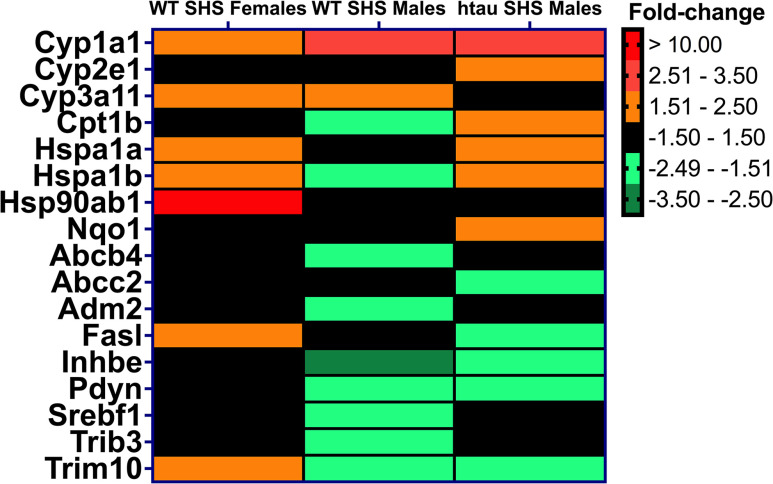
Wild-type (WT) and htau female and male mice were exposed to SHS (90% side stream, 10% main stream) using the SCIREQ® inExpose™ system or air control for 168 min per day, for 312 d, 7 d per week. The exposures continued during the days of behavioral and cognitive testing. In addition to behavioral and cognitive performance and neuropathology, the lungs of mice were examined for pathology and alterations in gene expression.
Mice exposed to chronic SHS exposure showed the following genotype-dependent responses: ) lower body weights in WT, but not htau, mice; ) less spontaneous alternation in WT, but not htau, mice in the Y maze; ) faster swim speeds of WT, but not htau, mice in the water maze; ) lower activity levels of WT and htau mice in the open field; ) lower expression of brain PHF1, TTCM1, , and HSP90 protein levels in WT male, but not female, mice; and ) more profound effects on hippocampal metabolic pathways in WT male than female mice and more profound effects in WT than htau mice.
The brain of WT mice, in particular WT male mice, might be especially susceptible to the effects of chronic SHS exposure. In WT males, independent pathways involving ascorbate, flavin adenine dinucleotide, or palmitoleic acid might contribute to the hippocampal injury following chronic SHS exposure. https://doi.org/10.1289/EHP8428.
接触二手烟(SHS)是形成散发性痴呆的危险因素。现已有人类 tau(htau)小鼠模型,其表现出年龄依赖性的 tau 失调、神经纤维缠结、神经元丢失、神经炎症和氧化应激,这些现象从 3-4 月龄开始出现,并伴有 tau 失调和神经元丢失,以及与突触功能障碍和认知能力下降相关。
本研究旨在评估慢性 SHS 暴露(暴露于 SHS10 个月)对小鼠行为和认知功能、代谢和神经病理学的影响。
使用 SCIREQ® inExpose™系统或空气对照,将野生型(WT)和 htau 雌性和雄性小鼠分别每天暴露于 SHS(90%侧流,10%主流)168 分钟,每周 7 天,持续 312 天。在进行行为和认知测试的同时,也要进行暴露。除了行为和认知表现以及神经病理学之外,还要检查小鼠的肺部是否存在病理学和基因表达改变。
暴露于慢性 SHS 的小鼠表现出以下基因型依赖性反应:WT 小鼠体重降低,但 htau 小鼠体重未降低;WT 小鼠 Y 迷宫自发交替减少,但 htau 小鼠未减少;WT 小鼠水迷宫游泳速度加快,但 htau 小鼠未加快;WT 和 htau 小鼠在旷场中的活动水平降低;WT 雄性小鼠而非雌性小鼠的大脑 PHF1、TTCM1、 和 HSP90 蛋白水平表达降低;WT 雄性小鼠而非雌性小鼠的海马代谢途径受影响更为显著,WT 小鼠受影响比 htau 小鼠更为显著。
WT 小鼠的大脑,尤其是 WT 雄性小鼠的大脑,可能特别容易受到慢性 SHS 暴露的影响。在 WT 雄性小鼠中,涉及抗坏血酸、黄素腺嘌呤二核苷酸或棕榈油酸的独立途径可能会导致慢性 SHS 暴露后海马损伤。https://doi.org/10.1289/EHP8428.