University of Southern California, Los Angeles, CA, USA.
Abbott Laboratories, Abbott Park, IL, USA.
J Prim Care Community Health. 2021 Jan-Dec;12:21501327211017014. doi: 10.1177/21501327211017014.
Over 25% of United States (US) community-dwelling, older adults are at nutritional risk. Health and cost burdens of poor nutrition can be lowered by nutrition programs for hospital inpatients, but few studies have looked at the impact on outpatients. The objective of our study was to assess outcomes of a nutrition focused quality improvement program (QIP) on healthcare resource use and costs in poorly nourished outpatients.
This pre-post QIP study was implemented at 3 US healthcare system clinics. Included patients (n = 600) were ≥45 years old, had ≥2 chronic conditions, and were enrolled over a 15-month interval. For comparison, historical (n = 600) and concurrent control (n = 600) groups were used. Assessment of poor nutritional status was performed during each patient's baseline visit. Healthcare resource use (hospitalizations, emergency department visits, and outpatient clinic visits), medication use, and costs were determined for a 90-day interval.
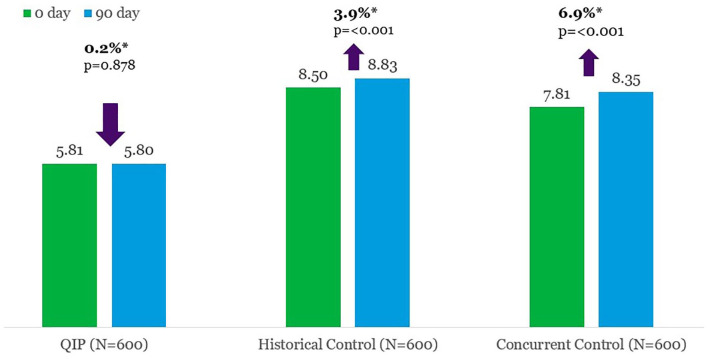
QIP patients (mean age 61.6 years) were predominantly female (62.5%) and overweight/obese (81.7%). The proportion of QIP outpatients presenting for healthcare services was significantly reduced compared to both historical and concurrent controls-relative risk reduction (RRR) versus historical (11.6%, < .001) and versus concurrent (8.9%, = .003). Of those who presented, RRR for healthcare resource use by QIP was significant in comparison with historical (12.9%, = .022) but not concurrent controls. No significant differences were observed for medication usage. Lower resource use among QIP patients yielded total cost savings of $290 923 or per-patient savings of $485.
Nutrition QIPs in outpatient clinics are feasible and can reduce healthcare resource use and cut costs. Such findings underscore benefits of nutritional interventions for community-dwelling outpatients with poor nutritional status.
超过 25%的美国社区居住的老年人存在营养风险。通过针对住院患者的营养计划,可以降低营养不良带来的健康和成本负担,但很少有研究关注其对门诊患者的影响。我们的研究目的是评估以营养为重点的质量改进计划(QIP)对营养状况不佳的门诊患者的医疗资源使用和成本的影响。
该 QIP 前后研究在 3 家美国医疗系统诊所实施。纳入的患者(n=600)年龄≥45 岁,患有≥2 种慢性疾病,并在 15 个月的时间内入组。为了进行比较,使用了历史(n=600)和同期对照组(n=600)。在每位患者的基线就诊期间评估营养状况不良。在 90 天的时间内确定医疗资源使用(住院、急诊就诊和门诊就诊)、药物使用和成本。
QIP 患者(平均年龄 61.6 岁)主要为女性(62.5%)和超重/肥胖(81.7%)。与历史和同期对照组相比,QIP 门诊患者就诊的比例显著降低-与历史组相比相对风险降低(RRR)为 11.6%( < .001),与同期对照组相比为 8.9%( = .003)。在就诊的患者中,与历史组相比,QIP 患者的医疗资源使用 RRR 显著(12.9%, = .022),但与同期对照组相比则无差异。药物使用没有显著差异。QIP 患者的资源使用减少带来了 290923 美元的总成本节约,或每位患者节约 485 美元。
门诊诊所的营养 QIP 是可行的,可以减少医疗资源的使用并降低成本。这些发现强调了针对营养状况不佳的社区居住门诊患者进行营养干预的益处。