Bérard Anick, Sheehy Odile, Zhao Jin-Ping, Vinet Evelyne, Quach Caroline, Kassai Behrouz, Bernatsky Sasha
Research Center, CHU Sainte-Justine, Montreal, Quebec, Canada.
Faculty of Pharmacy, University of Montreal, Montreal, Quebec, Canada.
PLoS One. 2021 May 19;16(5):e0251746. doi: 10.1371/journal.pone.0251746. eCollection 2021.
Medications already available to treat other conditions are presently being studied in clinical trials as potential treatments for COVID-19. Given that pregnant women are excluded from these trials, we aimed to investigate their safety when used during pregnancy within a unique population source.
Using the population-based Quebec Pregnancy Cohort, we identified women who delivered a singleton liveborn (1998-2015). Taking potential confounders into account including indications for use, the risk of prematurity, low birth weight (LBW), small for gestational age (SGA), and major congenital malformation (MCM) associated with COVID-19 repurposed drug use during pregnancy were quantified using generalized estimation equations.
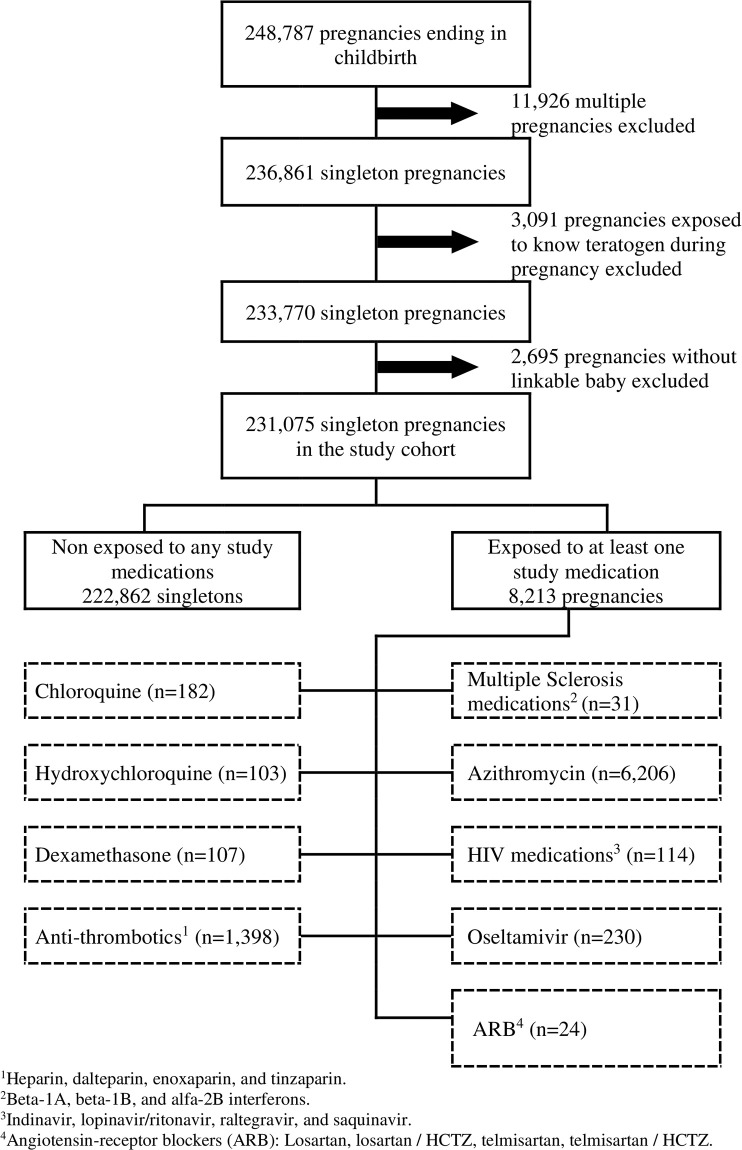
Of the 231,075 eligible pregnancies, 107 were exposed to dexamethasone (0.05%), 31 to interferons (0.01%), 1,398 to heparins (0.60%), 24 to angiotensin-receptor blockers (ARB) (0.01%), 182 to chloroquine (0.08%), 103 to hydroxychloroquine (0.05%), 6,206 to azithromycin (2.70%), 230 to oseltamivir (0.10%), and 114 to HIV medications (0.05%). Adjusting for potential confounders, we observed an increased risk of prematurity related to dexamethasone (aOR 1.92, 95%CI 1.11-3.33; 15 exposed cases), anti-thrombotics (aOR 1.58, 95%CI 1.31-1.91; 177 exposed cases), and HIV medications (aOR 2.04, 95%CI 1.01-4.11; 20 exposed cases) use. An increased risk for LBW associated with anti-thrombotics (aOR 1.72, 95%CI 1.41-2.11; 152 exposed cases), and HIV medications (aOR 2.48, 95%CI 1.25-4.90; 21 exposed cases) use were also found. Gestational exposure to anti-thrombotics (aOR 1.20, 95%CI 1.00-1.44; 176 exposed cases), and HIV medications (aOR 2.61, 95%CI 1.51-4.51; 30 exposed cases) were associated with SGA. First-trimester dexamethasone (aOR 1.66, 95%CI 1.02-2.69; 20 exposed cases) and azithromycin (aOR 1.10, 95%CI 1.02-1.19; 747 exposed cases) exposures were associated with MCM.
Many available medications considered as treatments for COVID-19 are associated with adverse pregnancy outcomes. Caution is warranted when considering these medications during the gestational period.
目前正在对已用于治疗其他疾病的药物进行临床试验,以研究其作为新型冠状病毒肺炎(COVID-19)潜在治疗方法的效果。鉴于孕妇被排除在这些试验之外,我们旨在通过一个独特的人群来源调查这些药物在孕期使用时的安全性。
利用基于人群的魁北克妊娠队列,我们确定了分娩单胎活产儿的妇女(1998 - 2015年)。考虑到潜在的混杂因素,包括用药指征、早产风险、低出生体重(LBW)、小于胎龄儿(SGA)以及与孕期使用COVID-19重新利用药物相关的重大先天性畸形(MCM),使用广义估计方程对其进行量化。
在231,075例符合条件的妊娠中,107例暴露于地塞米松(0.05%),31例暴露于干扰素(0.01%),1,398例暴露于肝素(0.60%),24例暴露于血管紧张素受体阻滞剂(ARB)(0.01%),182例暴露于氯喹(0.08%),103例暴露于羟氯喹(0.05%),6,206例暴露于阿奇霉素(2.70%),230例暴露于奥司他韦(0.10%),114例暴露于抗HIV药物(0.05%)。在对潜在混杂因素进行调整后,我们观察到与地塞米松(调整后比值比[aOR] 1.92,95%置信区间[CI] 1.11 - 3.33;15例暴露病例)、抗血栓药物(aOR 1.58,95%CI 1.31 - 1.91;177例暴露病例)以及抗HIV药物(aOR 2.04,95%CI 1.01 - 4.11;20例暴露病例)使用相关的早产风险增加。还发现与抗血栓药物(aOR 1.72,95%CI 1.41 - 2.11;152例暴露病例)以及抗HIV药物(aOR 2.48,95%CI 1.25 - 4.90;21例暴露病例)使用相关的低出生体重风险增加。孕期暴露于抗血栓药物(aOR 1.20,95%CI 1.00 - 1.44;176例暴露病例)以及抗HIV药物(aOR 2.61,95%CI 1.51 - 4.51;30例暴露病例)与小于胎龄儿相关。孕早期暴露于地塞米松(aOR 1.66,95%CI 1.02 - 2.69;20例暴露病例)和阿奇霉素(aOR 1.10,95%CI 1.02 - 1.19;747例暴露病例)与重大先天性畸形相关。
许多被视为COVID-19治疗药物与不良妊娠结局相关。孕期考虑使用这些药物时需谨慎。