Department of International Affairs, College of Arts and Sciences, Qatar University, Doha, 2713, Qatar.
International Centre for Advanced Mediterranean Agronomic Studies (CIHEAM-Bari), Via Ceglie 9, 70010, Valenzano (Bari), Italy.
Appetite. 2021 Oct 1;165:105309. doi: 10.1016/j.appet.2021.105309. Epub 2021 May 18.
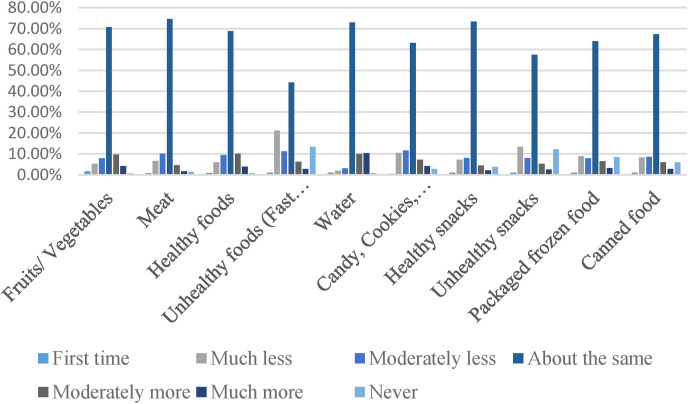
The Russian government took strong containment measures to prevent the spread of the severe acute respiratory syndrome coronavirus 2 (SARS-CoV-2) with rigid hygiene protocols and restrictions on daily living, such as social distancing and closing businesses and schools. While these measures were crucial to stop the diffusion of SARS-CoV-2, numerous voices highlighted their disorderly psychological, social, and economic impacts on food consumption behavior and lifestyle. Therefore, this paper aims to understand how consumers' food-related habits in Russia have shifted due to the COVID-19 pandemic and potential problems and opportunities this might bring for the Russian food system. The study is based on an online cross-sectional survey using a structured questionnaire administered in Russian through the Survey Monkey platform. A total of 1297 valid answers was collected. The results reveal that diet and food shopping, preparation, and use have been widely affected. Indeed, the survey results suggested (i) a change in the modality of acquiring food, consumers reduced the number of shopping trips and buying more on each trip to minimize store visits; (ii) a surge of stockpiling of non-perishable food items; (iii) a shift toward healthier diets; (iv) an increase in culinary capabilities; (v) a decrease of food waste. The results are expected to inform current emergency plans as well as long-term food-related strategies in Russia.
俄罗斯政府采取了严格的遏制措施来防止严重急性呼吸综合征冠状病毒 2(SARS-CoV-2)的传播,采取了严格的卫生协议和对日常生活的限制,例如社交距离和关闭企业和学校。虽然这些措施对于阻止 SARS-CoV-2 的扩散至关重要,但许多声音强调了它们对食品消费行为和生活方式在心理、社会和经济方面的无序影响。因此,本文旨在了解由于 COVID-19 大流行,俄罗斯消费者的食品相关习惯发生了怎样的变化,以及这可能给俄罗斯食品系统带来哪些潜在的问题和机遇。该研究基于一项在线横断面调查,使用俄语通过 Survey Monkey 平台进行结构化问卷。共收集到 1297 份有效答案。研究结果表明,饮食和食品购物、准备和使用受到了广泛影响。事实上,调查结果表明:(i)获取食物的方式发生了变化,消费者减少了购物次数,每次购物购买更多的商品,以减少去商店的次数;(ii)易腐食品的囤积量激增;(iii)转向更健康的饮食;(iv)烹饪能力提高;(v)减少食物浪费。研究结果有望为俄罗斯当前的紧急计划以及长期的食品相关战略提供信息。