Laboratorio de Química Orgánica y Farmacéutica, Departamento de Ciencias Farmacéuticas, Facultad de Farmacia, Universidad de Salamanca, Salamanca, Spain; Instituto de Investigación Biomédica de Salamanca (IBSAL), Facultad de Farmacia, Universidad de Salamanca, Salamanca, Spain; Centro de Investigación de Enfermedades Tropicales de la Universidad de Salamanca (CIETUS), Facultad de Farmacia, Universidad de Salamanca, Salamanca, Spain.
Laboratorio de Parasitología Molecular, Departamento de Biología Celular y Molecular, Centro de Investigaciones Biológicas Margarita Salas, Consejo Superior de Investigaciones Científicas, Madrid, Spain.
Int J Parasitol Drugs Drug Resist. 2021 Aug;16:45-64. doi: 10.1016/j.ijpddr.2021.02.006. Epub 2021 Mar 24.
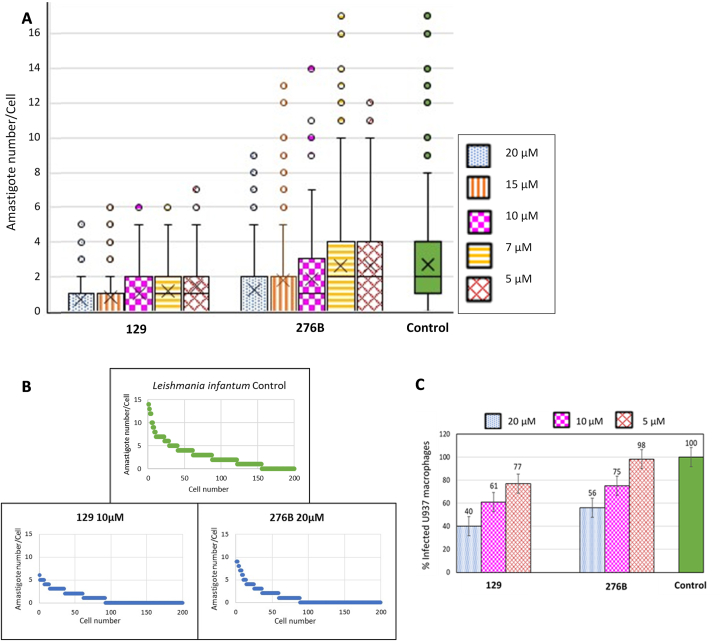
New drugs against visceral leishmaniasis with mechanisms of action differing from existing treatments and with adequate cost, stability, and properties are urgently needed. No antitubulin drug is currently in the clinic against Leishmania infantum, the causative agent of visceral leishmaniasis in the Mediterranean area. We have designed and synthesized a focused library of 350 compounds against the Leishmania tubulin based on the structure-activity relationship (SAR) and sequence differences between host and parasite. The compounds synthesized are accessible, stable, and appropriately soluble in water. We assayed the library against Leishmania promastigotes, axenic, and intracellular amastigotes and found 0, 8, and 16 active compounds, respectively, with a high success rate against intracellular amastigotes of over 10%, not including the cytotoxic compounds. Five compounds have a similar or better potency than the clinically used miltefosine. 14 compounds showed a host-dependent mechanism of action that might be advantageous as it may render them less susceptible to the development of drug resistance. The active compounds cluster in five chemical classes that provide structure-activity relationships for further hit improvement and facilitate series development. Molecular docking is consistent with the proposed mechanism of action, supported by the observed structure-activity relationships, and suggests a potential extension to other Leishmania species due to sequence similarities. A new family of diarylsulfonamides designed against the parasite tubulins is active against Leishmania infantum and represents a new class of potential drugs with favorable cost, stability, and aqueous solubility for the treatment of visceral leishmaniasis (VL). These results could be extended to other clinically relevant species of Leishmania spp.
urgently 需要开发具有不同于现有治疗方法的作用机制且价格合理、稳定性高、性质优良的新型抗内脏利什曼病药物。目前,尚无针对引起地中海地区内脏利什曼病的利什曼原虫的抗微管蛋白药物。我们根据宿主和寄生虫之间的结构-活性关系(SAR)和序列差异,针对利什曼原虫微管蛋白设计并合成了一个包含 350 个化合物的聚焦文库。合成的化合物易于获得、稳定且在水中具有适当的溶解度。我们对文库进行了利什曼原虫前鞭毛体、无细胞内鞭毛体和细胞内无鞭毛体的检测,发现分别有 0、8 和 16 个化合物具有活性,对超过 10%的细胞内无鞭毛体的成功率很高,不包括细胞毒性化合物。5 种化合物的效力与临床使用的米替福新相似或更好。14 种化合物具有宿主依赖性作用机制,这可能是有利的,因为它可能使它们不易产生耐药性。活性化合物集中在五个化学类别中,为进一步提高药效和促进系列开发提供了结构-活性关系。分子对接与所提出的作用机制一致,得到了观察到的结构-活性关系的支持,并由于序列相似性,提示该方法可能适用于其他利什曼原虫物种。针对寄生虫微管蛋白设计的一系列新型二芳基砜类化合物对利什曼原虫婴儿期有效,代表了一类新的潜在药物,具有良好的成本效益、稳定性和水溶解度,可用于治疗内脏利什曼病(VL)。这些结果可能适用于其他临床相关的利什曼原虫物种。