Department of Radiology, University of Washington, Seattle, WA, USA.
Department of Pharmacy, University of Washington, Seattle, WA, USA.
BMC Public Health. 2021 May 20;21(1):952. doi: 10.1186/s12889-021-10750-8.
Improving maternal health has been a primary goal of international health agencies for many years, with the aim of reducing maternal and child deaths and improving access to antenatal care (ANC) services, particularly in low-and-middle-income countries (LMICs). Health interventions with these aims have received more attention from a clinical effectiveness perspective than for cost impact and economic efficiency.
We collected data on resource use and costs as part of a large, multi-country study assessing the use of routine antenatal screening ultrasound (US) with the aim of considering the implications for economic efficiency. We assessed typical antenatal outpatient and hospital-based (facility) care for pregnant women, in general, with selective complication-related data collection in women participating in a large maternal health registry and clinical trial in five LMICs. We estimated average costs from a facility/health system perspective for outpatient and inpatient services. We converted all country-level currency cost estimates to 2015 United States dollars (USD). We compared average costs across countries for ANC visits, deliveries, higher-risk pregnancies, and complications, and conducted sensitivity analyses.
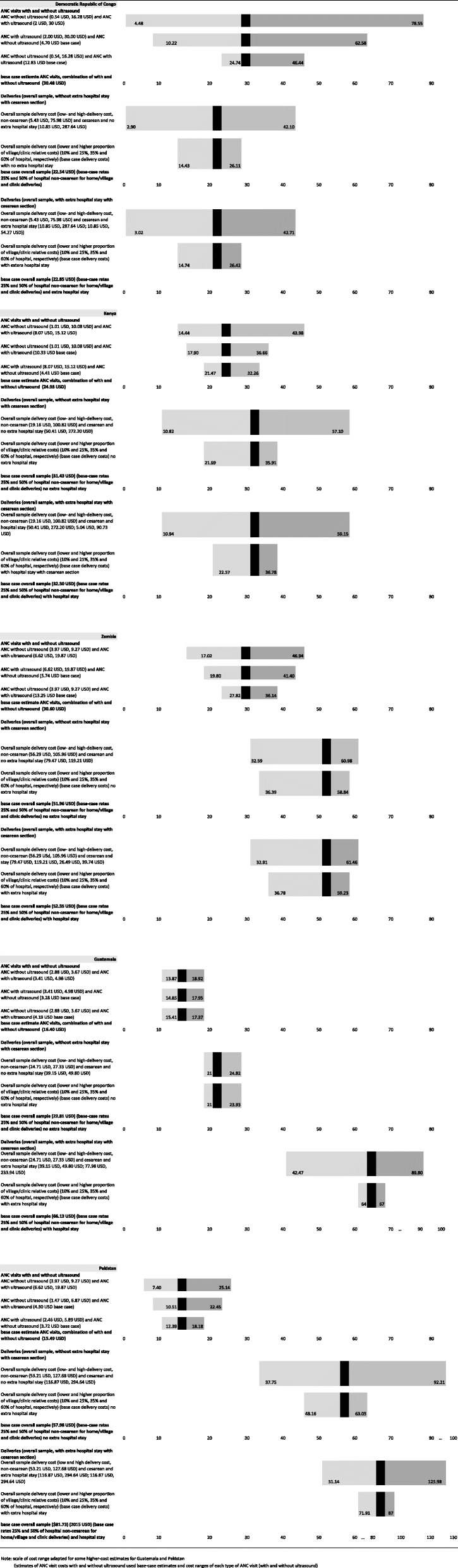
Our study included sites in five countries representing different regions. Overall, the relative cost of individual ANC and delivery-related healthcare use was consistent among countries, generally corresponding to country-specific income levels. ANC outpatient visit cost estimates per patient among countries ranged from 15 to 30 USD, based on average counts for visits with and without US. Estimates for antenatal screening US visits were more costly than non-US visits. Costs associated with higher-risk pregnancies were influenced by rates of hospital delivery by cesarean section (mean per person delivery cost estimate range: 25-65 USD).
Despite substantial differences among countries in infrastructures and health system capacity, there were similarities in resource allocation, delivery location, and country-level challenges. Overall, there was no clear suggestion that adding antenatal screening US would result in either major cost savings or major cost increases. However, antenatal screening US would have higher training and maintenance costs. Given the lack of clinical effectiveness evidence and greater resource constraints of LMICs, it is unlikely that introducing antenatal screening US would be economically efficient in these settings--on the demand side (i.e., patients) or supply side (i.e., healthcare providers).
Trial number: NCT01990625 (First posted: November 21, 2013 on https://clinicaltrials.gov ).
多年来,改善孕产妇健康一直是国际卫生机构的主要目标,旨在降低母婴死亡率并改善产前护理 (ANC) 服务的可及性,尤其是在中低收入国家 (LMIC)。从临床效果的角度来看,这些目标的健康干预措施受到了更多关注,而对成本影响和经济效率的关注则较少。
我们收集了资源利用和成本数据,作为评估常规产前超声筛查 (US) 应用的多国家研究的一部分,目的是考虑其对经济效率的影响。我们评估了一般情况下孕妇的常规门诊和医院 (机构) 护理,在五个 LMIC 中,针对参与大型孕产妇健康登记和临床试验的女性收集了选择性并发症相关数据。我们从机构/卫生系统的角度估计了门诊和住院服务的平均成本。我们将所有国家层面的货币成本估计值转换为 2015 年的美元 (USD)。我们比较了 ANC 就诊、分娩、高危妊娠和并发症的各国平均成本,并进行了敏感性分析。
我们的研究包括来自五个不同地区的国家的研究点。总体而言,单个 ANC 和分娩相关医疗保健使用的相对成本在各国之间保持一致,通常与特定国家的收入水平相对应。根据有和没有 US 的就诊的平均次数,各国 ANC 门诊就诊的每位患者的成本估计值在 15 至 30 美元之间。产前筛查 US 就诊的费用估计高于非 US 就诊。高危妊娠相关成本受剖宫产分娩率的影响 (人均分娩费用估计范围:25-65 美元)。
尽管各国在基础设施和卫生系统能力方面存在很大差异,但在资源分配、分娩地点和国家层面的挑战方面存在相似之处。总体而言,没有明显的迹象表明添加产前筛查 US 会导致成本大幅节省或增加。然而,产前筛查 US 会有更高的培训和维护成本。鉴于缺乏临床效果证据和 LMIC 的资源限制,在这些环境中引入产前筛查 US 不太可能具有经济效率——无论是从需求方 (即患者) 还是供应方 (即医疗保健提供者) 的角度来看。
试验编号:NCT01990625(首次发布:2013 年 11 月 21 日于 https://clinicaltrials.gov )。