Rashidi Hamidreza, Baulch Helen, Gill Arshdeep, Bharadwaj Lalita, Bradford Lori
School of Environment and Sustainability, University of Saskatchewan, Saskatoon, SK, Canada.
School of Public Health, University of Saskatchewan, Saskatoon, SK, Canada.
Environ Health Insights. 2021 May 5;15:11786302211014401. doi: 10.1177/11786302211014401. eCollection 2021.
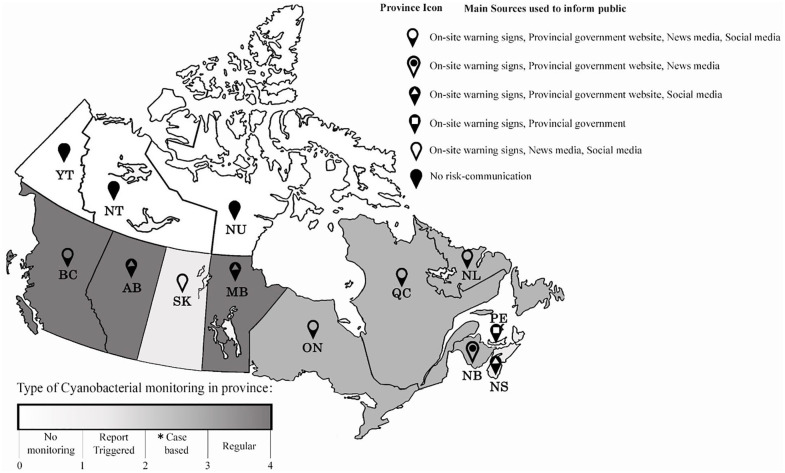
Globally, harmful algal blooms (HABs) are on the rise, as is evidence of their toxicity. The impacts associated with blooms, however, vary across Nation states, as do the strategies and protocols to assess, monitor, and manage their occurrence. In Canada, water quality guidelines are standardized nationally, but the management strategies for HABs are not. Here, we explore current strategies to understand how to better communicate risks associated with HABs to the public. Our team conducted an environmental scan on provincial and territorial government agency protocols around HABs. Results suggest that there are variations in the monitoring, managing, and communicating of risk to the public: British Columbia, Manitoba, New Brunswick, and Quebec have well-established inter-agency protocols, and most provinces report following federal guidelines for water quality. Notably, 3 northern territories have no HABs monitoring or management protocols in place. More populous provinces use a variety of information venues (websites, social media, on site postings, and radio) to communicate risks associated with HABs, whereas others' communications are limited. To induce more collaboration on HABs monitoring and management and reduce the associated risks, creating a coherent system with consistent messaging and inter-agency communication is suggested.
在全球范围内,有害藻华(HABs)正在增加,其毒性证据也在增加。然而,与藻华相关的影响在各个国家有所不同,评估、监测和管理藻华发生的策略和协议也是如此。在加拿大,水质指南在全国是标准化的,但有害藻华的管理策略并非如此。在此,我们探索当前的策略,以了解如何更好地向公众传达与有害藻华相关的风险。我们的团队对省级和地区政府机构关于有害藻华的协议进行了环境扫描。结果表明,在向公众监测、管理和传达风险方面存在差异:不列颠哥伦比亚省、马尼托巴省、新不伦瑞克省和魁北克省有完善的跨部门协议,大多数省份报告遵循联邦水质指南。值得注意的是,3个北部地区没有有害藻华监测或管理协议。人口较多的省份使用各种信息渠道(网站、社交媒体、现场张贴和广播)来传达与有害藻华相关的风险,而其他省份的沟通则有限。为了在有害藻华监测和管理方面促进更多合作并降低相关风险,建议创建一个具有一致信息和跨部门沟通的连贯系统。