Fragoulis George E, Soulaidopoulos Stergios, Sfikakis Petros P, Dimitroulas Theodoros, D Kitas George
Rheumatology Unit, Joint Rheumatology Program, Medical School, First Department of Propaedeutic Internal Medicine, National and Kapodistrian University of Athens, "Laiko" General Hospital, Athens, 115 27, Greece.
First Department of Cardiology, National and Kapodistrian University of Athens, Hippokration General Hospital, Athens, 115 27, Greece.
J Inflamm Res. 2021 May 14;14:1915-1931. doi: 10.2147/JIR.S282691. eCollection 2021.
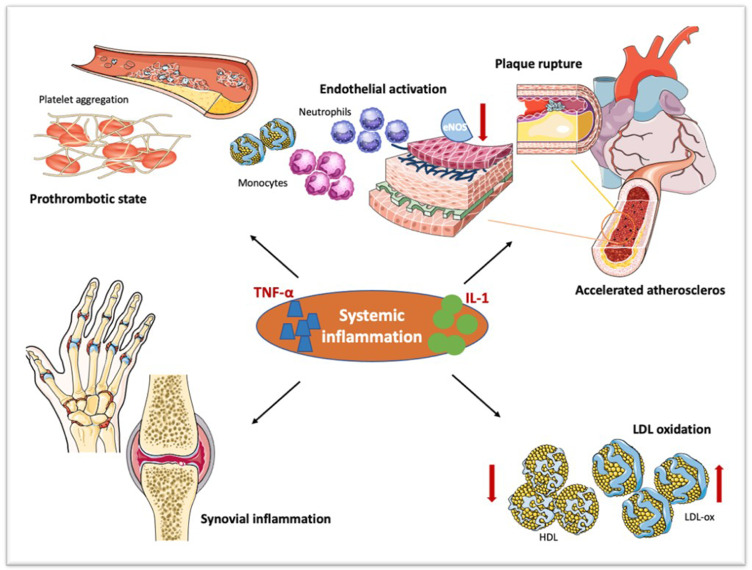
It is increasingly recognized that atherosclerosis and consequently cardiovascular disease (CVD) are closely linked with inflammatory processes. The latter is in the center of the pathogenic mechanism underlying autoimmune rheumatic diseases (ARD). It follows then, that optimal control of inflammation in ARDs may lead to a decrease of the accompanied CVD risk. Major trials (eg, CANTOS, CIRT), aimed at examining the possible benefits of immunomodulatory treatments in CVD, demonstrated conflicting results. On the other hand, substantial evidence is accumulating about the possible beneficial effects of biologic disease modifying antirheumatic drugs (bDMARDs) in patients with ARDs, particularly those with rheumatoid arthritis (RA). It seems that bDMARDs (some more than others) alter the lipid profile in RA patients but do not adversely affect, in most cases, the TC/HDL ratio. Favorable effects are noted for arterial stiffness and endothelial function. This is reflected in the lower risk for CVD events, seen in observational studies of RA patients treated with bDMARDs. It should be stressed that more data exist for the TNF-inhibitors than for other bDMARDs, such as tocilizumab, abatacept and rituximab. As regards the spondyloarthropathies (SpA), data are less robust. For TNF-inhibitors, effects appear to be on par with those seen in RA but no conclusions can be drawn for newer biologic drugs used in SpA (eg, IL-17 blockers). Finally, there is accumulating evidence for a beneficial effect of immunosuppressive treatment in cardiac inflammation and function in several ARDs. Introduction of newer therapeutic options in clinical practice seem to have a positive impact on CVD in the setting of ARD. This is probably due to better control of inflammation, but direct improvement in vascular pathology is also a valid hypothesis. Most data are derived from observational studies and, therefore, randomized controlled trials are needed to assess the possible favorable effect of bDMARDs on CVD outcomes.
人们越来越认识到,动脉粥样硬化以及随之而来的心血管疾病(CVD)与炎症过程密切相关。后者是自身免疫性风湿性疾病(ARD)潜在致病机制的核心。因此,最佳控制ARD中的炎症可能会降低伴随的CVD风险。旨在研究免疫调节治疗在CVD中可能益处的主要试验(如CANTOS、CIRT)结果相互矛盾。另一方面,越来越多的证据表明,生物性疾病改善抗风湿药物(bDMARDs)对ARD患者,尤其是类风湿关节炎(RA)患者可能具有有益作用。似乎bDMARDs(有些比其他的更明显)会改变RA患者的血脂谱,但在大多数情况下不会对总胆固醇/高密度脂蛋白比值产生不利影响。在动脉僵硬度和内皮功能方面有积极作用。这反映在用bDMARDs治疗的RA患者的观察性研究中,CVD事件风险较低。应该强调的是,关于肿瘤坏死因子(TNF)抑制剂的数据比其他bDMARDs(如托珠单抗、阿巴西普和利妥昔单抗)更多。至于脊柱关节炎(SpA),数据则不那么充分。对于TNF抑制剂,其效果似乎与在RA中观察到的效果相当,但对于用于SpA的新型生物药物(如白细胞介素-17阻滞剂)则无法得出结论。最后,越来越多的证据表明免疫抑制治疗对几种ARD的心脏炎症和功能有有益作用。在临床实践中引入更新的治疗选择似乎对ARD背景下的CVD有积极影响。这可能是由于炎症得到了更好的控制,但血管病理的直接改善也是一个合理的假设。大多数数据来自观察性研究,因此需要进行随机对照试验来评估bDMARDs对CVD结局可能的有利影响。