Al-Rawi Ziad S, Gorial Faiq I, Al-Bayati Anmar Abdulwahhab
Rheumatology Unit, Department of Medicine, Collage of Medicine, University of Baghdad, Iraq.
Baghdad Teaching Hospital, Rheumatology Unit, Baghdad, Iraq.
Mediterr J Rheumatol. 2018 Mar 19;29(1):38-42. doi: 10.31138/mjr.29.1.38. eCollection 2018 Mar.
Rheumatoid arthritis (RA) is a chronic systemic autoimmune inflammatory disease, which affects the joints and other body systems. Red cell distribution width (RDW) is a part of the complete blood count (CBC) test and estimates erythrocytic variability.
To evaluate RDW in RA and to assess the relationships of baseline demographic and clinical characteristics with RDW.
A total of 111 patients with RA diagnosed according to the 2010 American College of Rheumatology/European League Against Rheumatism (2010 ACR/EULAR) classification criteria for Rheumatoid arthritis) and compared with 97 healthy individuals matched in age and gender as controls. Age, gender, body mass index (BMI), clinical diseases activity index (CDAI) and diseases activity score 28 using erythrocyte sedimentation rate (ESR) (DAS28-ESR), and diseases durations were recorded. Rheumatoid Factor (RF), anti-citrullinated peptide antibody (ACPA), complete blood count (CBC) and ESR were all measured.
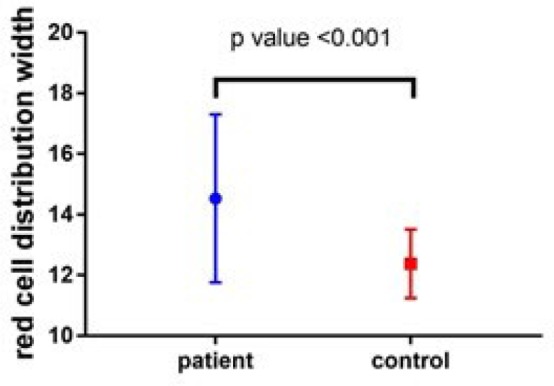
The mean age for patients and controls were 46.53 ± 11.89 and 48.19 ± 12.06 years respectively (p=0.321). RDW was significantly higher in patients (14.5 ± 2.8%) compared with controls (12.4 ± 1.1 %) (p=>0.001). There was no significant correlation between various variables (age, Body Mass Index [BMI], disease duration, CDAI), DAS28-ESR, ESR, gender, RF, and ACPA) with RDW. The RDW had good ability to differentiate RA patients from controls (AUC=0.804, 95% CI=0.744 - 0.856. p=<0.001), while ESR had excellent ability to differentiate between RA patients and controls (AUC=0.926, 95% CI=0.882 - 0.958, p<0.001).
RDW was significantly elevated in RA patients.
类风湿关节炎(RA)是一种慢性全身性自身免疫性炎症性疾病,会影响关节和身体其他系统。红细胞分布宽度(RDW)是全血细胞计数(CBC)检测的一部分,用于评估红细胞的变异性。
评估类风湿关节炎患者的红细胞分布宽度,并评估基线人口统计学和临床特征与红细胞分布宽度的关系。
根据2010年美国风湿病学会/欧洲抗风湿病联盟(2010 ACR/EULAR)类风湿关节炎分类标准诊断的111例类风湿关节炎患者,并与97名年龄和性别匹配的健康个体作为对照。记录年龄、性别、体重指数(BMI)、临床疾病活动指数(CDAI)以及使用红细胞沉降率(ESR)计算的疾病活动评分28(DAS28-ESR)和病程。检测类风湿因子(RF)、抗瓜氨酸化肽抗体(ACPA)、全血细胞计数(CBC)和ESR。
患者和对照组的平均年龄分别为46.53±11.89岁和48.19±12.06岁(p=0.321)。患者的红细胞分布宽度(14.5±2.8%)显著高于对照组(12.4±1.1%)(p<0.001)。各变量(年龄、体重指数[BMI]、病程、CDAI)、DAS28-ESR、ESR、性别、RF和ACPA)与红细胞分布宽度之间均无显著相关性。红细胞分布宽度具有较好的区分类风湿关节炎患者和对照组的能力(AUC=0.804,95%CI=0.744-0.856,p<0.001),而ESR具有出色的区分类风湿关节炎患者和对照组的能力(AUC=0.926,95%CI=0.882-0.958,p<0.001)。
类风湿关节炎患者的红细胞分布宽度显著升高。