Arctic seasonal timekeeping initiative (ASTI), Department of Arctic and Marine Biology, UiT - The Arctic University of Norway, Tromsø, Norway.
Unit of Animal Genomics, GIGA Institute, University of Liège, Liège, Belgium.
Front Immunol. 2021 May 4;12:669889. doi: 10.3389/fimmu.2021.669889. eCollection 2021.
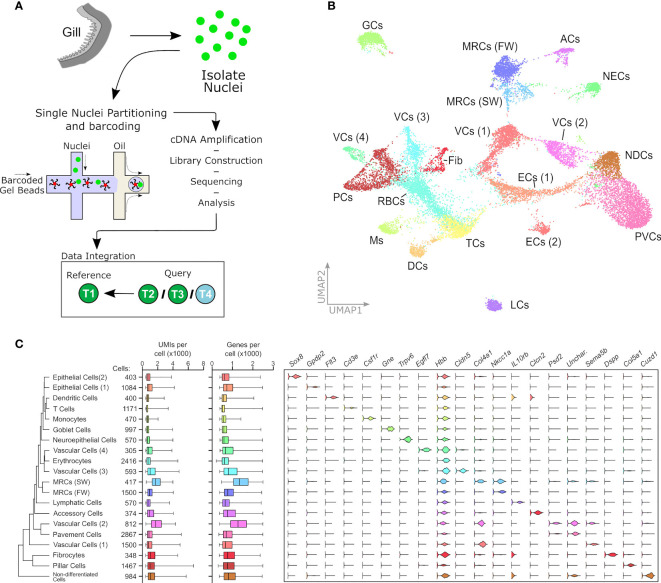
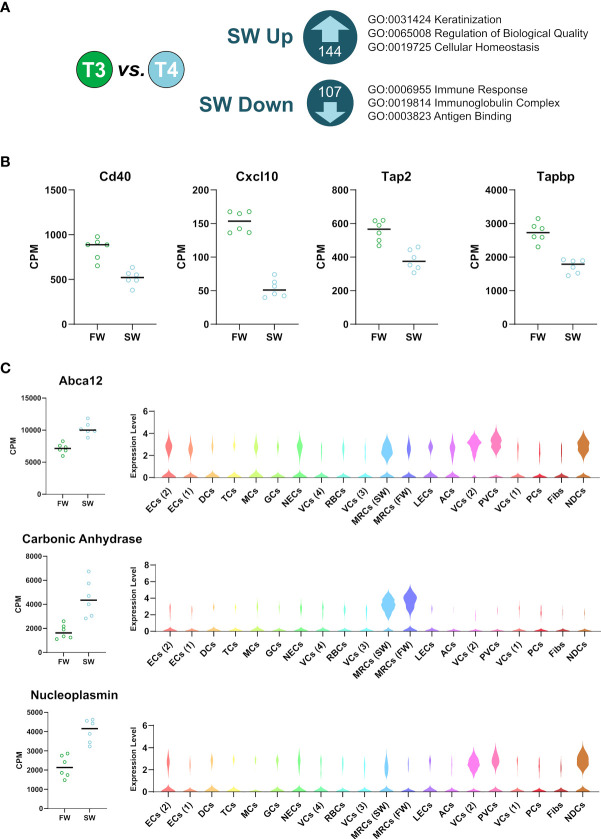
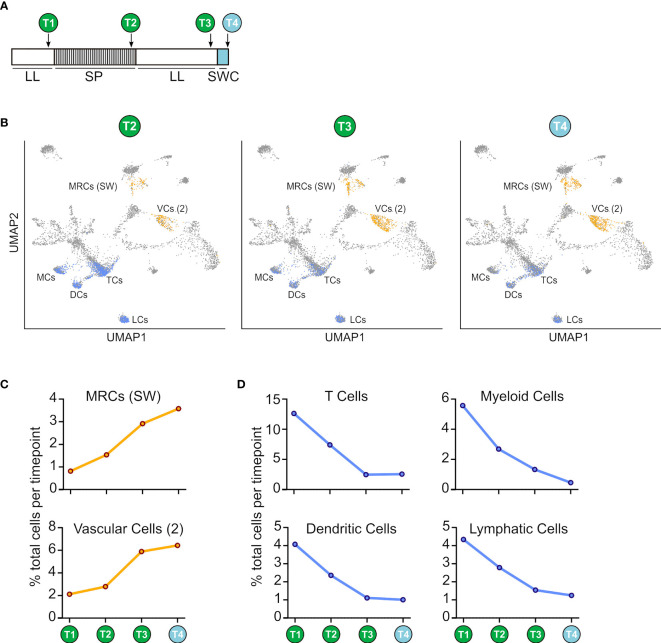
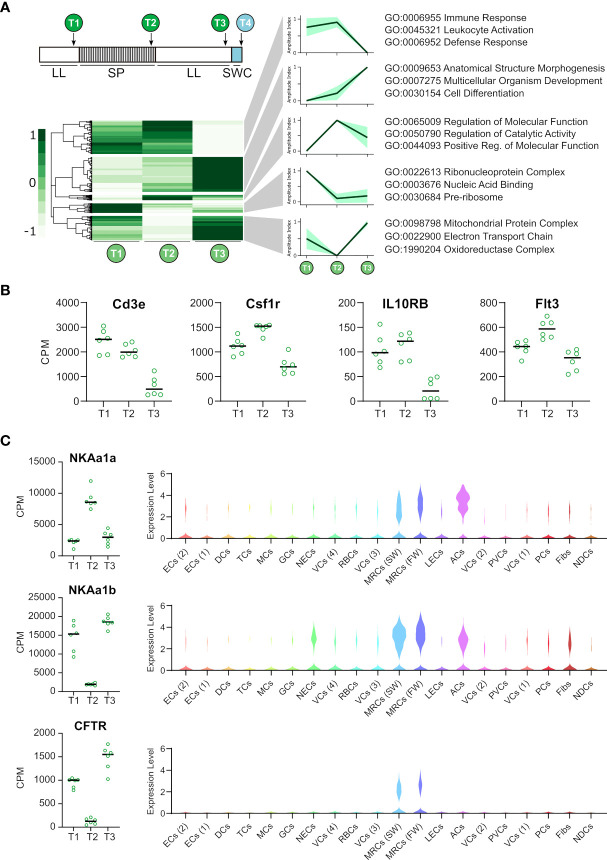
Anadromous salmonids begin life adapted to the freshwater environments of their natal streams before a developmental transition, known as smoltification, transforms them into marine-adapted fish. In the wild, smoltification is a photoperiod-regulated process, involving radical remodeling of gill function to cope with the profound osmotic and immunological challenges of seawater (SW) migration. While prior work has highlighted the role of specialized "mitochondrion-rich" cells (MRCs) and accessory cells (ACs) in delivering this phenotype, recent RNA profiling experiments suggest that remodeling is far more extensive than previously appreciated. Here, we use single-nuclei RNAseq to characterize the extent of cytological changes in the gill of Atlantic salmon during smoltification and SW transfer. We identify 20 distinct cell clusters, including known, but also novel gill cell types. These data allow us to isolate cluster-specific, smoltification-associated changes in gene expression and to describe how the cellular make-up of the gill changes through smoltification. As expected, we noted an increase in the proportion of seawater mitochondrion-rich cells, however, we also identify previously unknown reduction of several immune-related cell types. Overall, our results provide fresh detail of the cellular complexity in the gill and suggest that smoltification triggers unexpected immune reprogramming.
溯河洄游性鲑鱼在发育转变(称为变态)之前,一生都适应其出生地溪流的淡水环境,该转变将它们变成适应海洋的鱼类。在野外,变态是一个光周期调节的过程,涉及到鳃功能的彻底重塑,以应对海水(SW)迁移带来的巨大渗透和免疫挑战。虽然之前的工作强调了专门的“富含线粒体”细胞(MRCs)和辅助细胞(ACs)在实现这种表型中的作用,但最近的 RNA 分析实验表明,重塑的范围远比以前认为的要广泛得多。在这里,我们使用单核 RNAseq 来描述大西洋鲑在变态和 SW 转移过程中鳃的细胞学变化程度。我们确定了 20 个不同的细胞簇,包括已知的,但也有新的鳃细胞类型。这些数据使我们能够分离出与变态相关的簇特异性基因表达变化,并描述鳃的细胞组成如何通过变态发生变化。正如预期的那样,我们注意到海生富含线粒体细胞的比例增加,但是,我们也发现了几种以前未知的免疫相关细胞类型的减少。总的来说,我们的结果提供了鳃细胞复杂性的新细节,并表明变态触发了意想不到的免疫重编程。