Lorgen-Ritchie Marlene, Uren Webster Tamsyn, McMurtrie Jamie, Bass David, Tyler Charles R, Rowley Andrew, Martin Samuel A M
School of Biological Sciences, University of Aberdeen, Aberdeen, United Kingdom.
Centre for Sustainable Aquatic Research, Swansea University, Swansea, United Kingdom.
Front Microbiol. 2023 Jun 23;14:1200997. doi: 10.3389/fmicb.2023.1200997. eCollection 2023.
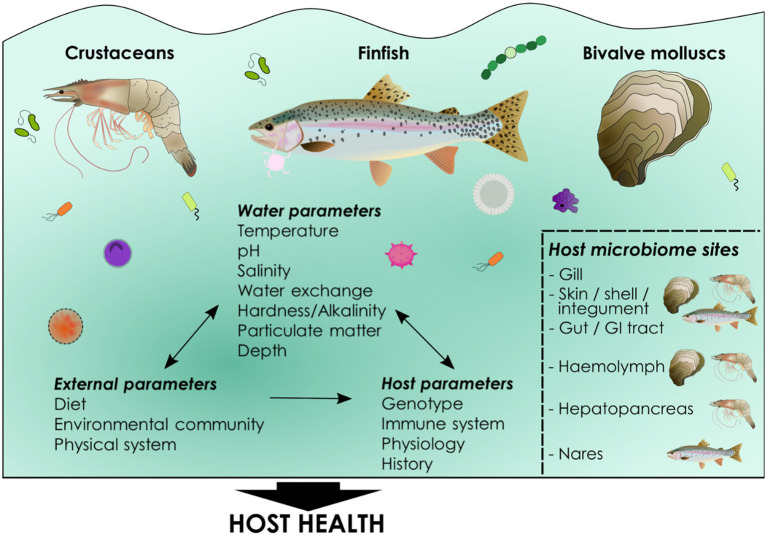
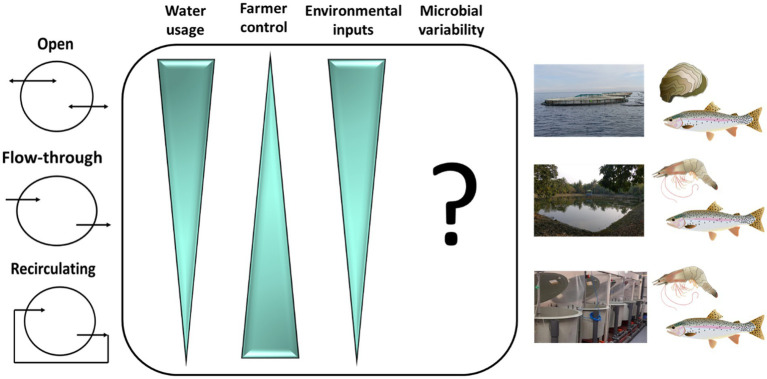
With an ever-growing human population, the need for sustainable production of nutritional food sources has never been greater. Aquaculture is a key industry engaged in active development to increase production in line with this need while remaining sustainable in terms of environmental impact and promoting good welfare and health in farmed species. Microbiomes fundamentally underpin animal health, being a key part of their digestive, metabolic and defense systems, in the latter case protecting against opportunistic pathogens in the environment. The potential to manipulate the microbiome to the advantage of enhancing health, welfare and production is an intriguing prospect that has gained considerable traction in recent years. In this review we first set out what is known about the role of the microbiome in aquaculture production systems across the phylogenetic spectrum of cultured animals, from invertebrates to finfish. With a view to reducing environmental footprint and tightening biological and physical control, investment in "closed" aquaculture systems is on the rise, but little is known about how the microbial systems of these closed systems affect the health of cultured organisms. Through comparisons of the microbiomes and their dynamics across phylogenetically distinct animals and different aquaculture systems, we focus on microbial communities in terms of their functionality in order to identify what features within these microbiomes need to be harnessed for optimizing healthy intensified production in support of a sustainable future for aquaculture.
随着人口的不断增长,对可持续生产营养食物来源的需求从未如此迫切。水产养殖是一个积极发展的关键产业,旨在根据这一需求增加产量,同时在环境影响方面保持可持续性,并促进养殖物种的良好福利和健康。微生物群是动物健康的根本支撑,是其消化、代谢和防御系统的关键部分,在后一种情况下可抵御环境中的机会性病原体。操纵微生物群以促进健康、福利和生产的潜力是一个引人入胜的前景,近年来已获得相当大的关注。在本综述中,我们首先阐述了关于微生物群在从无脊椎动物到有鳍鱼类等养殖动物系统发育谱中的水产养殖生产系统中的作用的已知情况。为了减少环境足迹并加强生物和物理控制,对“封闭”水产养殖系统的投资正在增加,但对于这些封闭系统的微生物系统如何影响养殖生物的健康却知之甚少。通过比较系统发育上不同的动物和不同水产养殖系统中的微生物群及其动态,我们从功能角度关注微生物群落,以便确定这些微生物群中的哪些特征需要加以利用,以优化健康的集约化生产,支持水产养殖的可持续未来。