Department of Orthopedics, Second Hospital of Jilin University, 218 Ziqiang Street, Changchun, Jilin, People's Republic of China.
School of Microelectronics, Wuhan University, Wuhan, Hubei, People's Republic of China.
J Orthop Surg Res. 2021 May 21;16(1):332. doi: 10.1186/s13018-021-02476-5.
This study aimed to predict C5 palsy (C5P) after posterior laminectomy and fusion (PLF) with cervical myelopathy (CM) from routinely available variables using a support vector machine (SVM) method.
We conducted a retrospective investigation based on 184 consecutive patients with CM after PLF, and data were collected from March 2013 to December 2019. Clinical and imaging variables were obtained and imported into univariable and multivariable logistic regression analyses to identify risk factors for C5P. According to published reports and clinical experience, a series of variables was selected to develop an SVM machine learning model to predict C5P. The accuracy (ACC), area under the receiver operating characteristic curve (AUC), and confusion matrices were used to evaluate the performance of the prediction model.
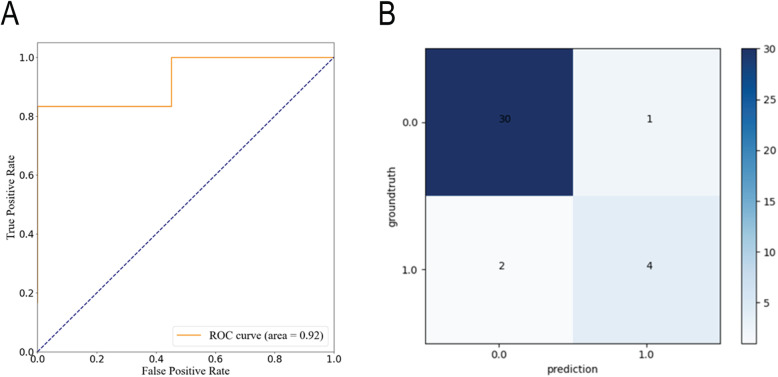
Among the 184 consecutive patients, C5P occurred in 26 patients (14.13%). Multivariate analyses demonstrated the following 4 independent factors associated with C5P: abnormal electromyogram (odds ratio [OR] = 7.861), JOA recovery rate (OR = 1.412), modified Pavlov ratio (OR = 0.009), and presence of C4-C5 foraminal stenosis (OR = 15.492). The SVM model achieved an area under the receiver operating characteristic curve (AUC) of 0.923 and an ACC of 0.918. Additionally, the confusion matrix showed the classification results of the discriminant analysis.
The designed SVM model presented satisfactory performance in predicting C5P from routinely available variables. However, future external validation is needed.
本研究旨在使用支持向量机(SVM)方法,通过常规变量预测伴有颈椎病的后路椎板切除融合术后发生 C5 神经麻痹(C5P)的风险。
我们对 184 例后路椎板切除融合术后伴有颈椎病的连续患者进行了回顾性研究,数据收集时间为 2013 年 3 月至 2019 年 12 月。获取了临床和影像学变量,并将其导入单变量和多变量逻辑回归分析中,以确定 C5P 的危险因素。根据已发表的报告和临床经验,选择了一系列变量来开发 SVM 机器学习模型,以预测 C5P。采用准确性(ACC)、受试者工作特征曲线下面积(AUC)和混淆矩阵来评估预测模型的性能。
在 184 例连续患者中,有 26 例(14.13%)发生 C5P。多变量分析表明,以下 4 个独立因素与 C5P 相关:肌电图异常(比值比 [OR] = 7.861)、JOA 恢复率(OR = 1.412)、改良 Pavlov 比值(OR = 0.009)和 C4-C5 椎间孔狭窄(OR = 15.492)。SVM 模型的受试者工作特征曲线下面积(AUC)为 0.923,准确性(ACC)为 0.918。此外,混淆矩阵显示了判别分析的分类结果。
所设计的 SVM 模型在预测伴有颈椎病的后路椎板切除融合术后发生 C5P 方面表现出了令人满意的性能,但需要进一步进行外部验证。