Department of Orthopaedic Surgery, Affiliated Hospital of Xuzhou Medical University, 99 Huaihai Road, Xuzhou, 221006, Jiangsu, China.
Xuzhou Medical University, 209 Tongshan Road, Xuzhou, 221004, Jiangsu, China.
J Orthop Surg Res. 2023 Jan 23;18(1):62. doi: 10.1186/s13018-023-03551-9.
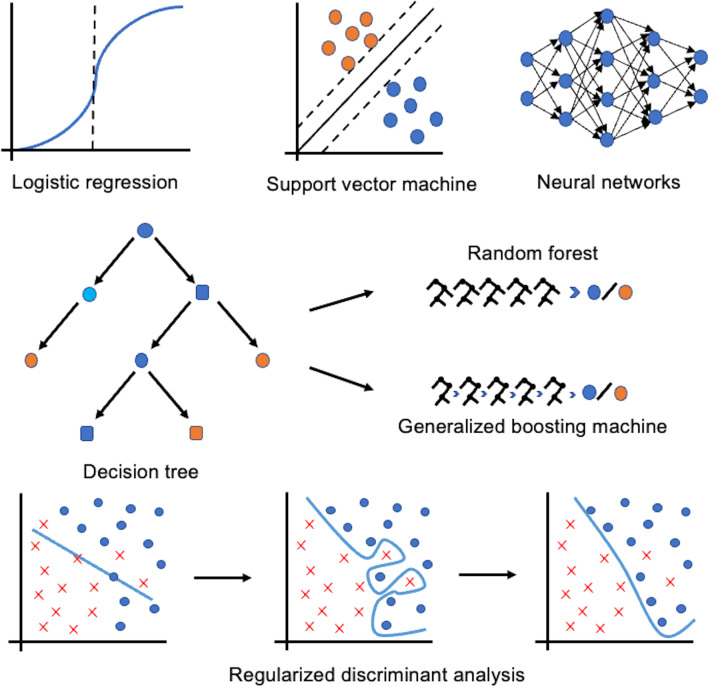
The use of machine learning has the potential to estimate the probability of a second classification event more accurately than traditional statistical methods, and few previous studies on predicting new fractures after osteoporotic vertebral compression fractures (OVCFs) have focussed on this point. The aim of this study was to explore whether several different machine learning models could produce better predictions than logistic regression models and to select an optimal model.
A retrospective analysis of 529 patients who underwent percutaneous kyphoplasty (PKP) for OVCFs at our institution between June 2017 and June 2020 was performed. The patient data were used to create machine learning (including decision trees (DT), random forests (RF), support vector machines (SVM), gradient boosting machines (GBM), neural networks (NNET), and regularized discriminant analysis (RDA)) and logistic regression models (LR) to estimate the probability of new fractures occurring after surgery. The dataset was divided into a training set (75%) and a test set (25%), and machine learning models were built in the training set after ten cross-validations, after which each model was evaluated in the test set, and model performance was assessed by comparing the area under the curve (AUC) of each model.
Among the six machine learning algorithms, except that the AUC of DT [0.775 (95% CI 0.728-0.822)] was lower than that of LR [0.831 (95% CI 0.783-0.878)], RA [0.953 (95% CI 0.927-0.980)], GBM [0.941 (95% CI 0.911-0.971)], SVM [0.869 (95% CI 0.827-0.910), NNET [0.869 (95% CI 0.826-0.912)], and RDA [0.890 (95% CI 0.851-0.929)] were all better than LR.
For prediction of the probability of new fracture after PKP, machine learning algorithms outperformed logistic regression, with random forest having the strongest predictive power.
机器学习在估计第二类事件的概率方面比传统统计方法更具潜力,之前很少有研究关注预测骨质疏松性椎体压缩性骨折(OVCF)后新骨折的问题。本研究旨在探讨几种不同的机器学习模型是否能比逻辑回归模型产生更好的预测结果,并选择最佳模型。
对 2017 年 6 月至 2020 年 6 月在我院接受经皮椎体后凸成形术(PKP)治疗的 529 例 OVCF 患者进行回顾性分析。利用患者数据建立机器学习(包括决策树(DT)、随机森林(RF)、支持向量机(SVM)、梯度提升机(GBM)、神经网络(NNET)和正则判别分析(RDA))和逻辑回归模型(LR),以预测术后新骨折发生的概率。数据集分为训练集(75%)和测试集(25%),在进行了十次交叉验证后,在训练集上构建机器学习模型,然后在测试集上评估每个模型,通过比较每个模型的曲线下面积(AUC)来评估模型性能。
在六种机器学习算法中,除了决策树的 AUC[0.775(95%CI 0.728-0.822)]低于逻辑回归[0.831(95%CI 0.783-0.878)]、随机森林[0.953(95%CI 0.927-0.980)]、GBM[0.941(95%CI 0.911-0.971)]、SVM[0.869(95%CI 0.827-0.910)]、神经网络[0.869(95%CI 0.826-0.912)]和正则判别分析[0.890(95%CI 0.851-0.929)]外,其他算法均优于逻辑回归。
对于预测 PKP 后新骨折的概率,机器学习算法优于逻辑回归,随机森林具有最强的预测能力。