Department of Dental Public Health, College & Hospital of Stomatology of Guangxi Medical University, Nanning, China.
Department of Epidemiology & Public Health, University College London, London, UK.
BMJ Open. 2021 May 21;11(5):e042908. doi: 10.1136/bmjopen-2020-042908.
Socioeconomic inequalities in oral health are often neglected in oral health promotion. This cross-sectional study assessed the association between dental caries and socioeconomic status (SES) among preschool children in China.
Cross-sectional study.
Data from the Fourth National Oral Health Survey of China (2015), comprising of 40 360 children aged 3-5 years was used.
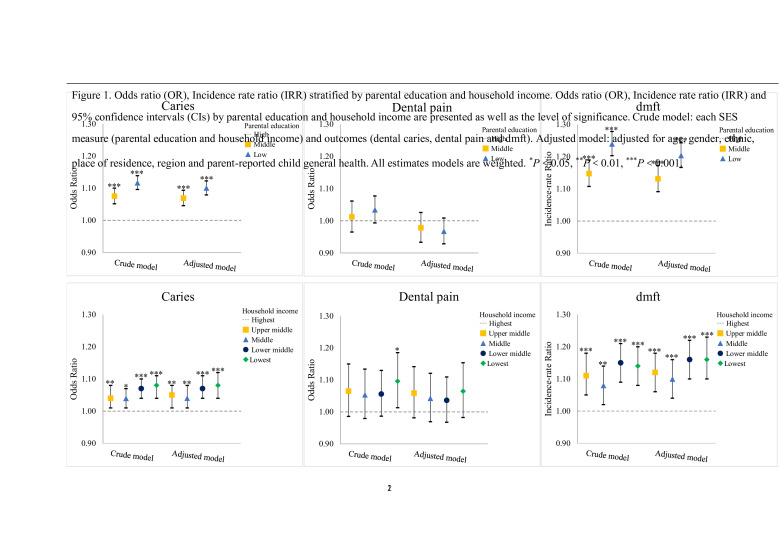
Dental caries indicators including prevalence of dental caries, dental pain experience and number of decayed, missing and filling teeth (dmft). SES indicators included parental education and household income. The associations between SES and dental caries were analysed by using negative binomial regression or Poisson regression models according to data distribution. Relative and absolute inequalities in dental caries were quantified by using the Relative Index of Inequality (RII) and Slope Index of Inequality (SII), respectively.
There were significant associations between SES and prevalence of dental caries and dmft (p<0.001). Children from lower educated (RII 1.36, 95% CI 1.3 to 1.43; SII 0.97, 95% CI 0.81 to 1.13) and lower household income (RII 1.17, 95% CI 1.11 to 1.24; SII 0.55, 95% CI 0.35 to 0.75) families had higher dmft than those from well-educated and most affluent families. Relative and absolute inequalities in dental caries were larger in urban areas by household income, and in rural areas by parental education.
Association between dental caries and SES was demonstrated and socioeconomic inequalities in dental caries existed among Chinese preschool children.
社会经济不平等在口腔健康促进中经常被忽视。本横断面研究评估了中国学龄前儿童龋齿与社会经济地位(SES)之间的关系。
横断面研究。
本研究使用了中国第四次全国口腔健康调查(2015 年)的数据,包括 40360 名 3-5 岁儿童。
龋齿指标包括龋齿患病率、牙痛经历和龋齿、缺失和补牙数(dmft)。SES 指标包括父母教育程度和家庭收入。根据数据分布,采用负二项回归或泊松回归模型分析 SES 与龋齿之间的关系。相对和绝对龋齿不平等分别用相对不平等指数(RII)和斜率不平等指数(SII)来量化。
SES 与龋齿患病率和 dmft 显著相关(p<0.001)。受教育程度较低(RII 1.36,95%CI 1.3 至 1.43;SII 0.97,95%CI 0.81 至 1.13)和家庭收入较低(RII 1.17,95%CI 1.11 至 1.24;SII 0.55,95%CI 0.35 至 0.75)的儿童 dmft 高于受教育程度较高和最富裕家庭的儿童。按家庭收入划分,城乡地区的龋齿相对和绝对不平等较大;按父母教育程度划分,农村地区的龋齿相对和绝对不平等较大。
证明了龋齿与 SES 之间存在关联,中国学龄前儿童的龋齿存在社会经济不平等。