Department of Pediatrics, Yonsei University College of Medicine, 211 Eonjuro Gangnamgu, Seoul, 06273, Republic of Korea.
Sci Rep. 2021 May 21;11(1):10689. doi: 10.1038/s41598-021-89868-z.
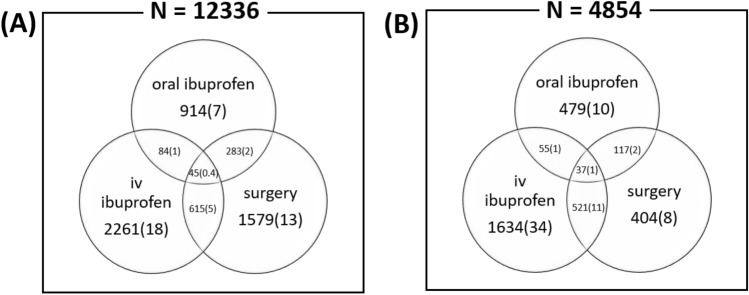
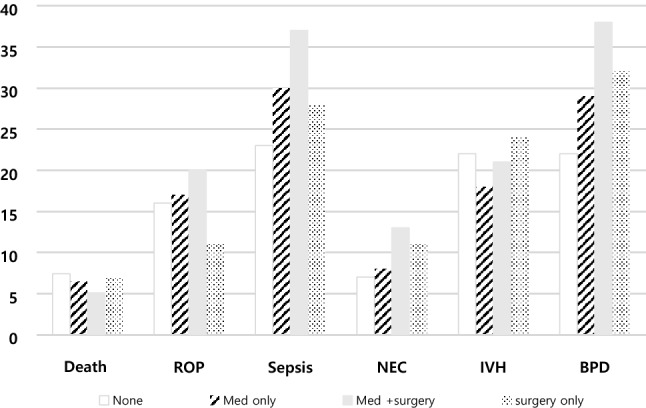
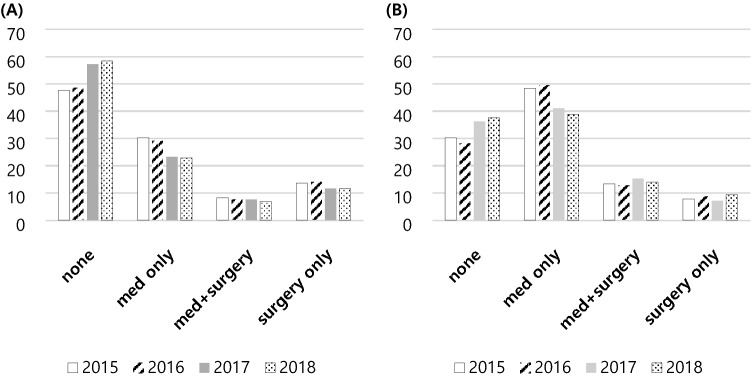
To evaluate national epidemiologic data on infants treated for patent ductus arteriosus (PDA) in Korea and analyze outcomes associated with different PDA treatments. We retrospectively evaluated data on 12,336 patients diagnosed with PDA (International Classification of Diseases-10 code: Q250) between 2015 and 2018 from the Health Insurance Review and Assessment database. Among them, 1623 patients underwent surgical ligation (code: O1671). We used birth certificate data from Statistics Korea to estimate the prevalence, diagnosis, and treatment of PDA. The prevalence of infants with PDA was 81 infants per 10,000 live births and 45.2% in very low birth weight (VLBW) infants, which increased from 2015 to 2018. PDA ligation was performed in 2571 infants and 22% VLBW infants. Medical treatment was administered to 4202 infants, which decreased significantly, especially in VLBW infants (62% to 53%). The proportion of treatment was as follows: conservative treatment (53.1%), intravenous ibuprofen (24.4%), surgery (20.4%), and oral ibuprofen (10.7%); that among 4854 VLBW infants was as follows: intravenous ibuprofen (46.3%), conservative treatment (33.2%), surgery (22.2%), and oral ibuprofen (14.2%). Surgical treatment had a significantly higher risk (odds ratio 1.36) of mortality than conservative treatment. Surgical and/or medical treatments were associated with a higher risk of morbidity. Recently, increased use of conservative management of PDA has contributed to improved neonatal outcomes in VLBW infants. Select patients may still benefit from surgical ligation following careful consideration.
评估韩国患有动脉导管未闭(PDA)的婴儿的国家流行病学数据,并分析不同 PDA 治疗方法的结果。
我们回顾性地评估了 2015 年至 2018 年期间,来自健康保险审查与评估数据库中 12336 名患有 PDA(国际疾病分类第 10 版编码:Q250)的患者的数据。其中 1623 名患者接受了手术结扎(编码:O1671)。我们使用韩国统计厅的出生证明数据来估计 PDA 的患病率、诊断和治疗情况。患有 PDA 的婴儿患病率为每 10000 例活产婴儿中有 81 例,极低出生体重(VLBW)婴儿中的患病率为 45.2%,从 2015 年到 2018 年呈上升趋势。PDA 结扎术在 2571 名婴儿和 22%的 VLBW 婴儿中进行。4202 名婴儿接受了药物治疗,尤其是 VLBW 婴儿,接受药物治疗的比例显著下降(62%降至 53%)。治疗方法如下:保守治疗(53.1%)、静脉注射布洛芬(24.4%)、手术(20.4%)和口服布洛芬(10.7%);4854 名 VLBW 婴儿的治疗方法如下:静脉注射布洛芬(46.3%)、保守治疗(33.2%)、手术(22.2%)和口服布洛芬(14.2%)。与保守治疗相比,手术治疗的死亡率风险显著更高(优势比 1.36)。手术和/或药物治疗与发病率升高相关。最近,对 VLBW 婴儿 PDA 保守治疗的应用增加,导致新生儿结局改善。在仔细考虑后,一些患者可能仍受益于手术结扎。