Liu Qi, Sterck Frank J, Zhang Jiao-Lin, Scheire Arne, Konings Evelien, Cao Min, Sha Li-Qing, Poorter Lourens
Forest Ecology and Forest Management Group, Wageningen University and Research, P.O. Box 47, 6700 AA, Wageningen, The Netherlands.
CAS Key Laboratory of Tropical Forest Ecology, Xishuangbanna Tropical Botanical Garden, Chinese Academy of Sciences, Yunnan, 666303, China.
Oecologia. 2021 Jun;196(2):499-514. doi: 10.1007/s00442-021-04937-4. Epub 2021 May 23.
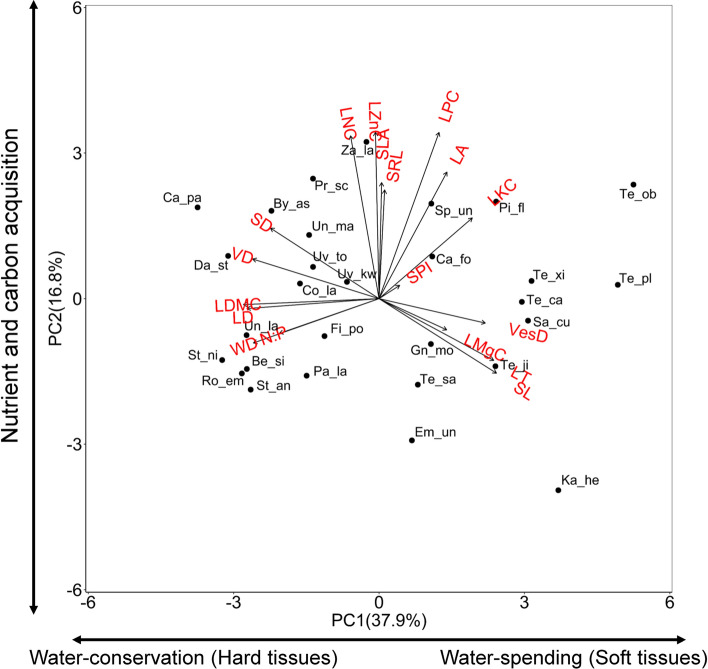
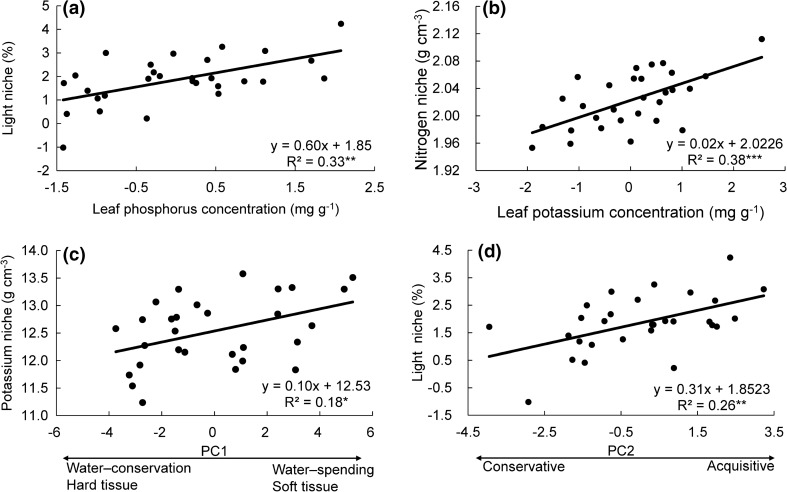
Plant functional traits and strategies hold the promise to explain species distribution, but few studies have linked multiple traits to multiple niche dimensions (i.e., light, water, and nutrients). Here, we analyzed for 29 liana species in a Chinese tropical seasonal rainforest how: (1) trait associations and trade-offs lead to different plant strategies; and (2) how these traits shape species' niche dimensions. Eighteen functional traits related to light, water, and nutrient use were measured and species niche dimensions were quantified using species distribution in a 20-ha plot combined with data on canopy gaps, topographic water availability, and soil nutrients. We found a tissue toughness spectrum ranging from soft to hard tissues along which species also varied from acquisitive to conservative water use, and a resource acquisition spectrum ranging from low to high light capture and nutrient use. Intriguingly, each spectrum partly reflected the conservative-acquisitive paradigm, but at the same time, the tissue toughness and the resource acquisition spectrum were uncoupled. Resource niche dimensions were better predicted by individual traits than by multivariate plant strategies. This suggests that trait components that underlie multivariate strategy axes, rather than the plant strategies themselves determine species distributions. Different traits were important for different niche dimensions. In conclusion, plant functional traits and strategies can indeed explain species distributions, but not in a simple and straight forward way. Although the identification of global plant strategies has significantly advanced the field, this research shows that global, multivariate generalizations are difficult to translate to local conditions, as different components of these strategies are important under different local conditions.
植物功能性状和策略有望解释物种分布,但很少有研究将多个性状与多个生态位维度(即光照、水分和养分)联系起来。在这里,我们分析了中国热带季节性雨林中的29种藤本植物:(1)性状关联和权衡如何导致不同的植物策略;(2)这些性状如何塑造物种的生态位维度。测量了与光照、水分和养分利用相关的18个功能性状,并结合20公顷样地中的物种分布、林冠间隙数据、地形水分可利用性和土壤养分数据对物种生态位维度进行了量化。我们发现了一个从软组织到硬组织的组织韧性谱,沿着这个谱,物种在水分利用上也从获取型到保守型变化,还有一个从低到高的光捕获和养分利用的资源获取谱。有趣的是,每个谱都部分反映了保守-获取范式,但同时,组织韧性和资源获取谱是不相关的。与多变量植物策略相比,个体性状能更好地预测资源生态位维度。这表明构成多变量策略轴基础的性状组成部分,而非植物策略本身决定了物种分布。不同的性状对不同的生态位维度很重要。总之,植物功能性状和策略确实可以解释物种分布,但并非以一种简单直接的方式。尽管全球植物策略的识别显著推动了该领域的发展,但这项研究表明,全球的多变量概括很难转化为当地情况,因为这些策略的不同组成部分在不同的当地条件下很重要。