Department of Medical Laboratory Sciences, Faculty of Allied Health Sciences, The Hashemite University, Zarqa, 13133, Jordan.
Department of Pharmacy, Alzaytoonah University of Jordan, Amman, Jordan.
Mol Biol Rep. 2021 May;48(5):4667-4675. doi: 10.1007/s11033-021-06390-1. Epub 2021 May 22.
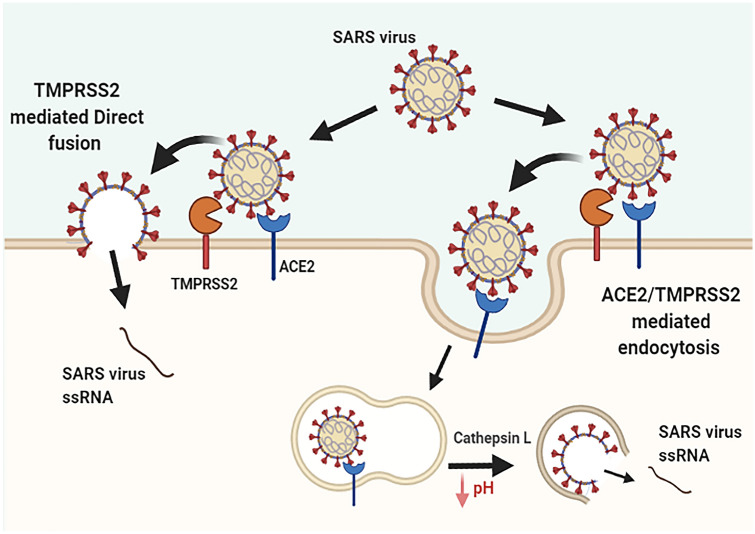
The transmembrane protease serine 2 (TMPRSS2) is a membrane anchored protease that primarily expressed by epithelial cells of respiratory and gastrointestinal systems and has been linked to multiple pathological processes in humans including tumor growth, metastasis and viral infections. Recent studies have shown that TMPRSS2 expressed on cell surface of host cells could play a crucial role in activation of severe acute respiratory syndrome coronavirus 2 (SARS-CoV-2) spike protein which facilitates the rapid early entry of the virus into host cells. In addition, direct suppression of TMPRSS2 using small drug inhibitors has been demonstrated to be effective in decreasing SARS-CoV-2 infection in vitro, which presents TMPRSS2 protease as a potential therapeutic strategy for SARS-CoV-2 infection. Recently, SARS-CoV-2 has been shown to be capable of infecting gastrointestinal enterocytes and to provoke gastrointestinal disorders in patients with COVID-19 disease, which is considered as a new transmission route and target organ of SARS-CoV-2. In this review, we highlight the biochemical properties of TMPRSS2 protease and discuss the potential targeting of TMPRSS2 by inhibitors to prevent the SARS-CoV-2 spreading through gastro-intestinal tract system as well as the hurdles that need to be overcome.
跨膜丝氨酸蛋白酶 2(TMPRSS2)是一种膜锚定蛋白酶,主要表达于呼吸系统和消化系统的上皮细胞,与人类的多种病理过程有关,包括肿瘤生长、转移和病毒感染。最近的研究表明,宿主细胞表面表达的 TMPRSS2 在严重急性呼吸综合征冠状病毒 2(SARS-CoV-2)刺突蛋白的激活中起着至关重要的作用,这有助于病毒快速早期进入宿主细胞。此外,使用小分子药物抑制剂直接抑制 TMPRSS2 已被证明可有效减少 SARS-CoV-2 在体外的感染,这表明 TMPRSS2 蛋白酶是 SARS-CoV-2 感染的潜在治疗策略。最近的研究表明,SARS-CoV-2 能够感染胃肠道肠细胞,并在 COVID-19 患者中引发胃肠道疾病,这被认为是 SARS-CoV-2 的新传播途径和靶器官。在这篇综述中,我们强调了 TMPRSS2 蛋白酶的生化特性,并讨论了抑制剂靶向 TMPRSS2 以阻止 SARS-CoV-2 通过胃肠道系统传播的潜力,以及需要克服的障碍。