Hugh Sinclair Unit of Human Nutrition, University of Reading, Reading, UK.
Population, Policy and Practice, UCL Institute of Child Health, London, UK.
Int J Obes (Lond). 2021 Aug;45(8):1751-1762. doi: 10.1038/s41366-021-00841-2. Epub 2021 May 24.
High milk intake has been associated with cardio-metabolic risk. We conducted a Mendelian Randomization (MR) study to obtain evidence for the causal relationship between milk consumption and cardio-metabolic traits using the lactase persistence (LCT-13910 C > T, rs4988235) variant as an instrumental variable.
We tested the association of LCT genotype with milk consumption (for validation) and with cardio-metabolic traits (for a possible causal association) in a meta-analysis of the data from three large-scale population-based studies (1958 British Birth Cohort, Health and Retirement study, and UK Biobank) with up to 417,236 participants and using summary statistics from consortia meta-analyses on intermediate traits (N = 123,665-697,307) and extended to cover disease endpoints (N = 86,995-149,821).
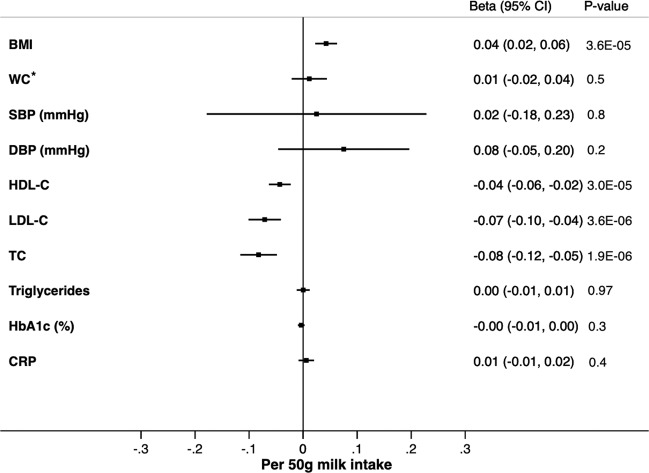
In the UK Biobank, carriers of 'T' allele of LCT variant were more likely to consume milk (P = 7.02 × 10). In meta-analysis including UK Biobank, the 1958BC, the HRS, and consortia-based studies, under an additive model, 'T' allele was associated with higher body mass index (BMI) (P = 4.68 × 10) and lower total cholesterol (TC) (P = 2.40 × 10), low-density lipoprotein cholesterol (LDL-C) (P = 2.08 × 10) and high-density lipoprotein cholesterol (HDL-C) (P = 9.40 × 10). In consortia meta-analyses, 'T' allele was associated with a lower risk of coronary artery disease (OR:0.86, 95% CI:0.75-0.99) but not with type 2 diabetes (OR:1.06, 95% CI:0.97-1.16). Furthermore, the two-sample MR analysis showed a causal association between genetically instrumented milk intake and higher BMI (P = 3.60 × 10) and body fat (total body fat, leg fat, arm fat and trunk fat; P < 1.37 × 10) and lower LDL-C (P = 3.60 × 10), TC (P = 1.90 × 10) and HDL-C (P = 3.00 × 10).
Our large-scale MR study provides genetic evidence for the association of milk consumption with higher BMI but lower serum cholesterol levels. These data suggest no need to limit milk intakes with respect to cardiovascular disease risk, with the suggested benefits requiring confirmation in further studies.
大量摄入牛奶与心血管代谢风险有关。我们进行了一项孟德尔随机化(MR)研究,使用乳糖酶持久性(LCT-13910 C > T,rs4988235)变异作为工具变量,以获得牛奶消耗与心血管代谢特征之间因果关系的证据。
我们在三个大型基于人群的研究(1958 年英国出生队列、健康与退休研究和英国生物库)的数据荟萃分析中,使用汇总统计数据测试了 LCT 基因型与牛奶消耗(用于验证)和中间特征(N = 123665-697307)之间的关联,并扩展到涵盖疾病终点(N = 86995-149821)。
在英国生物库中,LCT 变异的“T”等位基因携带者更有可能消耗牛奶(P = 7.02 × 10)。在包括英国生物库、1958BC、HRS 和基于联盟的研究在内的荟萃分析中,在加性模型下,“T”等位基因与更高的体重指数(BMI)(P = 4.68 × 10)和更低的总胆固醇(TC)(P = 2.40 × 10)相关,低密度脂蛋白胆固醇(LDL-C)(P = 2.08 × 10)和高密度脂蛋白胆固醇(HDL-C)(P = 9.40 × 10)。在联盟荟萃分析中,“T”等位基因与冠心病风险降低相关(OR:0.86,95%CI:0.75-0.99),但与 2 型糖尿病无关(OR:1.06,95%CI:0.97-1.16)。此外,两样本 MR 分析显示,基因介导的牛奶摄入与更高的 BMI(P = 3.60 × 10)和体脂肪(全身脂肪、腿部脂肪、手臂脂肪和躯干脂肪;P < 1.37 × 10)和更低的 LDL-C(P = 3.60 × 10)之间存在因果关系)、TC(P = 1.90 × 10)和 HDL-C(P = 3.00 × 10)。
我们的大规模 MR 研究提供了遗传证据,证明了牛奶消耗与更高的 BMI 但更低的血清胆固醇水平有关。这些数据表明,在心血管疾病风险方面,没有必要限制牛奶的摄入量,而建议的益处需要在进一步的研究中得到证实。