Cuveillier Camille, Boulan Benoit, Ravanello Charlotte, Denarier Eric, Deloulme Jean-Christophe, Gory-Fauré Sylvie, Delphin Christian, Bosc Christophe, Arnal Isabelle, Andrieux Annie
Univ. Grenoble Alpes, Inserm U1216, CEA-IRIG, CNRS, Grenoble Institut Neurosciences, Grenoble, France.
Front Mol Neurosci. 2021 May 5;14:665693. doi: 10.3389/fnmol.2021.665693. eCollection 2021.
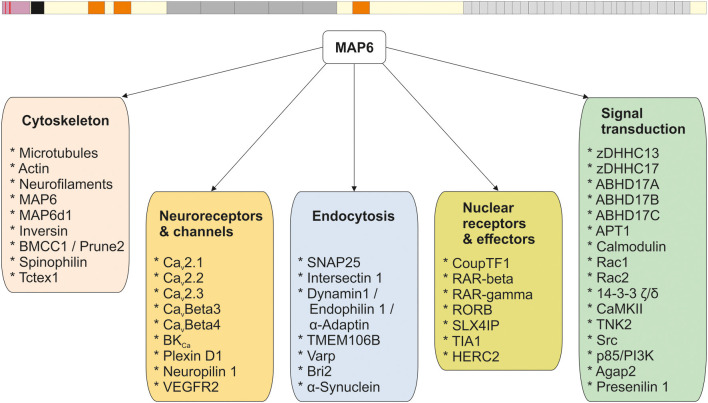
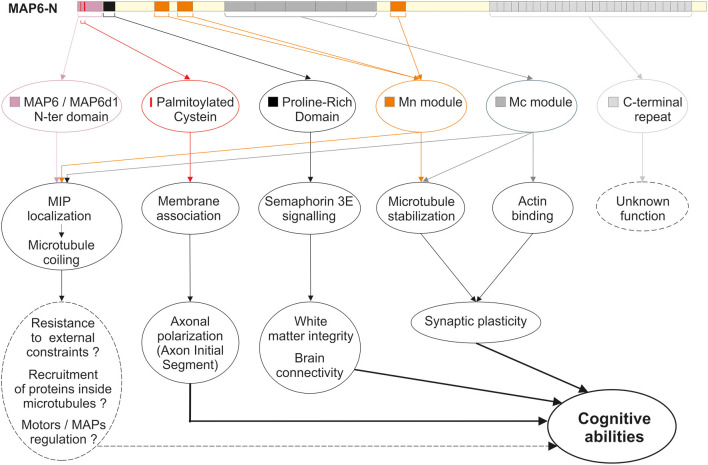
The development and function of the central nervous system rely on the microtubule (MT) and actin cytoskeletons and their respective effectors. Although the structural role of the cytoskeleton has long been acknowledged in neuronal morphology and activity, it was recently recognized to play the role of a signaling platform. Following this recognition, research into Microtubule Associated Proteins (MAPs) diversified. Indeed, historically, structural MAPs-including MAP1B, MAP2, Tau, and MAP6 (also known as STOP);-were identified and described as MT-binding and -stabilizing proteins. Extensive data obtained over the last 20 years indicated that these structural MAPs could also contribute to a variety of other molecular roles. Among multi-role MAPs, MAP6 provides a striking example illustrating the diverse molecular and cellular properties of MAPs and showing how their functional versatility contributes to the central nervous system. In this review, in addition to MAP6's effect on microtubules, we describe its impact on the actin cytoskeleton, on neuroreceptor homeostasis, and its involvement in signaling pathways governing neuron development and maturation. We also discuss its roles in synaptic plasticity, brain connectivity, and cognitive abilities, as well as the potential relationships between the integrated brain functions of MAP6 and its molecular activities. In parallel, the Collapsin Response Mediator Proteins (CRMPs) are presented as examples of how other proteins, not initially identified as MAPs, fall into the broader MAP family. These proteins bind MTs as well as exhibiting molecular and cellular properties very similar to MAP6. Finally, we briefly summarize the multiple similarities between other classical structural MAPs and MAP6 or CRMPs.In summary, this review revisits the molecular properties and the cellular and neuronal roles of the classical MAPs, broadening our definition of what constitutes a MAP.
中枢神经系统的发育和功能依赖于微管(MT)和肌动蛋白细胞骨架及其各自的效应器。尽管细胞骨架的结构作用在神经元形态和活动中早已得到认可,但最近人们认识到它还起着信号平台的作用。基于这一认识,对微管相关蛋白(MAPs)的研究呈现出多样化。实际上,从历史角度来看,包括MAP1B、MAP2、Tau和MAP6(也称为STOP)在内的结构MAPs被鉴定并描述为与MT结合并使其稳定的蛋白质。过去20年获得的大量数据表明,这些结构MAPs也可能参与多种其他分子作用。在具有多种作用的MAPs中,MAP6提供了一个显著的例子,说明了MAPs多样的分子和细胞特性,并展示了它们的功能多样性如何对中枢神经系统产生影响。在这篇综述中,除了MAP6对微管的作用外,我们还描述了它对肌动蛋白细胞骨架、神经受体稳态的影响,以及它在调控神经元发育和成熟的信号通路中的作用。我们还讨论了它在突触可塑性、脑连接性和认知能力方面的作用,以及MAP6的综合脑功能与其分子活性之间的潜在关系。同时,还介绍了塌陷反应介导蛋白(CRMPs),作为最初未被鉴定为MAPs的其他蛋白质如何属于更广泛的MAP家族的例子。这些蛋白质既能结合MT,又表现出与MAP6非常相似的分子和细胞特性。最后,我们简要总结了其他经典结构MAPs与MAP6或CRMPs之间的多重相似性。总之,这篇综述重新审视了经典MAPs的分子特性以及它们在细胞和神经元中的作用,拓宽了我们对MAPs构成的定义。