Guo Lingjian, Shi Haixia, Zhu Limin
LongHua Hospital Shanghai University of Traditional Chinese Medicine, Shanghai, China.
Shanghai Ninth People's Hospital Affiliated to School of Medicine, Shanghai Jiao Tong University, Shanghai, China.
Front Oncol. 2021 May 7;11:671382. doi: 10.3389/fonc.2021.671382. eCollection 2021.
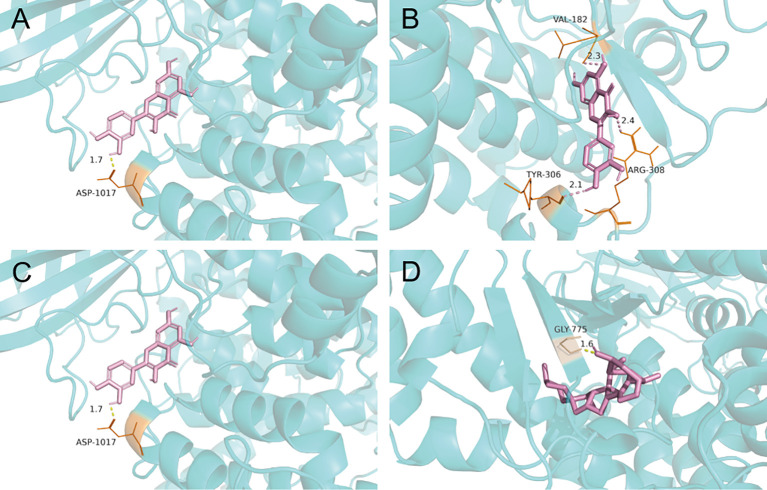
Siteng Fang (STF) has been shown to inhibit migration, invasion, and adhesion as well as promote apoptosis in gastric cancer (GC) cells. However, whether it can reverse the multidrug resistance (MDR) of GC to chemotherapy drugs is unknown. Thus, we aimed to elucidate the mechanism of STF in reversing the MDR of GC. The chemical composition of STF and genes related to GC were obtained from the TCMNPAS(TCM Network Pharmacology Analysis System, TCMNPAS) Database, and the targets of the active ingredients were predicted using the Swiss Target Prediction Database. The obtained data were mapped to obtain the key active ingredients and core targets of STF in treating GC. The active component-target network and protein interaction network were constructed by Cytoscape and String database, and the key genes and core active ingredients were obtained. The biological functions and related signal pathways corresponding to the key targets were analyzed and then verified molecular docking. A total of 14 core active ingredients of STF were screened, as well as 20 corresponding targets, which were mainly enriched in cancer pathway, proteoglycan synthesis, PI3K-AKT signaling pathway, and focal adhesion. Molecular docking showed that the core active ingredients related to MDR, namely quercetin and diosgenin, could bind well to the target. In summary, STF may reverse the MDR of GC and exert synergistic effect with chemotherapeutic drugs. It mediates MDR mainly through the action of quercetin and diosgenin on the PI3K/AKT signaling pathway. These findings are the first to demonstrate the molecular mechanism of STF in reversing MDR in GC, thus providing a direction for follow-up basic research.
四藤方(STF)已被证明可抑制胃癌(GC)细胞的迁移、侵袭和黏附,并促进其凋亡。然而,它是否能逆转GC对化疗药物的多药耐药性(MDR)尚不清楚。因此,我们旨在阐明STF逆转GC的MDR的机制。从中药网络药理学分析系统(TCMNPAS)数据库中获取STF的化学成分和与GC相关的基因,并使用瑞士靶点预测数据库预测活性成分的靶点。将获得的数据进行映射,以获得STF治疗GC的关键活性成分和核心靶点。通过Cytoscape和String数据库构建活性成分-靶点网络和蛋白质相互作用网络,获得关键基因和核心活性成分。分析关键靶点对应的生物学功能和相关信号通路,然后通过分子对接进行验证。共筛选出STF的14种核心活性成分以及20个相应靶点,主要富集于癌症通路、蛋白聚糖合成、PI3K-AKT信号通路和黏着斑。分子对接显示,与MDR相关的核心活性成分槲皮素和薯蓣皂苷元能与靶点良好结合。综上所述,STF可能逆转GC的MDR并与化疗药物发挥协同作用。它主要通过槲皮素和薯蓣皂苷元对PI3K/AKT信号通路的作用来介导MDR。这些发现首次证明了STF逆转GC中MDR的分子机制,从而为后续的基础研究提供了方向。