Payen Valéry L, Lavergne Arnaud, Alevra Sarika Niki, Colonval Megan, Karim Latifa, Deckers Manon, Najimi Mustapha, Coppieters Wouter, Charloteaux Benoît, Sokal Etienne M, El Taghdouini Adil
Laboratory of Pediatric Hepatology and Cell Therapy (PEDI), IREC Institute, Université catholique de Louvain, Brussels, Belgium.
Laboratory of Advanced Drug Delivery and Biomaterials (ADDB), LDRI Institute, Université catholique de Louvain, Brussels, Belgium.
JHEP Rep. 2021 Mar 21;3(3):100278. doi: 10.1016/j.jhepr.2021.100278. eCollection 2021 Jun.
BACKGROUND & AIMS: The multiple vital functions of the human liver are performed by highly specialised parenchymal and non-parenchymal cells organised in complex collaborative sinusoidal units. Although crucial for homeostasis, the cellular make-up of the human liver remains to be fully elucidated. Here, single-cell RNA-sequencing was used to unravel the heterogeneity of human liver cells, in particular of hepatocytes (HEPs) and hepatic stellate cells (HSCs).
The transcriptome of ~25,000 freshly isolated human liver cells was profiled using droplet-based RNA-sequencing. Recently published data sets and RNA hybridisation were integrated to validate and locate newly identified cell populations.
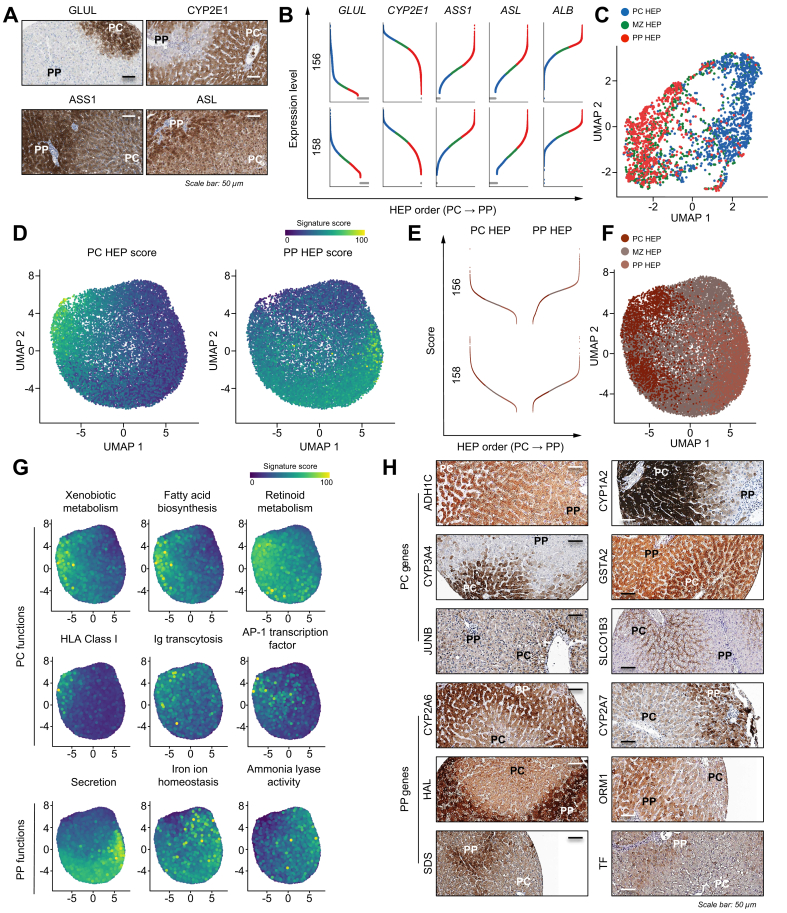
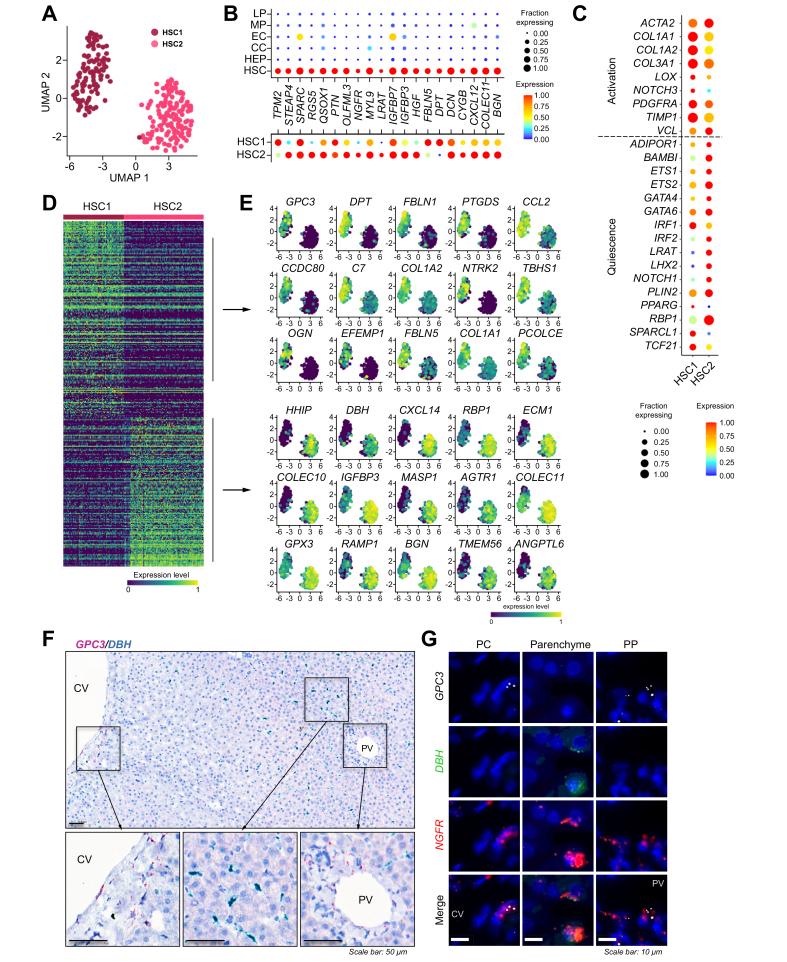
In total, 22 cell populations were annotated that reflected the heterogeneity of human parenchymal and non-parenchymal liver cells. More than 20,000 HEPs were ordered along the portocentral axis to confirm known, and reveal previously undescribed, zonated liver functions. The existence of 2 subpopulations of human HSCs with unique gene expression signatures and distinct intralobular localisation was revealed ( portal and central vein-concentrated HSCs and perisinusoidally located HSCs). In particular, these data suggest that, although both subpopulations collaborate in the production and organisation of extracellular matrix, HSCs specifically express genes involved in the metabolism of glycosaminoglycans, whereas HSCs display a gene signature that is reminiscent of antigen-presenting cells.
This study highlights metabolic zonation as a key determinant of HEP transcriptomic heterogeneity and, for the first time, outlines the existence of heterogeneous HSC subpopulations in the human liver. These findings call for further research on the functional implications of liver cell heterogeneity in health and disease.
This study resolves the cellular landscape of the human liver in an unbiased manner and at high resolution to provide new insights into human liver cell biology. The results highlight the physiological heterogeneity of human hepatic stellate cells.
人类肝脏的多种重要功能由高度专业化的实质细胞和非实质细胞执行,这些细胞组织成复杂的协作性肝血窦单位。尽管对体内平衡至关重要,但人类肝脏的细胞组成仍有待充分阐明。在此,单细胞RNA测序被用于揭示人类肝细胞,特别是肝细胞(HEPs)和肝星状细胞(HSCs)的异质性。
使用基于液滴的RNA测序对约25,000个新鲜分离的人类肝细胞的转录组进行分析。整合最近发表的数据集和RNA杂交以验证和定位新鉴定的细胞群体。
总共注释了22个细胞群体,反映了人类肝脏实质细胞和非实质细胞的异质性。超过20,000个肝细胞沿门中央轴排列,以确认已知的并揭示先前未描述的分区肝功能。揭示了具有独特基因表达特征和不同小叶内定位的人类肝星状细胞的2个亚群的存在(门静脉和中央静脉集中的肝星状细胞以及位于肝血窦周围的肝星状细胞)。特别是,这些数据表明,尽管两个亚群在细胞外基质的产生和组织中协作,但肝星状细胞特异性表达参与糖胺聚糖代谢的基因,而肝星状细胞显示出类似于抗原呈递细胞的基因特征。
本研究强调代谢分区是肝细胞转录组异质性的关键决定因素,并首次概述了人类肝脏中异质性肝星状细胞亚群的存在。这些发现需要对肝细胞异质性在健康和疾病中的功能意义进行进一步研究。
本研究以无偏见的方式和高分辨率解析了人类肝脏的细胞景观,为人类肝细胞生物学提供了新的见解。结果突出了人类肝星状细胞的生理异质性。