The Division of Cardiology Department of Medicine University of California, San DiegoSulpizio Cardiovascular Center San Diego CA.
The Division of Cardiovascular Medicine Department of Medicine Kurume University School of Medicine Fukuoka Japan.
J Am Heart Assoc. 2021 Jun;10(11):e018553. doi: 10.1161/JAHA.120.018553. Epub 2021 May 22.
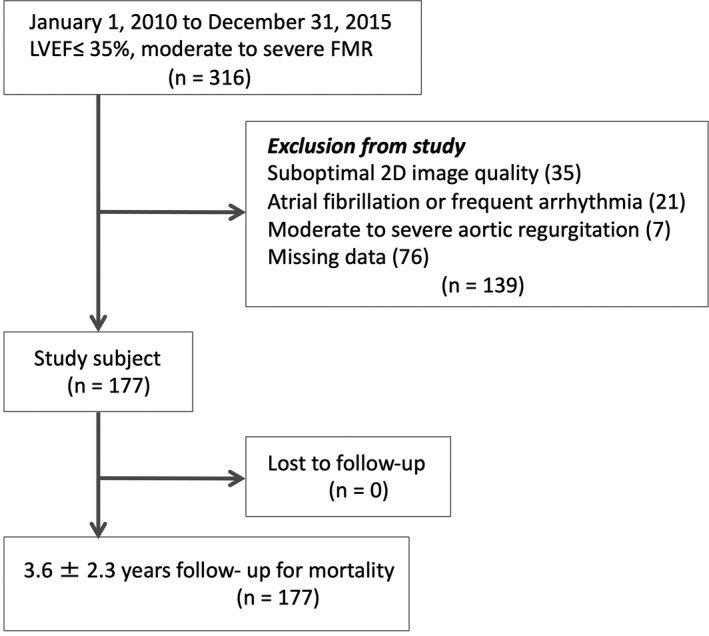
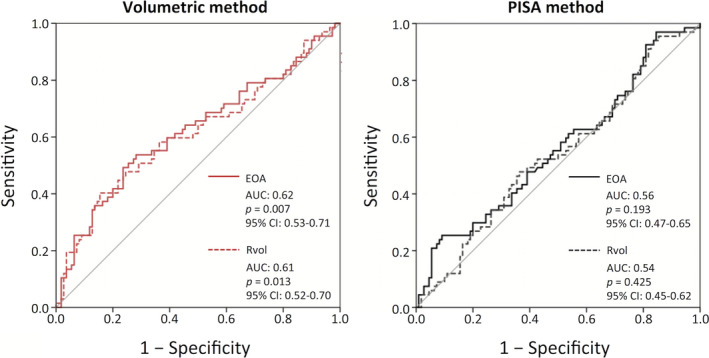
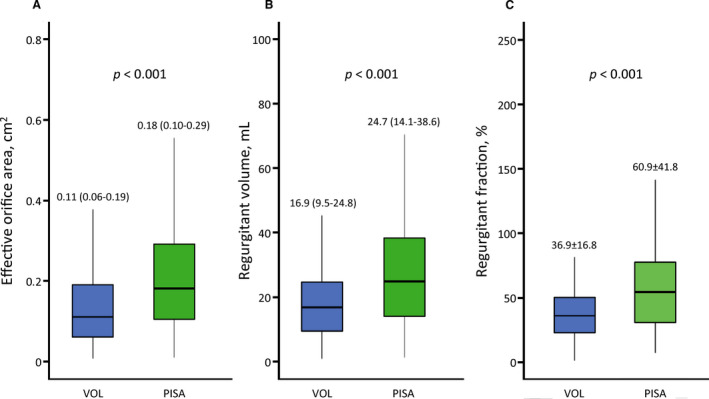
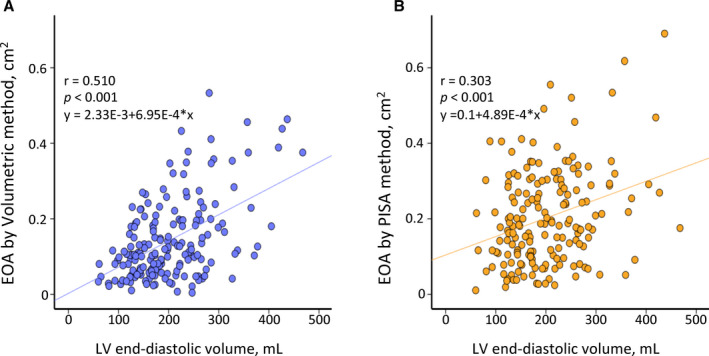
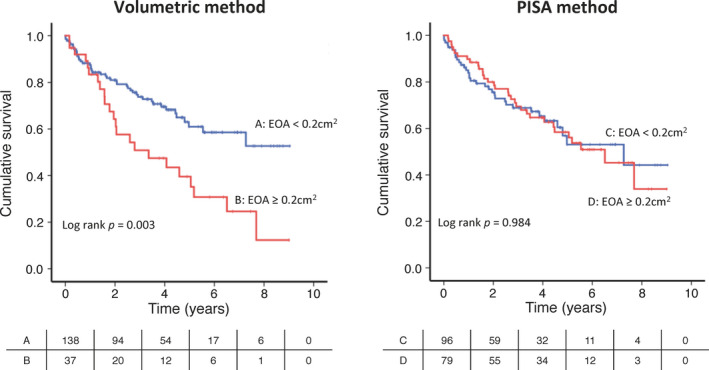
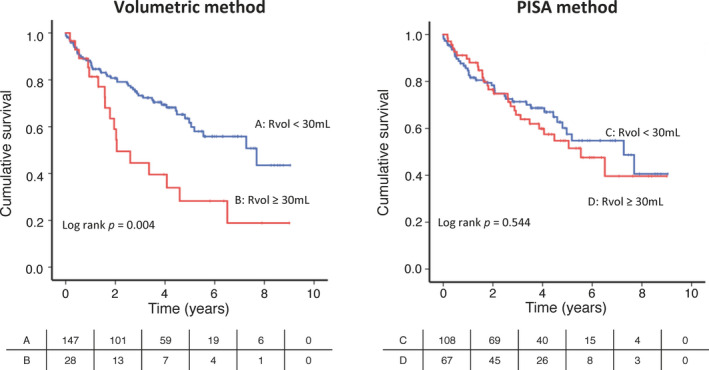
Background Effective orifice area (EOA) ≥0.2 cm or regurgitant volume (Rvol) ≥30 mL predicts prognostic significance in functional mitral regurgitation (FMR). Both volumetric and proximal isovelocity surface area (PISA) methods enable calculation of these metrics. To determine their clinical value, we compared EOA and Rvol derived by volumetric and PISA quantitation upon outcome of patients with FMR. Methods and Results We examined the outcome of patients with left ventricular ejection fraction <35% and moderate to severe FMR. All had a complete echocardiogram including EOA and Rvol by both standard PISA and volumetric quantitation using total stroke volume calculated by left ventricular end-diastolic volume×left ventricular ejection fraction and forward flow by Doppler method: EOA=Rvol/mitral regurgitation velocity time integral. Primary outcome was all-cause mortality or heart transplantation. We examined 177 patients: mean left ventricular ejection fraction 25.2% and 34.5% with ischemic cardiomyopathy. Echo measurements were greater by PISA than volumetric quantitation: EOA (0.18 versus 0.11 cm), Rvol (24.7 versus 16.9 mL), and regurgitant fraction (61 versus 37 %) respectively (all value <0.001). During 3.6±2.3 years' follow-up, patients with EOA ≥0.2 cm or Rvol ≥30 mL had a worse outcome than those with EOA <0.2 cm or Rvol <30 mL only by volumetric (log rank =0.003 and 0.004) but not PISA quantitation (log rank =0.984 and 0.544), respectively. Conclusions Volumetric and PISA methods yield different measurements of EOA and Rvol in FMR; volumetric values exhibit greater prognostic significance. The echo method of quantifying FMR may affect the management of this disorder.
有效瓣口面积(EOA)≥0.2cm 或反流容积(Rvol)≥30mL 可预测功能性二尖瓣反流(FMR)的预后意义。容积法和近端等速表面积(PISA)法均可计算这些指标。为了确定它们的临床价值,我们比较了 FMR 患者的结局中容积法和 PISA 法计算的 EOA 和 Rvol。
我们检查了左心室射血分数(LVEF)<35%和中重度 FMR 的患者的结局。所有患者均接受了完整的超声心动图检查,包括通过标准 PISA 和容积定量法测量的 EOA 和 Rvol,容积定量法使用左心室舒张末期容积×LVEF 计算总stroke volume,使用多普勒法测量前向血流:EOA=Rvol/二尖瓣反流速度时间积分。主要结局是全因死亡率或心脏移植。我们检查了 177 例患者:平均 LVEF 分别为 25.2%和 34.5%,病因分别为缺血性心肌病和非缺血性心肌病。PISA 测量值大于容积定量法:EOA(0.18 比 0.11cm)、Rvol(24.7 比 16.9mL)和反流分数(61 比 37%)分别(所有 P 值<0.001)。在 3.6±2.3 年的随访期间,仅通过容积定量法(对数秩检验=0.003 和 0.004),而不是 PISA 定量法(对数秩检验=0.984 和 0.544),EOA≥0.2cm 或 Rvol≥30mL 的患者比 EOA<0.2cm 或 Rvol<30mL 的患者预后更差。
容积法和 PISA 法在 FMR 中产生不同的 EOA 和 Rvol 测量值;容积法值具有更大的预后意义。定量 FMR 的超声方法可能会影响这种疾病的治疗。