Department of Global Health, School of Public Health, Boston University, Boston, Massachusetts, United States of America.
School of Public Health, University of Western Cape, Bellville, South Africa.
PLoS One. 2021 May 24;16(5):e0251230. doi: 10.1371/journal.pone.0251230. eCollection 2021.
Public health practitioners have little guidance around how to plan for the sustainability of donor sponsored programs after the donor withdraws. The literature is broad and provides no consensus on a definition of sustainability. This study used a mixed-methods methodology to assess program sustainability factors to inform donor-funded programs.
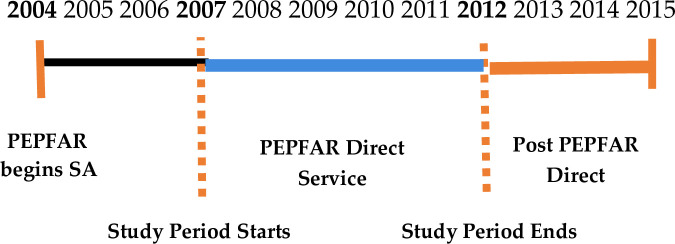
This study examined 61 health facilities in the Western Cape, South Africa, supported by four PEPFAR-funded non-governmental organizations from 2007 to 2012. Retention in care (RIC) was used to determine health facility performance. Sustainability was measured by comparing RIC during PEPFAR direct service (20072012), to RIC in the post PEPFAR period (2013 to 2015). Forty-three semi-structured in-depth interviews were conducted with key informants. The qualitative data were used to examine how predictor variables were operationalized at a health facility and NGO level.
Our qualitative results suggest the following lessons for the sustainability of future programs: Sufficient and stable resources (i.e., financial, human resources, technical expertise, equipment, physical space)Investment in organizations that understand the local context and have strong relationships with local government.Strong leadership at a health facility levelJoint planning/coordination and formalized skill transferLocal positive perceived value of the programPartnerships.
Sustainability is complex, context dependent, and is reliant on various processes and outcomes. This study suggests additional health facility and community level staff should be employed in the health system to ensure RIC sustainability. Sustainability requires joint donor coordination with experienced local organizations with strong managers before during and after program implementation. If the program is as large as the South African HIV effort some dedicated additional resources in the long term would be required.
公共卫生从业者在捐助者撤出后如何规划捐助赞助项目的可持续性方面几乎没有指导。文献广泛,但对可持续性的定义没有达成共识。本研究采用混合方法学方法评估了项目可持续性因素,以为捐助资金项目提供信息。
本研究检查了南非西开普省的 61 家卫生机构,这些机构在 2007 年至 2012 年间得到了四个由美国国际开发署资助的非政府组织的支持。保留治疗(Retention in care,RIC)用于确定卫生机构的绩效。可持续性通过比较美国国际开发署直接服务期间(2007 年至 2012 年)和美国国际开发署后期间(2013 年至 2015 年)的 RIC 来衡量。对 43 名关键知情者进行了 43 次半结构化深入访谈。对定性数据进行了分析,以检查预测变量如何在卫生机构和非政府组织层面上运作。
我们的定性结果为未来项目的可持续性提供了以下经验教训:充足和稳定的资源(即财务、人力资源、技术专长、设备、物理空间)对了解当地情况并与当地政府建立了良好关系的组织进行投资。在卫生机构层面上有强大的领导力联合规划/协调和正式的技能转移当地对该计划的积极感知价值伙伴关系。
可持续性是复杂的、依赖于背景的,并且依赖于各种过程和结果。本研究表明,应在卫生系统中雇用更多的卫生机构和社区一级的工作人员,以确保 RIC 的可持续性。可持续性需要捐助者在项目实施之前、之中和之后与有经验的当地组织进行联合协调,这些组织有强大的管理者。如果该计划像南非的艾滋病毒努力一样大,那么在长期内将需要一些额外的专用资源。