Division of Pulmonary, Critical Care and Sleep Medicine, Department of Internal Medicine, The Ohio State University, Columbus, OH.
Center for Biostatistics, Department of Biomedical Informatics, The Ohio State University, Columbus, OH.
Chest. 2021 Oct;160(4):1340-1349. doi: 10.1016/j.chest.2021.05.031. Epub 2021 May 23.
Tobacco smoking is associated with a reduced risk of developing sarcoidosis, and we previously reported that nicotine normalizes immune responses to environmental antigens in patients with active pulmonary sarcoidosis. The effects of nicotine on the progression of pulmonary sarcoidosis are unknown.
Is nicotine treatment well tolerated, and will it improve lung function in patients with active pulmonary sarcoidosis?
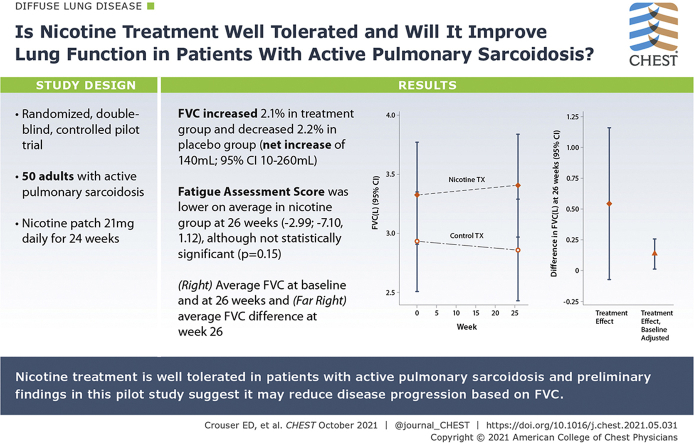
With local institutional review board approval, a randomized, double-blind, controlled pilot trial was conducted of daily nicotine transdermal patch treatment (21 mg daily) or placebo patch use for 24 weeks. The Ohio State University Wexner Medical Center and Cleveland Clinic enrolled 50 consecutive subjects aged ≥ 18 years with active pulmonary sarcoidosis, based on symptoms (ie, dyspnea, cough) and objective radiographic evidence of infiltrates consistent with nonfibrotic lung disease. Each study group was compared at 26 weeks based on repeated measures of FVC, FEV, quantitative lung texture score based on CT texture analysis, Fatigue Assessment Score (FAS), St. George's Respiratory Questionnaire (SGRQ), and the Sarcoidosis Assessment Tool.
Nicotine treatment was associated with a clinically significant, approximately 2.1% (70 mL) improvement in FVC from baseline to 26 weeks. FVC decreased by a similar amount (2.2%) in the placebo group, with a net increase of 140 mL (95% CI, 10-260) when comparing nicotine vs placebo groups at 26 weeks. FEV and FAS improved marginally in the nicotine-treated group, compared with those on placebo. No improvement was observed in lung texture score, FAS, St. George's Respiratory Questionnaire score, or the Sarcoidosis Assessment Tool. There were no reported serious adverse events or evidence of nicotine addiction.
Nicotine treatment was well tolerated in patients with active pulmonary sarcoidosis, and the preliminary findings of this pilot study suggest that it may reduce disease progression, based on FVC.
ClinicalTrials.gov; No.: NCT02265874; URL: www.clinicaltrials.gov.
吸烟与结节病风险降低有关,我们之前报道过尼古丁可使活动期肺结节病患者对环境抗原的免疫反应正常化。尼古丁对肺结节病进展的影响尚不清楚。
尼古丁治疗是否耐受良好,是否会改善活动期肺结节病患者的肺功能?
经当地机构审查委员会批准,我们进行了一项随机、双盲、对照的尼古丁透皮贴剂(21mg/天)或安慰剂贴剂治疗 24 周的试验。俄亥俄州立大学韦克斯纳医学中心和克利夫兰诊所纳入了 50 名年龄≥18 岁的活动期肺结节病患者,纳入标准为症状(即呼吸困难、咳嗽)和影像学表现为非纤维化肺病浸润的客观证据。每个研究组在 26 周时根据 FVC、FEV、基于 CT 纹理分析的定量肺纹理评分、疲劳评估评分(FAS)、圣乔治呼吸问卷(SGRQ)和结节病评估工具进行重复测量比较。
尼古丁治疗与 FVC 从基线到 26 周的临床显著改善相关,约为 2.1%(70ml)。安慰剂组 FVC 下降相似(2.2%),26 周时尼古丁组与安慰剂组比较,FVC 增加 140ml(95%CI,10-260)。与安慰剂组相比,尼古丁治疗组的 FEV 和 FAS 略有改善。肺纹理评分、FAS、圣乔治呼吸问卷评分或结节病评估工具均未见改善。未报告严重不良事件或尼古丁成瘾的证据。
尼古丁治疗在活动期肺结节病患者中耐受良好,这项初步研究结果表明,根据 FVC,它可能会减缓疾病进展。
ClinicalTrials.gov;编号:NCT02265874;网址:www.clinicaltrials.gov。