Headache Unit, Department of Neurology, La Princesa Research Institute. Hospital Universitario de la Princesa, Madrid, Spain.
Praxis Gendolla. Zentrum für Neurologie und Schmerztherapie, Essen, Germany.
J Headache Pain. 2021 May 24;22(1):43. doi: 10.1186/s10194-021-01258-y.
There is currently a wide therapeutic arsenal for migraine patients, without a single first-line preventive drug and we choose the different available alternatives taking into account comorbidities, national guidelines, previous treatments and personal experiences. Our objective was to evaluate the differences in the use of migraine treatments between neurologists from different countries.
This is a multi-centre observational study carried out by neurologists from specialized headache units in seven countries, retrospective with consecutive inclusion of all patients presenting with a migraine diagnosis, over a period of three months.
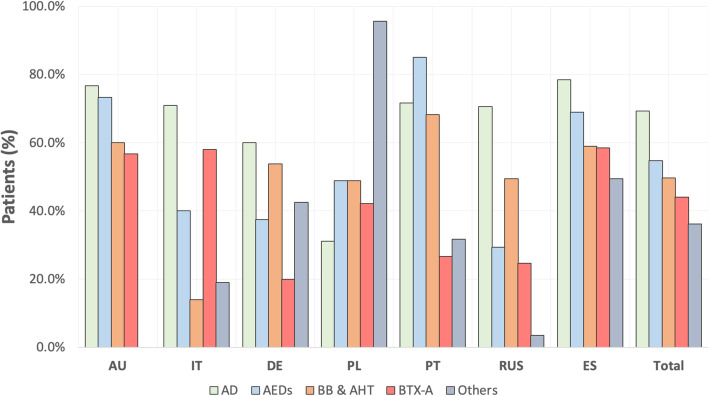
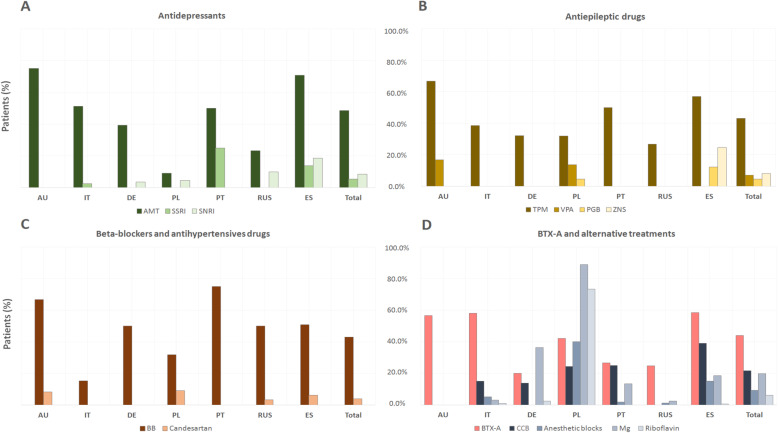
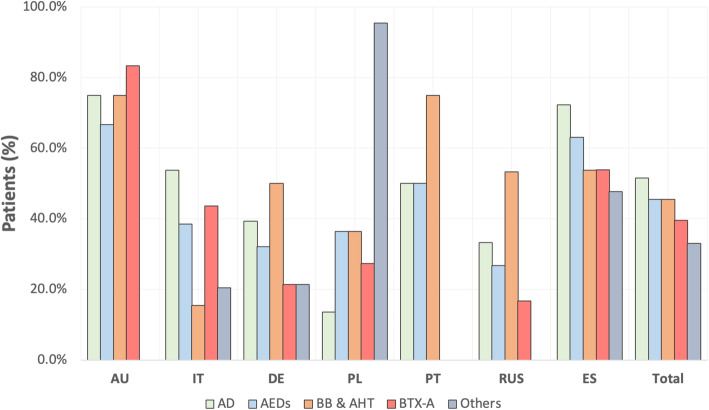
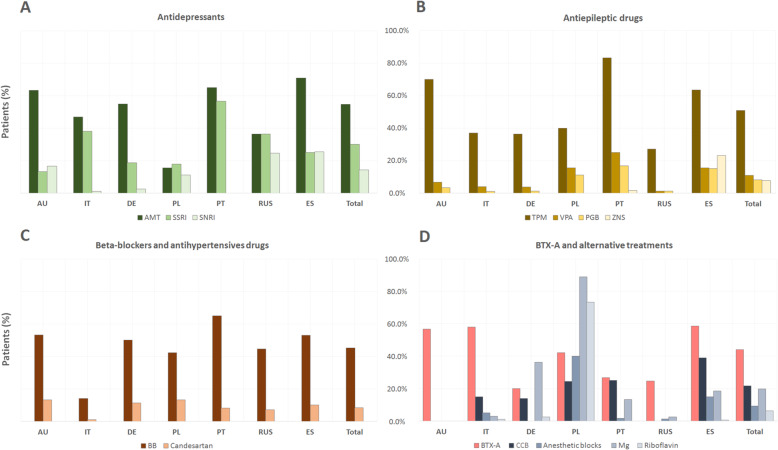
A total of 734 patients were recruited but only 600 were considered in the analysis in order to homogenize the patient cohorts from countries: 200 Spain (ES), 100 Italy (IT), 85 Russia (RUS), 80 Germany (DE), 60 Portugal (PT), 45 Poland (PL) and 30 Australia (AU). 85.4 % of patients were women with a mean age of 42.6 ± 11.8 years. Considering previous and current preventive treatment, the order of use was: antidepressants (69.3 %), antiepileptic drugs (54.7 %), beta-blockers and antihypertensive drugs (49.7 %), OnabotulinumtoxinA (44.0 %) and others (36.2 %). Statistically significant differences were found between all pharmacological classes: antidepressants were commonly used in all countries, with the exception of Poland (AU: 76.7 %, IT: 71.0 %, DE: 60.0 %, PL: 31.1 %, PT: 71.7 %, RUS: 70.6 %, ES: 78.5 %; p < 0.0001); antiepileptic drugs were more frequently prescribed in Portugal, Australia and Spain (AU: 73.3 %, IT: 40.0 %, DE: 37.5 %, PL: 48.9 %, PT: 85.0 %, RUS: 29.4 % and ES: 69.0 %; p < 0.0001); beta-blockers and antihypertensive drugs were frequently used in all countries except Italy (AU: 60.0 %, IT: 14.0 %, DE: 53.8 %, PL: 48.9 %, PT: 68.3 %, RUS: 49.4 % and ES: 59.0 %; p < 0.0001); BTX-A were predominately used in Spain, Italy and Australia (AU:56.7 %, IT:58.0 %, DE:20.0 %, PL: 42.2 %, PT: 26.7 %, RUS: 24.7 % and ES: 58.5 %; p < 0.0001) and others were most frequently used in Poland (AU: 0.0 %, IT: 19.0 %, DE: 42.5 %, PL: 95.6 %, PT: 31.7 %, RUS: 3.5 % and ES: 49.5 %; p < 0.0001). If only patients without comorbidities are considered (200/600), statistically differences between countries persist in all preventive treatments.
There is heterogeneity in the choice of preventive treatment between different countries. Prospective comparative studies of the different oral and subcutaneous alternatives would help to create a global therapeutic algorithm that would guarantee the best option for our patients.
目前,偏头痛患者有广泛的治疗手段,但没有一种单一的一线预防药物,我们会根据合并症、国家指南、既往治疗和个人经验选择不同的可用替代方案。我们的目标是评估不同国家的神经病学家在偏头痛治疗选择上的差异。
这是一项由来自七个国家的专门头痛单位的神经病学家进行的多中心观察性研究,回顾性连续纳入所有偏头痛诊断患者,为期三个月。
共纳入 734 名患者,但为了使来自不同国家的患者队列同质化,仅对 600 名患者进行了分析:西班牙 200 名(ES)、意大利 100 名(IT)、俄罗斯 85 名(RUS)、德国 80 名(DE)、葡萄牙 60 名(PT)、波兰 45 名(PL)和澳大利亚 30 名(AU)。85.4%的患者为女性,平均年龄为 42.6±11.8 岁。考虑到既往和当前的预防性治疗,使用顺序为:抗抑郁药(69.3%)、抗癫痫药(54.7%)、β受体阻滞剂和降压药(49.7%)、肉毒杆菌毒素 A(44.0%)和其他药物(36.2%)。在所有药理类别之间均发现了统计学上的显著差异:抗抑郁药在所有国家都普遍使用,波兰除外(AU:76.7%,IT:71.0%,DE:60.0%,PL:31.1%,PT:71.7%,RUS:70.6%,ES:78.5%;p<0.0001);抗癫痫药在葡萄牙、澳大利亚和西班牙更常被开(AU:73.3%,IT:40.0%,DE:37.5%,PL:48.9%,PT:85.0%,RUS:29.4%和 ES:69.0%;p<0.0001);β受体阻滞剂和降压药在除意大利以外的所有国家都经常使用(AU:60.0%,IT:14.0%,DE:53.8%,PL:48.9%,PT:68.3%,RUS:49.4%和 ES:59.0%;p<0.0001);肉毒杆菌毒素 A 主要在西班牙、意大利和澳大利亚使用(AU:56.7%,IT:58.0%,DE:20.0%,PL:42.2%,PT:26.7%,RUS:24.7%和 ES:58.5%;p<0.0001),而其他药物在波兰最常被使用(AU:0.0%,IT:19.0%,DE:42.5%,PL:95.6%,PT:31.7%,RUS:3.5%和 ES:49.5%;p<0.0001)。如果仅考虑无合并症的患者(200/600),则各国之间在所有预防治疗方面的差异仍然存在统计学意义。不同口服和皮下替代方案的前瞻性比较研究将有助于制定全球治疗算法,从而保证为我们的患者提供最佳选择。