Seaver Autism Center for Research and Treatment, Icahn School of Medicine at Mount Sinai, New York, NY, USA.
Division of Tics, Obsessive-Compulsive Disorder (OCD) and Related Disorders, Icahn School of Medicine at Mount Sinai, New York, NY, USA.
Psychol Med. 2021 Oct;51(13):2247-2259. doi: 10.1017/S0033291721001744. Epub 2021 May 25.
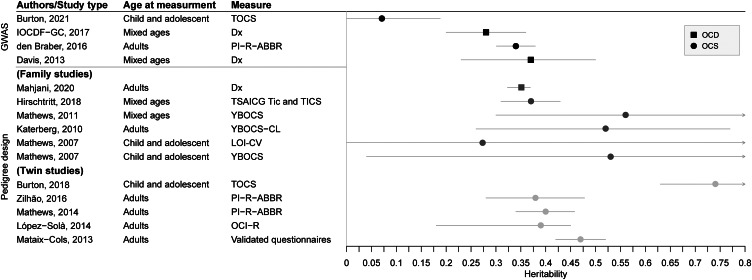
Obsessive-compulsive disorder (OCD) is a psychiatric disorder with multiple symptom dimensions (e.g. contamination, symmetry). OCD clusters in families and decades of twin studies clearly demonstrate an important role for genetics in the etiology of the disorder.
In this review, we summarize the genetic epidemiology and molecular genetic studies of OCD and obsessive-compulsive symptoms.
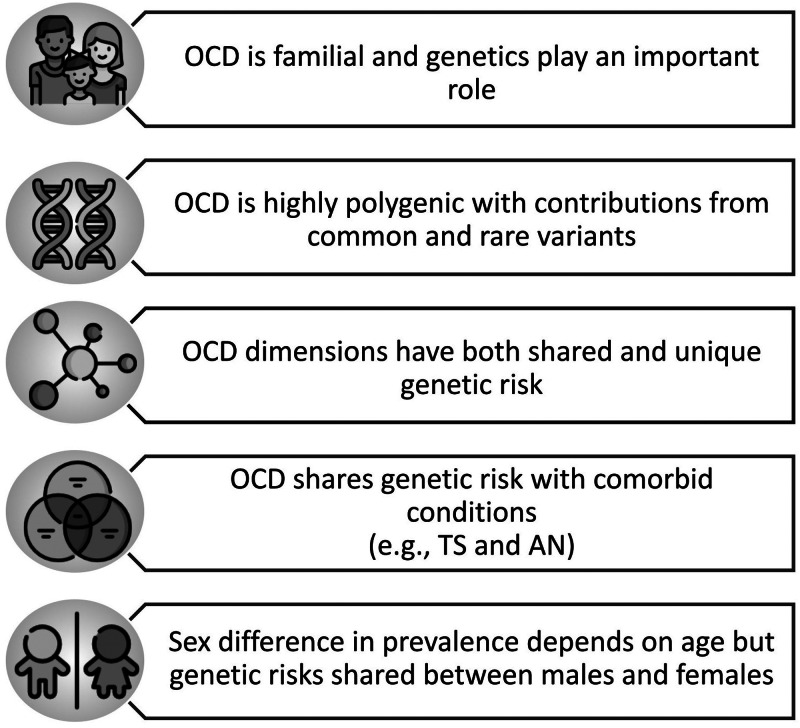
OCD is a heritable, polygenic disorder with contributions from both common and rare variants, including de novo deleterious variations. Multiple studies have provided reliable support for a large additive genetic contribution to liability to OCD, with discrete OCD symptom dimensions having both shared and unique genetic risks. Genome-wide association studies have not produced significant results yet, likely because of small sample sizes, but larger meta-analyses are forthcoming. Both twin and genome-wide studies show that OCD shares genetic risk with its comorbid conditions (e.g. Tourette syndrome and anorexia nervosa).
Despite significant efforts to uncover the genetic basis of OCD, the mechanistic understanding of how genetic and environmental risk factors interact and converge at the molecular level to result in OCD's heterogeneous phenotype is still mostly unknown. Future investigations should increase ancestral genetic diversity, explore age and/or sex differences in genetic risk for OCD and expand the study of pharmacogenetics, gene expression, gene × environment interactions and epigenetic mechanisms for OCD.
强迫症(OCD)是一种具有多种症状维度的精神障碍(例如,污染,对称)。 OCD 在家庭中聚集,并且数十年的双胞胎研究清楚地表明遗传在该疾病的病因学中起着重要作用。
在这篇综述中,我们总结了 OCD 和强迫症状的遗传流行病学和分子遗传学研究。
OCD 是一种可遗传的多基因疾病,既有常见的也有罕见的变异,包括从头产生的有害变异。多项研究为 OCD 易感性的大量加性遗传贡献提供了可靠的支持,离散的 OCD 症状维度既有共同的遗传风险,也有独特的遗传风险。全基因组关联研究尚未产生显著结果,可能是由于样本量小,但更大的荟萃分析即将进行。双胞胎和全基因组研究均表明 OCD 与共病(例如妥瑞氏症和神经性厌食症)具有遗传风险。
尽管已经做出了很大的努力来揭示 OCD 的遗传基础,但对于遗传和环境风险因素如何在分子水平上相互作用并汇聚,从而导致 OCD 的异质表型,我们仍知之甚少。未来的研究应增加祖先遗传多样性,探索 OCD 遗传风险的年龄和/或性别差异,并扩大对药物遗传学,基因表达,基因×环境相互作用和 OCD 表观遗传机制的研究。