Department of Global Health, University of Washington, Seattle, Washington, USA.
Institute of Tropical Diseases, University of Nairobi, Nairobi, Kenya.
AIDS. 2021 Sep 1;35(11):1723-1731. doi: 10.1097/QAD.0000000000002956.
Heightened systemic inflammation is common in obese individuals and persons with HIV (PWH) and is independently associated with an increased risk of cardiovascular diseases (CVDs). We investigated the combined effect of central obesity, a surrogate measure of visceral fat and HIV on circulating levels of inflammatory cytokines among Kenyan adults.
A cross-sectional study.
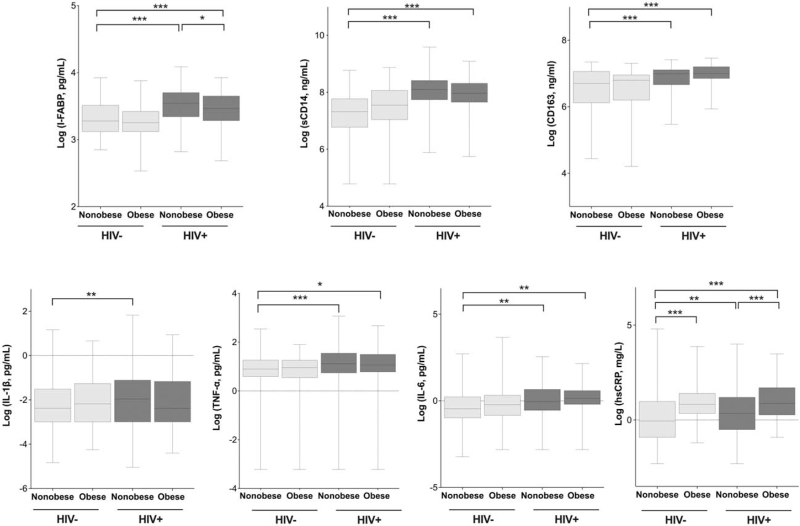
We analysed and compared data from 287 virally suppressed PWH and 277 noninfected Kenyan adults, including biomarkers of gut epithelial dysfunction (intestinal fatty acid binding protein), monocyte activation (soluble CD163 and CD14) and inflammation [interleukin (IL)-1β, IL-6, TNF-α and hsCRP] by HIV/central obesity status (HIV-positive/obese, HIV-negative/obese, HIV-positive/nonobese and HIV-negative/nonobese). Central obesity was defined as waist circumference more than 80 cm for women and more than 94 cm for men. We assessed the association of HIV/obesity status with elevated biomarkers (>75th percentile) using logistic regression.
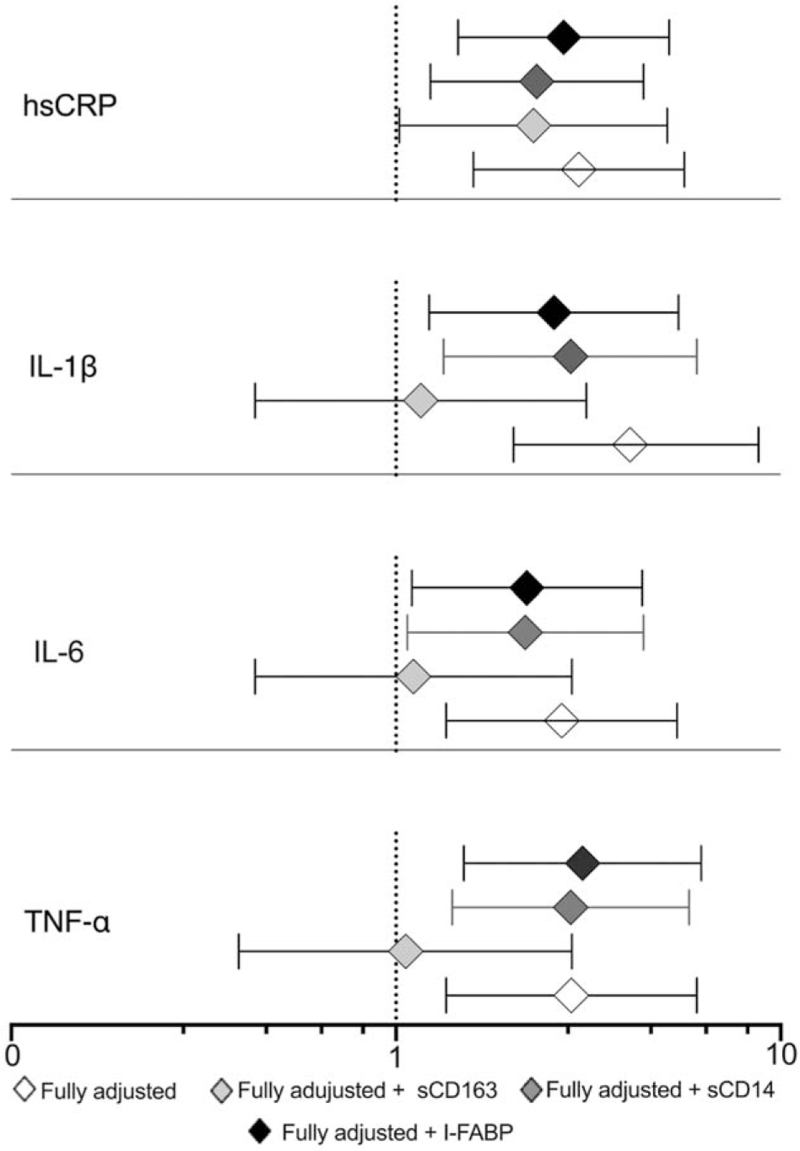
Median age for participants was 44 years and 37% were centrally obese. Levels of all biomarkers were higher among the HIV-positive/obese compared with the HIV-negative/nonobese (P < 0.05 for all comparisons). The HIV-positive/obese group had the greatest odds of having elevated inflammatory biomarkers compared with other groups even after adjustment of age, BMI and other conventional CVD risk factors (P < 0.05 for all). Additional adjustment for sCD163 in the multivariate model substantially attenuated the association for HIV-positive/obesity with IL-1β, IL-6 and TNF-α but not hsCRP. The contribution of HIV-positive/obesity to inflammation was independent of the degree of immunosuppression.
Central obesity is prevalent among virally suppressed African PWH and is associated with greater inflammation and monocyte activation independent of other comorbidities and HIV-specific factors.
全身性炎症在肥胖个体和 HIV 感染者(PWH)中很常见,并且与心血管疾病(CVD)的风险增加独立相关。我们研究了中心性肥胖(内脏脂肪的替代测量指标)和 HIV 对肯尼亚成年人循环中炎症细胞因子水平的综合影响。
横断面研究。
我们分析并比较了 287 名病毒抑制的 PWH 和 277 名未感染的肯尼亚成年人的数据,包括肠道上皮功能障碍的生物标志物(肠脂肪酸结合蛋白)、单核细胞活化(可溶性 CD163 和 CD14)和炎症标志物[白细胞介素(IL)-1β、IL-6、TNF-α 和高敏 C 反应蛋白],按 HIV/中心性肥胖状态(HIV 阳性/肥胖、HIV 阴性/肥胖、HIV 阳性/非肥胖和 HIV 阴性/非肥胖)进行分类。中心性肥胖定义为女性腰围大于 80cm,男性腰围大于 94cm。我们使用逻辑回归评估了 HIV/肥胖状态与升高的生物标志物(>第 75 百分位数)之间的关联。
参与者的中位年龄为 44 岁,37%为中心性肥胖。与 HIV 阴性/非肥胖者相比,HIV 阳性/肥胖者的所有生物标志物水平均较高(所有比较 P<0.05)。即使在调整年龄、BMI 和其他常规 CVD 风险因素后,HIV 阳性/肥胖组与其他组相比,具有升高的炎症生物标志物的可能性仍然最大(所有比较 P<0.05)。在多变量模型中进一步调整 sCD163 后,HIV 阳性/肥胖与 IL-1β、IL-6 和 TNF-α的关联明显减弱,但与 hsCRP 无关。HIV 阳性/肥胖对炎症的影响独立于免疫抑制的程度。
在病毒抑制的非洲 PWH 中,中心性肥胖很常见,与其他合并症和 HIV 特异性因素无关,与更大程度的炎症和单核细胞活化相关。