UK Centre for Ecology and Hydrology, Benson Lane, Wallingford, Oxfordshire, UK.
School of Mathematics and Statistics, University of Glasgow, Glasgow, UK.
J R Soc Interface. 2021 May;18(178):20210049. doi: 10.1098/rsif.2021.0049. Epub 2021 May 26.
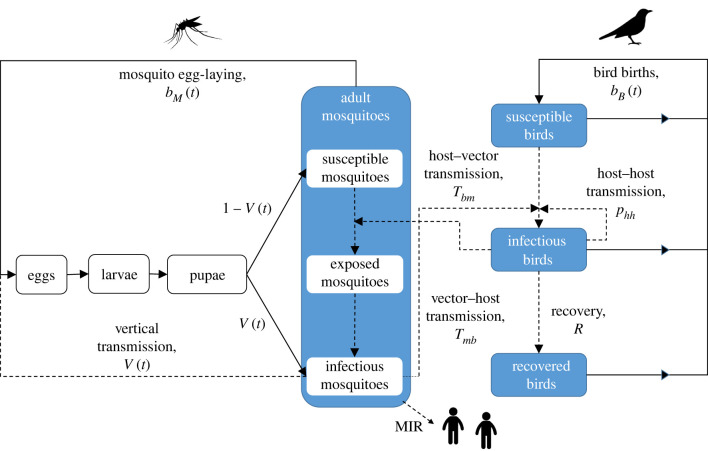
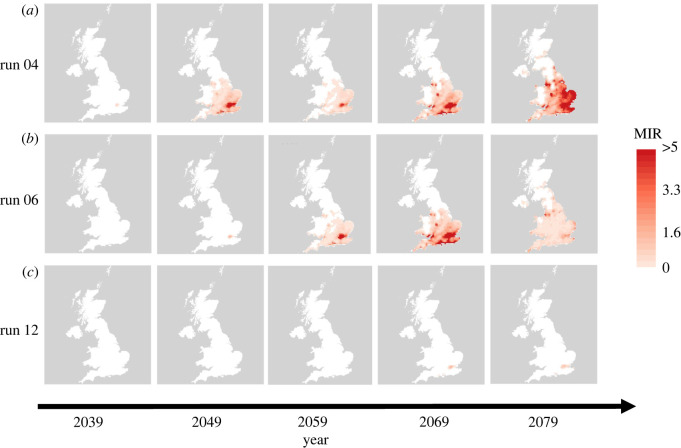
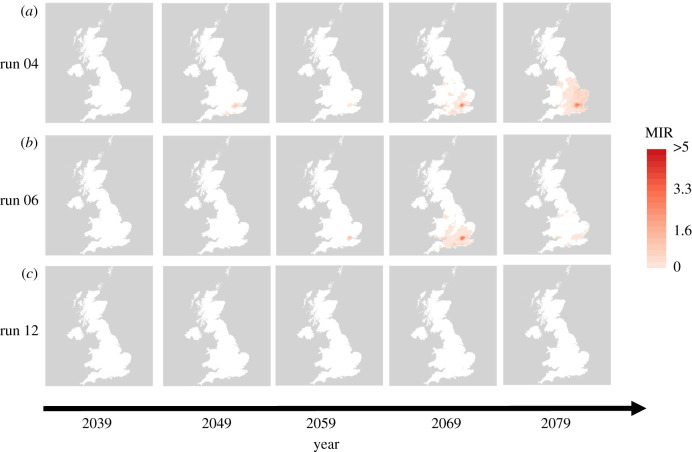
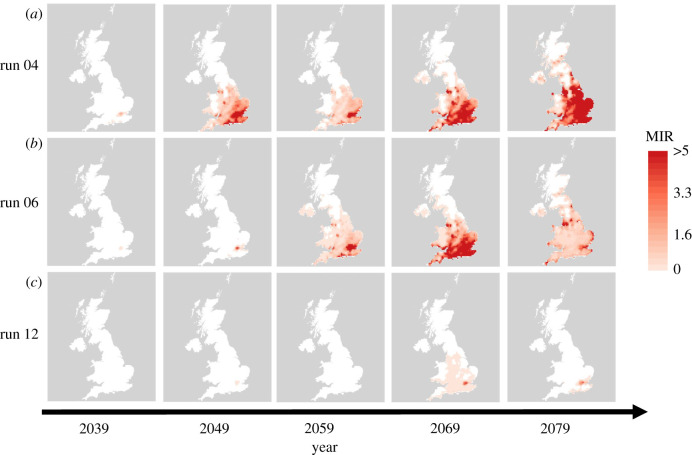
Vector-borne diseases (VBDs), such as dengue, Zika, West Nile virus (WNV) and tick-borne encephalitis, account for substantial human morbidity worldwide and have expanded their range into temperate regions in recent decades. Climate change has been proposed as a likely driver of past and future expansion, however, the complex ecology of host and vector populations and their interactions with each other, environmental variables and land-use changes makes understanding the likely impacts of climate change on VBDs challenging. We present an environmentally driven, stage-structured, host-vector mathematical modelling framework to address this challenge. We apply our framework to predict the risk of WNV outbreaks in current and future UK climates. WNV is a mosquito-borne arbovirus which has expanded its range in mainland Europe in recent years. We predict that, while risks will remain low in the coming two to three decades, the risk of WNV outbreaks in the UK will increase with projected temperature rises and outbreaks appear plausible in the latter half of this century. This risk will increase substantially if increased temperatures lead to increases in the length of the mosquito biting season or if European strains show higher replication at lower temperatures than North American strains.
虫媒病(VBD),如登革热、寨卡病毒、西尼罗河病毒(WNV)和蜱传脑炎,在全球范围内导致了大量的人类发病,并在最近几十年中扩大到了温带地区。气候变化被认为是过去和未来扩张的一个可能驱动因素,然而,宿主和媒介种群的复杂生态及其相互作用、环境变量和土地利用变化,使得理解气候变化对 VBD 的可能影响具有挑战性。我们提出了一个受环境驱动的、具有阶段结构的、宿主-媒介数学模型框架来应对这一挑战。我们应用我们的框架来预测当前和未来英国气候下 WNV 爆发的风险。WNV 是一种蚊媒传播的虫媒病毒,近年来在欧洲大陆的范围有所扩大。我们预测,在未来两到三十年,风险仍将保持较低水平,但随着预计气温的上升,英国爆发 WNV 的风险将会增加,本世纪后半叶爆发的可能性较大。如果气温升高导致蚊子叮咬季节延长,或者欧洲株在较低温度下的复制率高于北美株,那么这种风险将会大大增加。