Istituto Zooprofilattico Sperimentale delle Venezie, Viale dell'Università 10, 35020, Legnaro, Padua, Italy.
Parasit Vectors. 2020 May 29;13(1):271. doi: 10.1186/s13071-020-04143-w.
Vector-borne infectious diseases (VBDs) represent a major public health concern worldwide. Among VBDs, West Nile virus (WNV) showed an increasingly wider spread in temperate regions of Europe, including Italy. During the last decade, WNV outbreaks have been recurrently reported in mosquitoes, horses, wild birds, and humans, showing great variability in the temporal and spatial distribution pattern. Due to the complexity of the environment-host-vector-pathogen interaction and the incomplete understanding of the epidemiological pattern of the disease, WNV occurrences can be difficult to predict. The analyses of ecological drivers responsible for the earlier WNV reactivation and transmission are pivotal; in particular, variations in the vector population dynamics may represent a key point of the recent success of WNV and, more in general, of the VBDs.
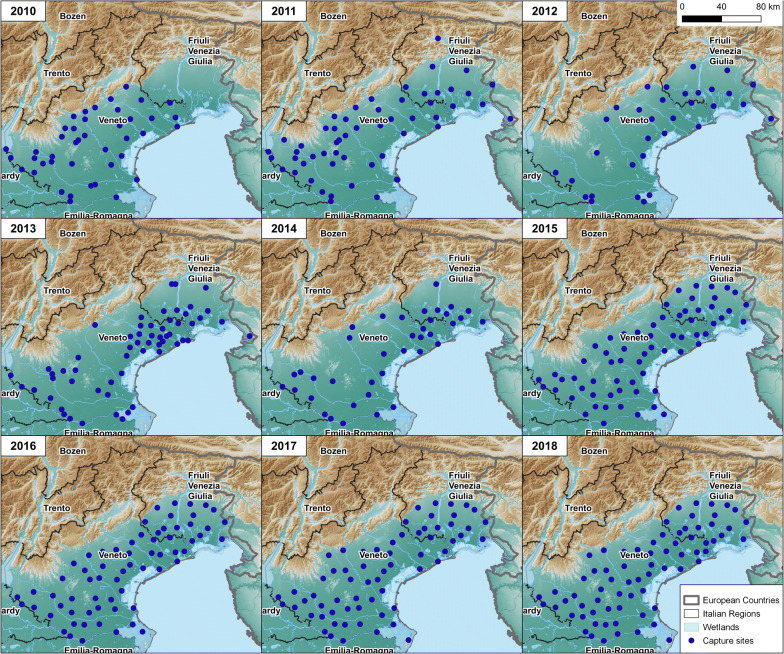
We investigated the variations of Culex pipiens population abundance using environmental, climatic and trapping data obtained over nine years (2010 to 2018) through the WNV entomological surveillance programme implemented in northeastern Italy. An information theoretic approach (IT-AIC) and model-averaging algorithms were implemented to examine the relationship between the seasonal mosquito population growth rates and both intrinsic (e.g. intraspecific competition) and extrinsic (e.g. environmental and climatic variables) predictors, to identify the most significant combinations of variables outlining the Cx. pipiens population dynamics.
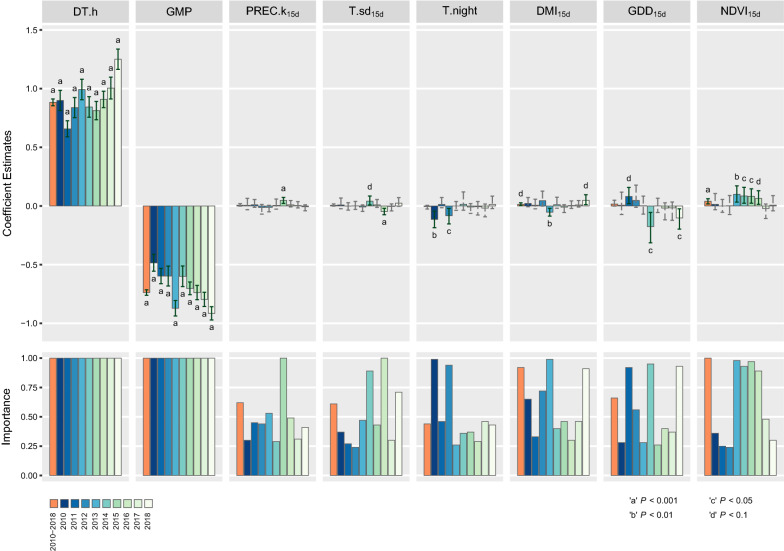
Population abundance (proxy for intraspecific competition) and length of daylight were the predominant factors regulating the mosquito population dynamics; however, other drivers encompassing environmental and climatic variables also had a significant impact, although sometimes counterintuitive and not univocal. The analyses of the single-year datasets, and the comparison with the results obtained from the overall model (all data available from 2010 to 2018), highlighted remarkable differences in coefficients magnitude, sign and significance. These outcomes indicate that different combinations of factors might have distinctive, and sometimes divergent, effects on mosquito population dynamics.
A more realistic acquaintance of the intrinsic and extrinsic mechanisms of mosquito population fluctuations in relation to continuous changes in environmental and climatic conditions is paramount to properly reinforce VBDs risk-based surveillance activities, to plan targeted density control measures and to implement effective early detection programmes.
虫媒传染病(VBDs)是全球主要的公共卫生关注点。在 VBDs 中,西尼罗河病毒(WNV)在欧洲温带地区的传播范围越来越广,包括意大利。在过去的十年中,蚊子、马、野生鸟类和人类中反复报告了 WNV 暴发,其时空分布模式具有很大的变异性。由于环境-宿主-媒介-病原体相互作用的复杂性以及对疾病流行病学模式的不完全理解,WNV 的发生难以预测。分析导致 WNV 早期再激活和传播的生态驱动因素至关重要;特别是,媒介种群动态的变化可能是 WNV 近期成功以及更普遍的 VBDs 的关键点。
我们通过在意大利东北部实施的 WNV 昆虫学监测计划,利用 2010 年至 2018 年九年来获得的环境、气候和诱捕数据,研究了库蚊种群丰度的变化。我们采用信息理论方法(IT-AIC)和模型平均算法,研究了季节性蚊子种群增长率与内在(例如种内竞争)和外在(例如环境和气候变量)预测因子之间的关系,以确定确定概述库蚊种群动态的最显著变量组合。
种群丰度(种内竞争的代表)和日光长度是调节蚊子种群动态的主要因素;但是,其他包括环境和气候变量在内的驱动因素也具有重大影响,尽管有时具有反直觉性且不明确。对单一年份数据集的分析以及与从整体模型(2010 年至 2018 年所有可用数据)获得的结果进行比较,突出了系数幅度、符号和显著性的显著差异。这些结果表明,不同的因素组合可能对蚊子种群动态具有不同的、有时甚至不同的影响。
更好地了解与环境和气候条件不断变化有关的蚊子种群波动的内在和外在机制,对于加强基于疾病风险的监测活动、规划有针对性的密度控制措施以及实施有效的早期检测计划至关重要。