Department of Neurology, Brigham and Women's Hospital, Harvard Medical School, Boston, MA, 02115, USA.
Department of Psychiatry, McLean Hospital, Harvard Medical School, Belmont, MA, 02478, USA.
Mol Brain. 2021 May 25;14(1):85. doi: 10.1186/s13041-021-00796-5.
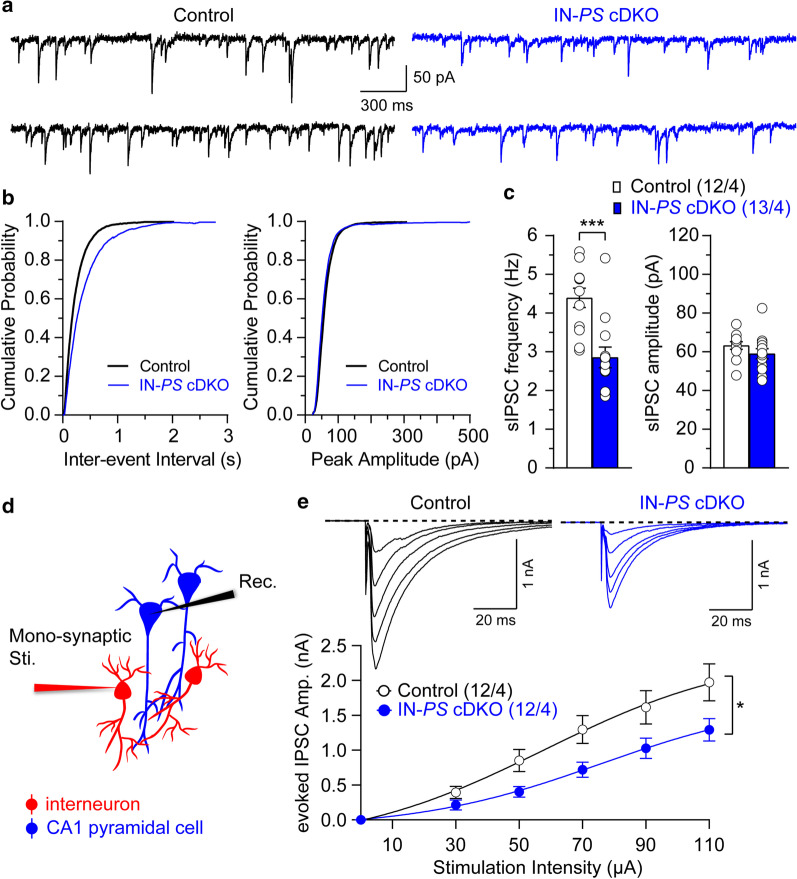
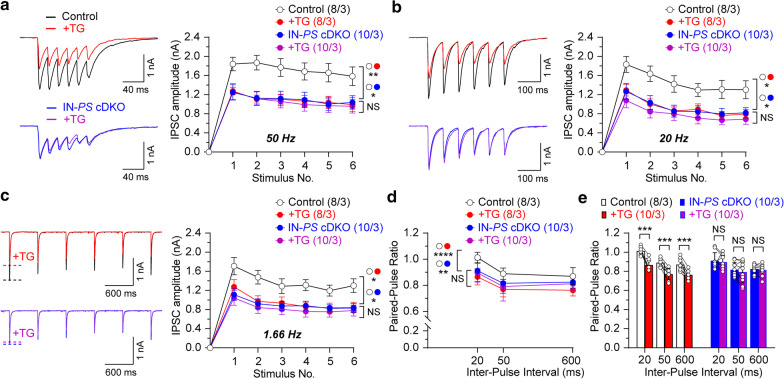
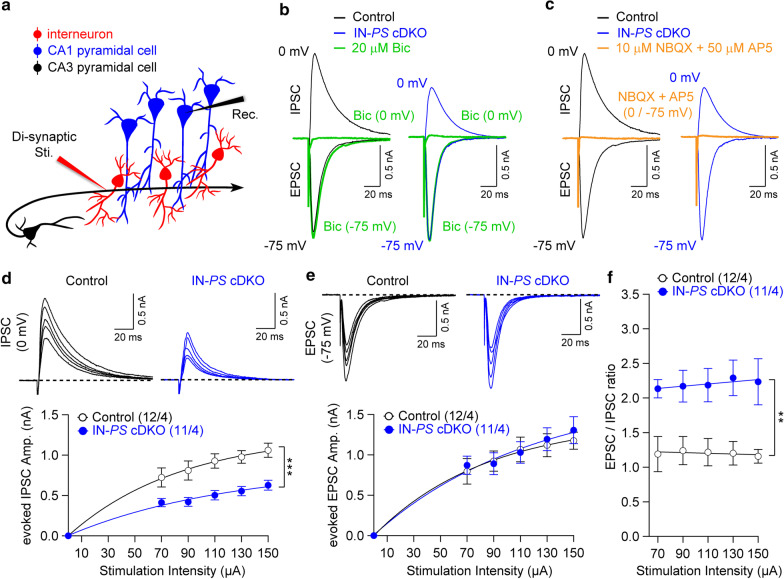
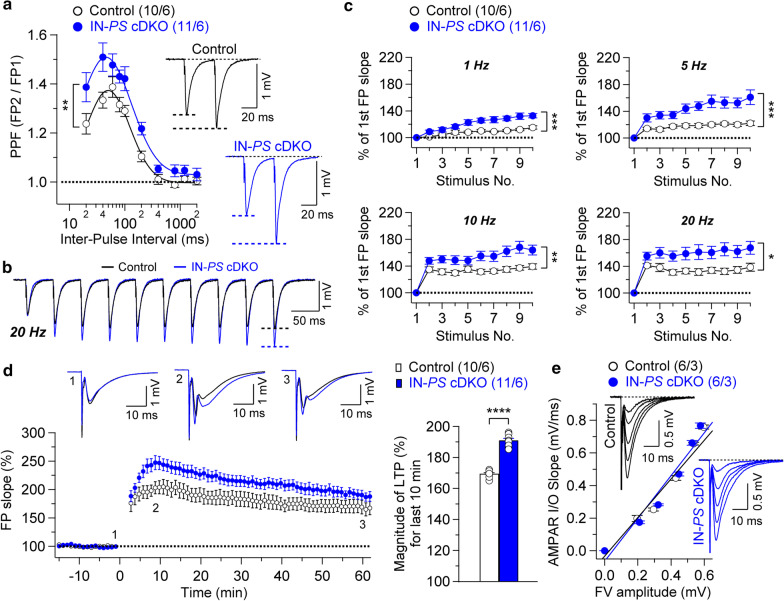
Mutations in the Presenilin genes are the major genetic cause of Alzheimer's disease (AD). Presenilin (PS) is highly expressed in the hippocampus, which is particularly vulnerable in AD. Previous studies of PS function in the hippocampus, however, focused exclusively on excitatory neurons. Whether PS regulates inhibitory neuronal function remained unknown. In the current study, we investigate PS function in GABAergic neurons by performing whole-cell and field-potential electrophysiological recordings using acute hippocampal slices from inhibitory neuron-specific PS conditional double knockout (IN-PS cDKO) mice at 2 months of age, before the onset of age-dependent loss of interneurons. We found that the frequency of spontaneous inhibitory postsynaptic currents (sIPSCs) is reduced in hippocampal CA1 neurons of IN-PS cDKO mice, whereas the amplitude of sIPSCs is normal. Moreover, the efficacy of inhibitory neurotransmission as assessed with synaptic input/output relations for evoked mono- and di-synaptic IPSCs is markedly lowered in hippocampal CA1 neurons of IN-PS cDKO mice. Consistent with these findings, IN-PS cDKO mice display enhanced paired-pulse facilitation, frequency facilitation and long-term potentiation in the Schaffer collateral-CA1 pathway. Interestingly, depletion of intracellular Ca stores by inhibition of sarcoendoplasmic reticulum Ca ATPase results in a reduction of IPSC amplitude in control hippocampal neurons but not in IN-PS cDKO neurons, suggesting that impaired intracellular calcium homeostasis in the absence of PS may contribute to the deficiencies in inhibitory neurotransmission. Furthermore, the amplitude of IPSCs induced by short trains of presynaptic stimulation and paired-pulse ratio are decreased in IN-PS cDKO mice. These findings show that inactivation of PS in interneurons results in decreased GABAergic responses and enhanced synaptic plasticity in the hippocampus, providing additional evidence for the importance of PS in the regulation of synaptic plasticity and calcium homeostasis.
早老素基因(Presenilin genes)的突变是阿尔茨海默病(Alzheimer's disease,AD)的主要遗传病因。早老素(Presenilin,PS)在海马体中高度表达,而海马体在 AD 中特别容易受到影响。然而,之前对 PS 在海马体中的功能的研究仅集中在兴奋性神经元上。PS 是否调节抑制性神经元功能仍不清楚。在当前的研究中,我们通过对 2 个月大的抑制性神经元特异性早老素条件性双敲除(inhibitory neuron-specific PS conditional double knockout,IN-PS cDKO)小鼠的急性海马切片进行全细胞和场电位电生理记录,研究了 PS 在 GABA 能神经元中的功能,此时抑制性神经元尚未出现年龄依赖性缺失。我们发现,IN-PS cDKO 小鼠海马体 CA1 神经元的自发性抑制性突触后电流(spontaneous inhibitory postsynaptic currents,sIPSCs)频率降低,而 sIPSCs 的幅度正常。此外,通过评估诱发的单突触和双突触 IPSC 的突触输入/输出关系,评估抑制性神经传递的效能,IN-PS cDKO 小鼠的 CA1 神经元中的抑制性神经传递效率明显降低。与这些发现一致的是,IN-PS cDKO 小鼠的 Schaffer 侧支-CA1 通路中的成对脉冲易化、频率易化和长时程增强增强。有趣的是,通过抑制肌浆内质网 Ca ATP 酶耗竭细胞内钙库导致对照海马神经元的 IPSC 幅度降低,但 IN-PS cDKO 神经元没有降低,表明 PS 缺失时细胞内钙稳态受损可能导致抑制性神经传递缺陷。此外,IN-PS cDKO 小鼠的短串刺激诱导的 IPSC 幅度和成对脉冲比降低。这些发现表明,抑制性神经元中 PS 的失活导致 GABA 能反应降低和海马体中的突触可塑性增强,为 PS 在调节突触可塑性和钙稳态中的重要性提供了额外的证据。