Department of Natural Sciences, School of Arts and Sciences, Lebanese American University, Byblos Campus, P.O. Box 36, Byblos, Lebanon.
Department of Agriculture and Food Engineering, Holy Spirit University of Kaslik, P.O. Box 446, Jounieh, Lebanon.
Sci Rep. 2021 May 25;11(1):10865. doi: 10.1038/s41598-021-89622-5.
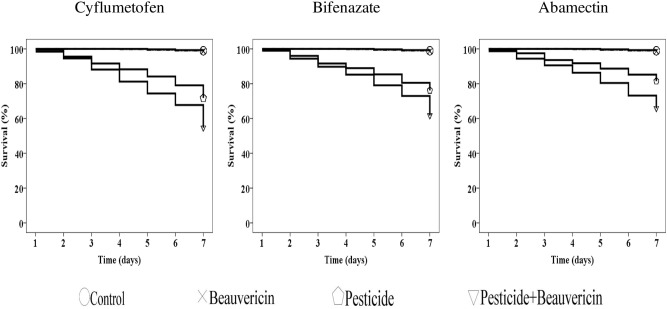
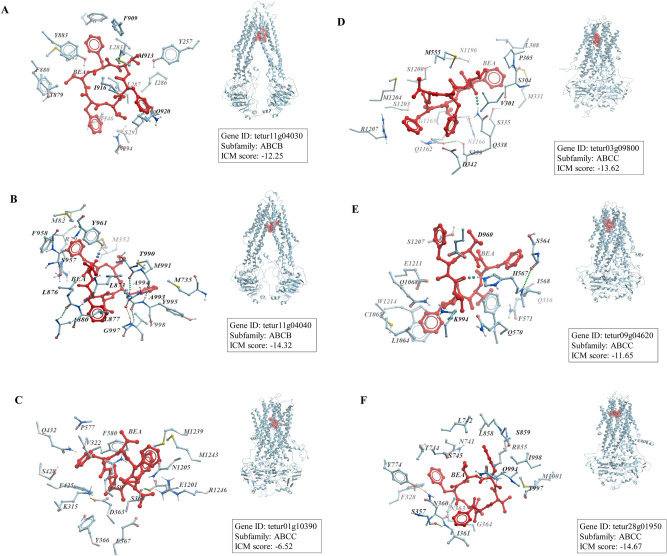
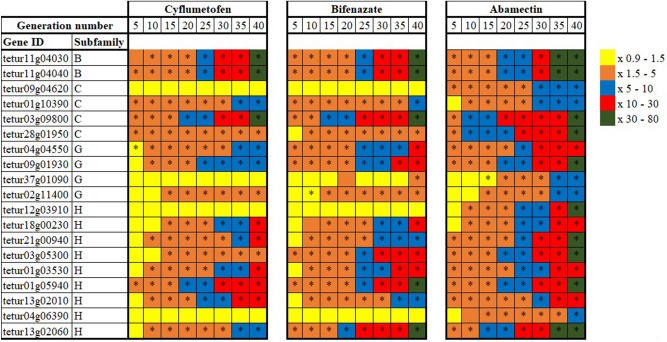
Multi-drug resistance is posing major challenges in suppressing the population of pests. Many herbivores develop resistance, causing a prolonged survival after exposure to a previously effective pesticide. Consequently, resistant pests reduce the yield of agricultural production, causing significant economic losses and reducing food security. Therefore, overpowering resistance acquisition of crop pests is a must. The ATP binding cassette transporters (ABC transporters) are considered as the main participants to the pesticide efflux and their neutralization will greatly contribute to potentiate failed treatments. Real-Time PCR analysis of 19 ABC transporter genes belonging to the ABCB, ABCC, ABCG, and ABCH revealed that a broad range of efflux pumps is activated in response to the exposure to pesticides. In this study, we used beauvericin (BEA), a known ABC transporters modulator, to resensitize different strains of Tetranychus urticae after artificial selection for resistance to cyflumetofen, bifenazate, and abamectin. Our results showed that the combinatorial treatment of pesticide (manufacturer's recommended doses) + BEA (sublethal doses: 0.15 mg/L) significantly suppressed the resistant populations of T. urticae when compared to single-drug treatments. Moreover, after selective pressure for 40 generations, the LC values were significantly reduced from 36.5, 44.7, and 94.5 (pesticide) to 8.3, 12.5, and 23.4 (pesticide + BEA) for cyflumetofen, bifenazate, and abamectin, respectively. While the downstream targets for BEA are still elusive, we demonstrated hereby that it synergizes with sub-lethal doses of different pesticides and increases their effect by inhibiting ABC transporters. This is the first report to document such combinatorial activity of BEA against higher invertebrates paving the way for its usage in treating refractory cases of resistance to pesticides. Moreover, we demonstrated, for the first time, using in silico techniques, the higher affinity of BEA to ABC transformers subfamilies when compared to xenobiotics; thus, elucidating the pathway of the mycotoxin.
多药耐药性对抑制害虫种群构成重大挑战。许多食草动物产生抗药性,导致在接触以前有效的杀虫剂后存活时间延长。因此,抗药性害虫降低了农业生产的产量,造成重大经济损失,减少了粮食安全。因此,必须克服作物害虫的抗药性获得。ATP 结合盒转运蛋白(ABC 转运蛋白)被认为是农药外排的主要参与者,其中和将极大地有助于增强失败的治疗。属于 ABCB、ABCC、ABCG 和 ABCH 的 19 种 ABC 转运基因的实时 PCR 分析表明,广泛的外排泵被激活以响应于暴露于杀虫剂。在这项研究中,我们使用了 beauvericin (BEA),一种已知的 ABC 转运蛋白调节剂,在对 cyflumetofen、bifenazate 和 abamectin 产生抗药性的人工选择后,使不同品系的 Tetranychus urticae 重新敏感。我们的结果表明,与单一药物处理相比,农药(制造商建议剂量)+BEA(亚致死剂量:0.15mg/L)的组合处理显著抑制了 T. urticae 的耐药种群。此外,经过 40 代的选择性压力后,LC 值从 36.5、44.7 和 94.5(农药)显著降低到 8.3、12.5 和 23.4(农药+BEA),cyflumetofen、bifenazate 和 abamectin 分别。虽然 BEA 的下游靶标仍不清楚,但我们在此证明它与不同农药的亚致死剂量协同作用,并通过抑制 ABC 转运蛋白增加它们的效果。这是第一个记录 BEA 对高等无脊椎动物具有这种组合活性的报告,为其在治疗抗药性难治病例中的应用铺平了道路。此外,我们首次使用计算机技术证明了 BEA 与 xenobiotics 相比对 ABC 转化子亚家族的更高亲和力;从而阐明了真菌毒素的途径。