Barigela Ravi, Kodali Prakash Babu, Hense Sibasis
Department of Public Health and Community Medicine, Central University of Kerala, Kasaragod, Kerala, India.
Indian J Community Med. 2021 Jan-Mar;46(1):97-101. doi: 10.4103/ijcm.IJCM_304_20. Epub 2021 Mar 1.
Electronic medical records (EMRs) are computerized medical information systems that collect, store, and display patient information and essential for the achievement of primary health-care goals. This study explores the availability and utilization of EMR and analyzed the barriers inhibiting their implementation at primary health centers (PHCs) in Nalgonda district of Telangana, India.
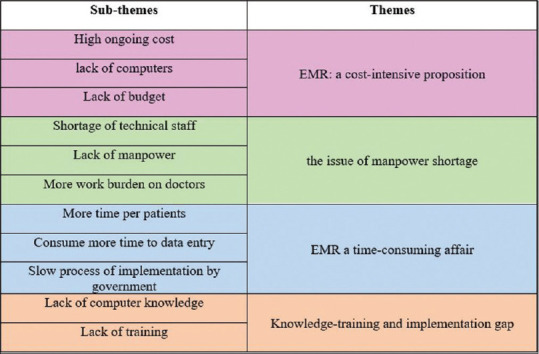
The research employed a sequential mixed-method design. Quantitative data were collected using a questionnaire by conducting facility surveys across 75 PHCs and in-depth interviews with district health authorities were conducted using a predesigned guide. Quantitative data were analyzed using descriptive statistics and thematic analysis of interviews resulted in four themes focusing on the factors inhibiting PHCs to use EMR.
The availability of EMR facility was low (19.14%) and they are routinely used for maintaining immunization data in 83% of the PHCs. In contrast, none of the PHCs used EMR for prescribing medications to patients. Budgetary constraints, unavailability of dedicated information technology staff, gaps in technical knowledge, and perceptions about EMR as a time-consuming system were the commonly reported barriers inhibiting PHCs to go digital.
The availability and utilization of EMR keeping was low across PHCs of Nalgonda district. The study identified multiple barriers which hinder the implementation of EMR facilities at PHCs. Addressing these barriers is crucial for the successful implementation of EMR.
电子病历(EMR)是一种计算机化的医疗信息系统,用于收集、存储和显示患者信息,对实现初级卫生保健目标至关重要。本研究探讨了电子病历的可用性和利用率,并分析了印度特伦甘纳邦纳尔贡达区初级卫生中心(PHC)实施电子病历的障碍。
本研究采用了顺序混合方法设计。通过对75个初级卫生中心进行设施调查,使用问卷收集定量数据,并使用预先设计的指南对地区卫生当局进行深入访谈。定量数据采用描述性统计进行分析,访谈的主题分析得出了四个主题,重点关注阻碍初级卫生中心使用电子病历的因素。
电子病历设施的可用性较低(19.14%),83%的初级卫生中心常规使用电子病历记录免疫数据。相比之下,没有一个初级卫生中心使用电子病历为患者开药方。预算限制、缺乏专门的信息技术人员、技术知识差距以及认为电子病历是一个耗时的系统,是普遍报道的阻碍初级卫生中心实现数字化的障碍。
纳尔贡达区各初级卫生中心电子病历的可用性和利用率较低。该研究确定了多个阻碍初级卫生中心实施电子病历设施的障碍。解决这些障碍对于成功实施电子病历至关重要。