Faculty of Economics and Business, University of Groningen, Groningen, The Netherlands.
BMC Health Serv Res. 2010 Aug 6;10:231. doi: 10.1186/1472-6963-10-231.
The main objective of this research is to identify, categorize, and analyze barriers perceived by physicians to the adoption of Electronic Medical Records (EMRs) in order to provide implementers with beneficial intervention options.
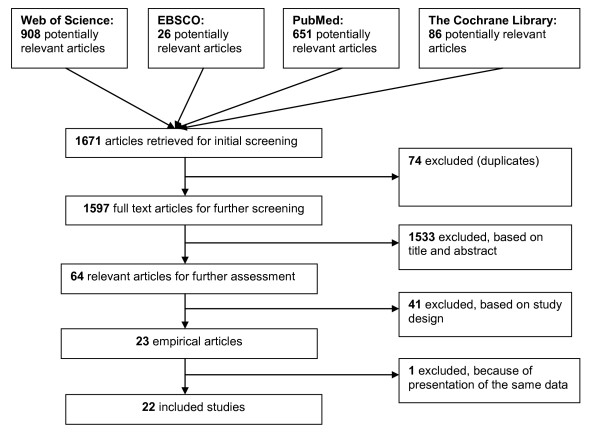
A systematic literature review, based on research papers from 1998 to 2009, concerning barriers to the acceptance of EMRs by physicians was conducted. Four databases, "Science", "EBSCO", "PubMed" and "The Cochrane Library", were used in the literature search. Studies were included in the analysis if they reported on physicians' perceived barriers to implementing and using electronic medical records. Electronic medical records are defined as computerized medical information systems that collect, store and display patient information.
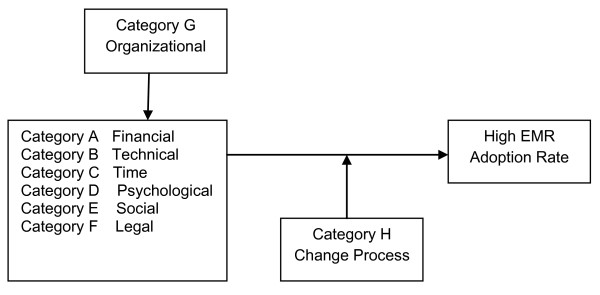
The study includes twenty-two articles that have considered barriers to EMR as perceived by physicians. Eight main categories of barriers, including a total of 31 sub-categories, were identified. These eight categories are: A) Financial, B) Technical, C) Time, D) Psychological, E) Social, F) Legal, G) Organizational, and H) Change Process. All these categories are interrelated with each other. In particular, Categories G (Organizational) and H (Change Process) seem to be mediating factors on other barriers. By adopting a change management perspective, we develop some barrier-related interventions that could overcome the identified barriers.
Despite the positive effects of EMR usage in medical practices, the adoption rate of such systems is still low and meets resistance from physicians. This systematic review reveals that physicians may face a range of barriers when they approach EMR implementation. We conclude that the process of EMR implementation should be treated as a change project, and led by implementers or change managers, in medical practices. The quality of change management plays an important role in the success of EMR implementation. The barriers and suggested interventions highlighted in this study are intended to act as a reference for implementers of Electronic Medical Records. A careful diagnosis of the specific situation is required before relevant interventions can be determined.
本研究的主要目的是识别、分类和分析医生在采用电子病历(EMR)方面所感知到的障碍,以便为实施者提供有益的干预选择。
基于 1998 年至 2009 年期间有关医生接受电子病历障碍的研究论文,进行了系统的文献回顾。使用了四个数据库,即“Science”、“EBSCO”、“PubMed”和“Cochrane Library”进行文献检索。如果研究报告了医生在实施和使用电子病历方面所感知到的障碍,则将其纳入分析。电子病历被定义为收集、存储和显示患者信息的计算机化医疗信息系统。
该研究包括 22 篇文章,这些文章考虑了医生对电子病历的感知障碍。确定了八个主要障碍类别,包括 31 个子类别。这八个类别是:A)财务、B)技术、C)时间、D)心理、E)社会、F)法律、G)组织和 H)变革过程。所有这些类别都相互关联。特别是,类别 G(组织)和 H(变革过程)似乎是其他障碍的中介因素。通过采用变革管理视角,我们制定了一些与障碍相关的干预措施,可以克服已确定的障碍。
尽管电子病历在医疗实践中具有积极的影响,但这类系统的采用率仍然较低,且遭到了医生的抵制。本次系统回顾揭示了医生在实施电子病历时可能会面临一系列障碍。我们得出结论,电子病历的实施过程应被视为医疗实践中的变革项目,并由实施者或变革管理者来领导。变革管理的质量在电子病历实施的成功中起着重要作用。本研究中强调的障碍和建议的干预措施旨在为电子病历的实施者提供参考。在确定相关干预措施之前,需要对具体情况进行仔细诊断。