Ayonrinde Oyekoya T
Department of Gastroenterology and Hepatology, Fiona Stanley Hospital, Murdoch, WA, Australia.
Medical School, The University of Western Australia, Perth, WA, Australia.
JHEP Rep. 2021 Feb 26;3(3):100261. doi: 10.1016/j.jhepr.2021.100261. eCollection 2021 Jun.
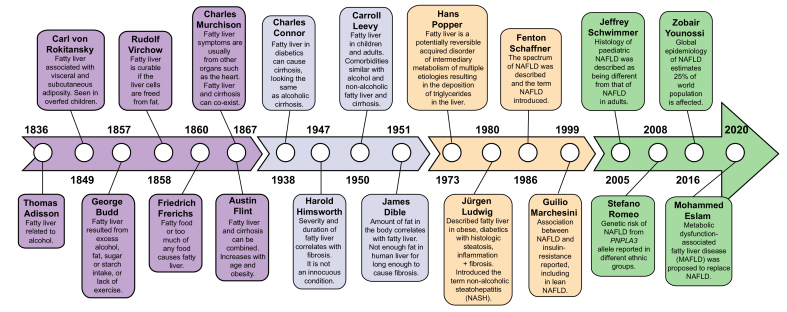
Non-alcoholic fatty liver disease (NAFLD) is the most common chronic liver disorder worldwide. This historical narrative traces the evolution from basic descriptions of fatty liver in the nineteenth century to our contemporary understanding of NAFLD in the twentieth and twenty-first centuries. A detailed historiographic review of fatty liver from 1800s onwards was performed alongside a brief review of contemporary associations. Archived published literature dating back to the 1800s describe clinicopathological features of fatty liver. In the nineteenth century, doyens of medicine associated fatty liver with alcohol, malnutrition or wasting conditions, and subsequently adiposity, unhealthy diets and sedentary lifestyle. Microscopically, fatty liver was described when 5% or more hepatocytes were distended with fat. Recommendations to reverse fatty liver included reducing consumption of fat, sugar, starchy carbohydrates and alcohol, plus increasing physical exercise. Fatty liver was associated with liver fibrosis and cirrhosis in the late 1800s, and with diabetes in the early 1900s. The diagnostic labels NAFLD and non-alcoholic steatohepatitis (NASH) were introduced in the late 1900s. Metabolic dysfunction-associated fatty liver disease (MAFLD) was recently proposed to update the nosology of fatty liver, recognising the similar metabolic pathogenesis evident in individuals with typical NAFLD and those with heterogenous "secondary" co-factors including alcohol and other aetiologies. Fatty liver has emerged from being considered a disorder of nutritional extremes or alcohol excess to contemporary recognition as a complex metabolic disorder that risks progression to cirrhosis and hepatocellular carcinoma. The increasing prevalence of NAFLD and our growing understanding of its lifestyle and metabolic determinants justify the current exercise of re-examining the evolution of this common metabolic disorder.
非酒精性脂肪性肝病(NAFLD)是全球最常见的慢性肝脏疾病。这段历史叙述追溯了从19世纪对脂肪肝的基本描述到我们在20世纪和21世纪对NAFLD的当代理解的演变过程。我们对19世纪以来的脂肪肝进行了详细的史学回顾,并简要回顾了当代的相关联系。可追溯到19世纪的存档发表文献描述了脂肪肝的临床病理特征。在19世纪,医学权威将脂肪肝与酒精、营养不良或消瘦状况联系起来,随后又与肥胖、不健康饮食和久坐不动的生活方式联系起来。在显微镜下,当5%或更多的肝细胞被脂肪充盈时,就被描述为脂肪肝。逆转脂肪肝的建议包括减少脂肪、糖、淀粉类碳水化合物和酒精的摄入,以及增加体育锻炼。19世纪末,脂肪肝与肝纤维化和肝硬化相关,20世纪初与糖尿病相关。“非酒精性脂肪性肝病(NAFLD)”和“非酒精性脂肪性肝炎(NASH)”这两个诊断标签于20世纪末被引入。最近提出了代谢功能障碍相关脂肪性肝病(MAFLD)以更新脂肪肝的疾病分类学,认识到在典型NAFLD患者以及具有包括酒精和其他病因在内的异质性“继发性”共同因素的患者中明显存在的相似代谢发病机制。脂肪肝已从被认为是营养极端或酒精过量的疾病,发展到当代被认识为一种复杂的代谢性疾病,有进展为肝硬化和肝细胞癌的风险。NAFLD患病率的不断上升以及我们对其生活方式和代谢决定因素的日益了解,证明了当前重新审视这种常见代谢性疾病演变的做法是合理的。