Department of Human Oncology, School of Medicine and Public Health, University of Wisconsin, Madison, WI, USA.
J Appl Clin Med Phys. 2021 Jun;22(6):92-103. doi: 10.1002/acm2.13278. Epub 2021 May 25.
To explore candidate RayStation beam models to serve as a class-specific template for a TrueBeam treatment delivery system.
Established validation techniques were used to evaluate three photon beam models: a clinically optimized model from the authors' institution, the built-in RayStation template, and a hybrid consisting of the RayStation template except substituting average MLC parameter values from a recent IROC survey. Comparisons were made for output factors, dose profiles from open fields, as well as representative VMAT test plans.
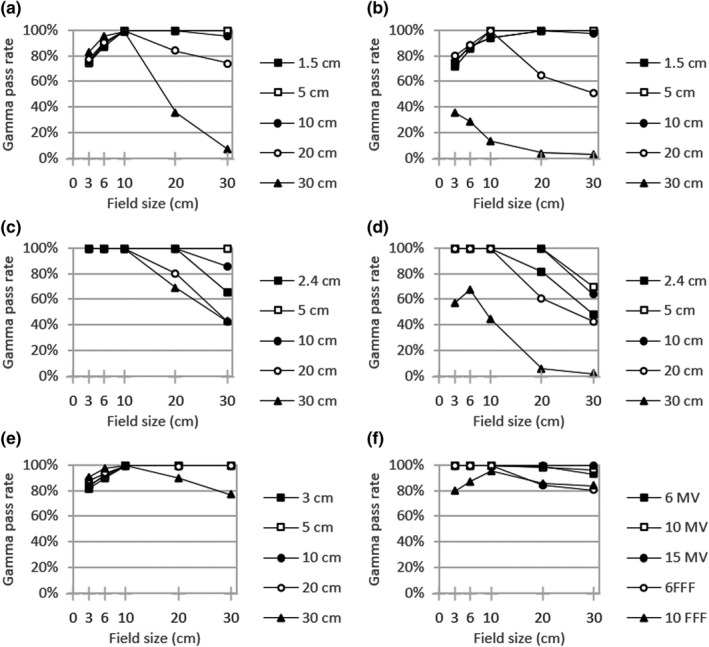
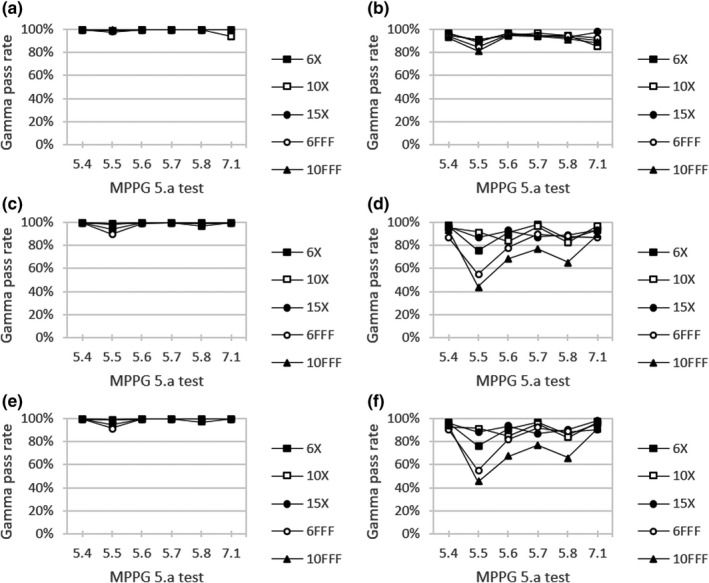
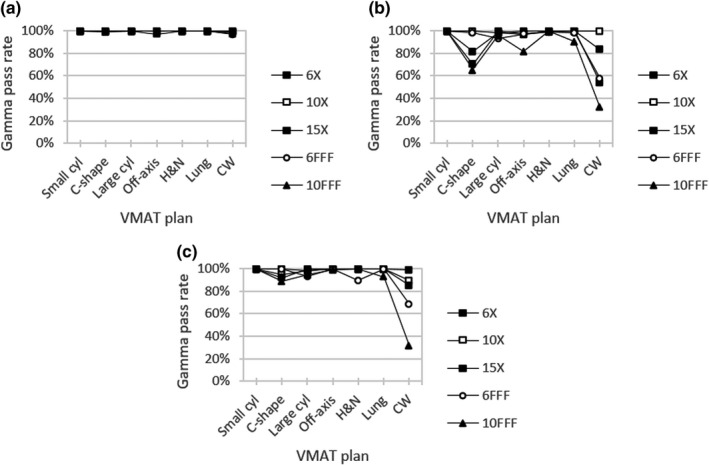
For jaw-defined output factors, each beam model was within 1.6% of expected published values. Similarly, the majority (57-66%) of jaw-defined dose curves from each model had a gamma pass rate >95% (2% / 3 mm, 20% threshold) when compared to TrueBeam representative beam data. For dose curves from MPPG 5.a MLC-defined fields, average gamma pass rates (1% / 1 mm, 20% threshold) were 92.9%, 85.1%, and 86.0% for the clinical, template, and hybrid models, respectively. For VMAT test plans measured with a diode array detector, median dose differences were 0.6%, 1.3%, and 1.1% for the clinical, template, and hybrid models, respectively. For in-phantom ionization chamber measurements with the same VMAT test plans, the average percent difference was -0.3%, -1.4%, and -1.0% for the clinical, template, and hybrid models, respectively.
Beam model templates taken from the vendor and aggregate results within the community were both reasonable starting points, but neither approach was as optimal as a clinically tuned model, the latter producing better agreement with all validation measurements. Given these results, the clinically optimized model represents a better candidate as a consensus template. This can benefit the community by reducing commissioning time and improving dose calculation accuracy for matched TrueBeam treatment delivery systems.
探索候选的 RayStation 射束模型,作为 TrueBeam 治疗递送系统的特定类别模板。
使用既定的验证技术来评估三种光子束模型:来自作者所在机构的临床优化模型、内置的 RayStation 模板,以及由 RayStation 模板组成的混合模型,只是替代了来自最近 IROC 调查的平均 MLC 参数值。对输出因子、开放野的剂量分布,以及代表性的 VMAT 测试计划进行了比较。
对于 jaw-defined 输出因子,每个束模型的结果都在预期发表值的 1.6%以内。同样,当与 TrueBeam 代表性束数据进行比较时,每个模型的大多数(57-66%)jaw-defined 剂量曲线的伽马通过率>95%(2%/3mm,20%阈值)。对于 MPPG 5.a MLC-defined 场的剂量曲线,临床、模板和混合模型的平均伽马通过率(1%/1mm,20%阈值)分别为 92.9%、85.1%和 86.0%。对于使用二极管阵列探测器测量的 VMAT 测试计划,临床、模板和混合模型的中位剂量差异分别为 0.6%、1.3%和 1.1%。对于相同的 VMAT 测试计划的体模电离室测量,临床、模板和混合模型的平均百分比差异分别为-0.3%、-1.4%和-1.0%。
从供应商处获取的束模型模板和社区内的汇总结果都是合理的起点,但都不如临床优化的模型理想,后者与所有验证测量的一致性更好。鉴于这些结果,临床优化的模型代表了更好的共识模板候选。这可以通过减少委托时间和提高匹配 TrueBeam 治疗递送系统的剂量计算准确性来使社区受益。